
Worldtable · an AI game master for worlds you build
Draw a
world.
Then let people in. Keep scrolling and watch one get made.
I
Rough it in.
Sketch the shape you have in mind, or start from one of fourteen. A few strokes is enough.
II
The engine draws
the rest.
Coasts, rivers, roads, every town and its name, grown from your sketch. Then it's held: the storyteller can't move a town or shorten a road to bail anyone out.
III
Then let people in.
Your players make a character and type what they do. An AI voices every innkeeper, bandit and rival you wrote. It never gets to touch the dice.
IV
Getting there takes days.
A trip is a real distance on a real road, walked at a real pace. The clock runs while you travel, and the trouble you left behind keeps developing.Sign up freeFree to build · 50 free turns to start
The World Studio
Then fill it in.
The parts that matter aren't left to the storyteller. They're data the engine holds, and the storyteller has to work inside them.
The World Studio · 1 / 6
The land
Draw the coast or pick a shape, then go region by region: what the land is, how many towns, what they're called. Drag a region's name and its borders regrow around it.
The World Studio · 2 / 6
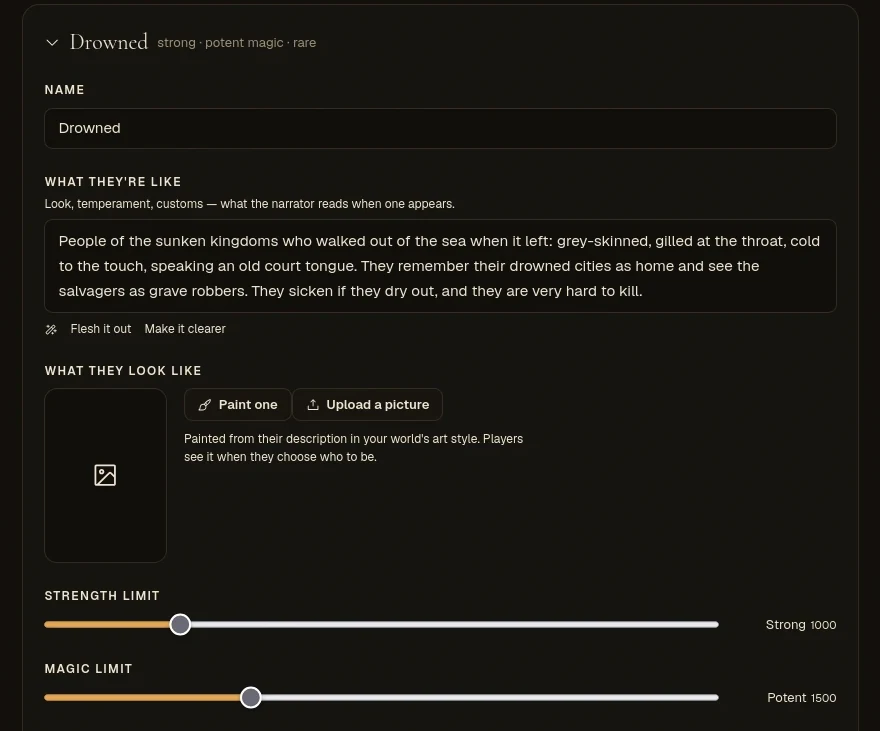
Its peoples
What they're like, what they look like, and a ceiling on how strong and how magical any of them can be. New characters are held to it.
The World Studio · 3 / 6
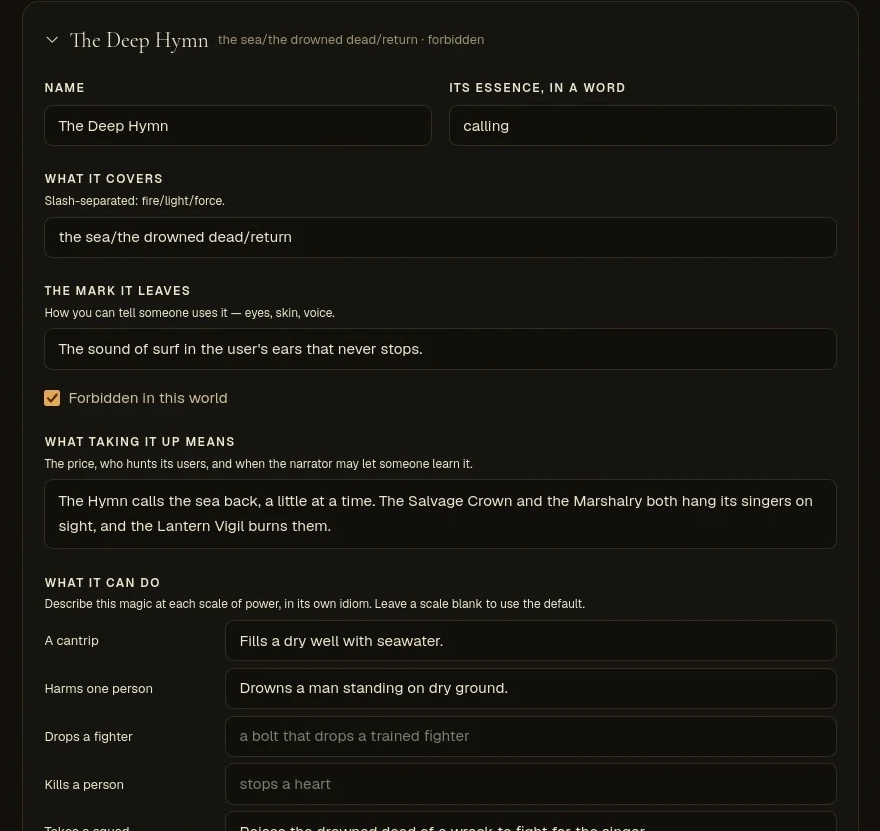
Its magic
What each school covers, the mark it leaves on people who use it, what taking it up costs. Forbid one and the storyteller is told to treat it that way.
The World Studio · 4 / 6
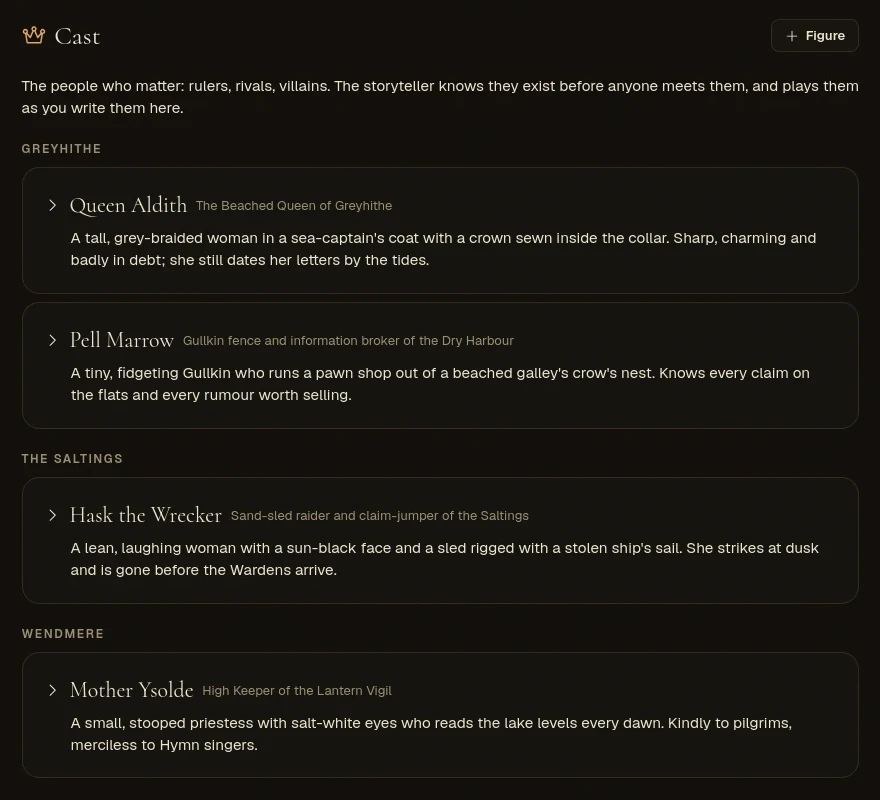
Its cast
Rulers, rivals, fences and villains. The storyteller knows they exist before anyone meets them, and plays them the way you wrote them.
The World Studio · 5 / 6
Its rules
Pick them in plain words. These aren't suggestions to the storyteller: the engine applies them, so a world where death is final really is.
The World Studio · 6 / 6
Or just ask Hob.
Hob is the Studio's assistant. Say what you want in plain words and it makes the edits itself: a landmark on the map, a new people, a rival for the cast. Don't like it? Undo the whole reply.
Or don't start from nothing
Six questions to a first draft.
Say what the world is about and how it should feel. Worldtable drafts the land, peoples, magic, a cast, lore and its own money in a minute or two, and you edit it line by line.
Sign up and start building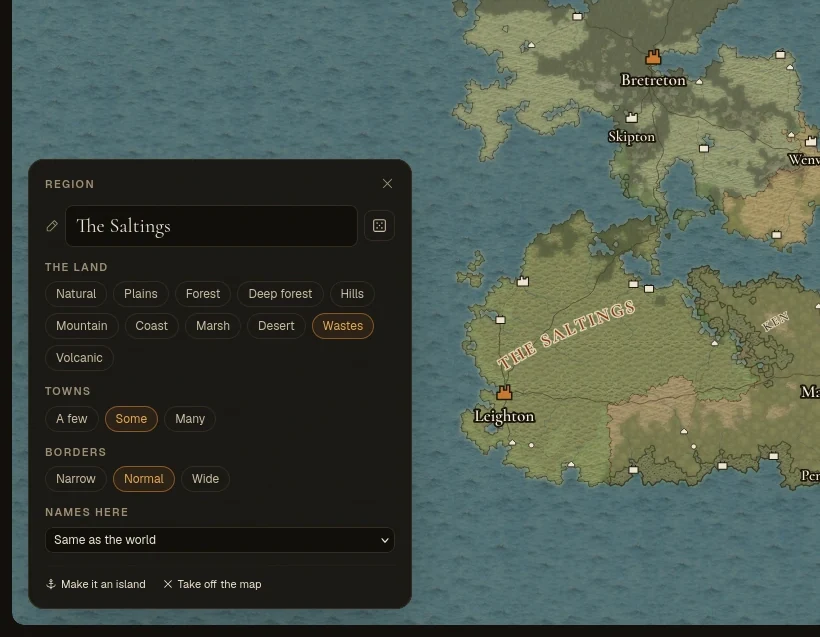
Death and danger
Pick in words. The engine holds the storyteller to them.
When a hero falls
Enemies' aim
Companions who can follow one hero
Capitals
Hob
The Studio's assistant
Put a ruined lighthouse on Rifjor's north coast, and write down why nobody goes near it.
Vesk the Cutthroat
What he remembers about you
- Day 12
saw it“Beat me at knucklebones in the Salt Lantern and kept the stake. Laughed about it.” - Day 19
heard it“Mara says this one sold my name to the Wardens. Hasn't been seen since.” - Day 41
saw it“Walked back into the Salt Lantern like nothing happened.”
Trust
Respect
Fear
Hostility
Indoors
Every building has an inside.
The town's tavern, temple and keep, and any place the story turns up along the way: a smithy, a shrine, a fence's back room. Walk in and it's laid out room by room, with the people in it standing somewhere in particular.
The people
They remember you. Specifically.
Every named character keeps a file on you: what you did in front of them, what they heard from somebody else, and how far they trust you. It comes back every time they're in a scene.
The fights
Fights you can actually lose.
Enemies announce their blows before they land, so stepping aside works. Shove someone into a shelf and the shelf breaks; fire leaves the ground burning. Bring friends and you fight in shared rounds: each of you says what your own hero does, and the engine works out every blow before the narrator writes a word.Enemies announce their blows, so stepping aside works. With friends, each of you says what your own hero does; the engine works out every blow.CRITICAL1.4×GLANCING0.5×BACKFIRE0.0×Sign up and pick a fight
Clue 1 · Krystad · A thing to find
A line on a tavern tally board: the name, against a debt paid the spring before you came.
Kept by the gameplaced in Krystad
Clue 2 · Gimsvik · A person
A dockhand who saw who rowed you ashore. She'll tell you, after.
Her price12 silver, named first
Clue 3 · Lopalen · Somewhere to go
The rest is under the barrow on the Lopalen road.
Kept by the gameplaced on the Lopalen road
News · day 45
“The Wardens have been asking at the Gimsvik docks. The dockhand's price has gone up.”
News · day 49
“Wardens on the Lopalen road, riding south.”
Your story
Whose name am I wearing?
The answersealed before your first turn
Everyone says the same date
The Wardens reach the barrow on day 52.
Your own story
If you think AI games are slop,
you're mostly right.
Most of them forget what they said a page ago and never go anywhere. Here, when you make a character, the world writes one story for them out of their backstory, decides the answer, and the game keeps it. The AI tells it. It can't change it.
Your own story
A question with a real answer.
“Who has my father's barge?” “Whose name am I wearing?” The answer is decided before your first turn, so it never shifts under you, and nothing on screen will contradict it.
Your own story
Clues you find, not clues you're told.
They wait in real places on the map: a line on a tally board, a dockhand who saw something. A thing is something you read or find. A person tells you in their own words, and most of them want something first.
Your own story
Someone working against you.
Your rival acts on their own dates, and you hear about it as news: a price raised, riders on a road. When time runs short, someone tells you, and everyone gives the same date.
Your own story
Or go and do something else.
Ignore it and the world lets it go; whatever you follow instead becomes the story. When a question is settled on screen, the story ends there, what you won goes on your sheet, and the next one grows out of what you did.Find out what yours is
Clue three · under the Lopalen road
Some answers are underground.
Under some landmarks there's a way down. A dungeon is a real place you walk on a map with the character you already have, and your party comes with you. The fog lifts as you go.
Dungeons
Decided before you arrive.
Every room, door, key and secret, who is down there and what they carry, is fixed and kept by the game. The storyteller judges what you try. It can't talk a locked door open, and neither can you, unless you do what opens it.
Dungeons
And things down there move.
Some of them hunt, and you hear them before you see them. When something's in the way, you say what you do in your own words, and the dungeon answers.Sign up and go down
Day 41 · Orstad
“A stranger started a fight in Bram's common room.”
Day 43 · Krystad
“A stranger put Vesk the Cutthroat through the bar at the Salt Lantern.”
Day 44 · Gimsvik
“They say the Quiet Blade killed Vesk and two of his men without a word.”
Day 47 · Beisfsos
“The Quiet Blade cut down six Wardens in Orstad. Bolt your doors.”
Consequence · Day 41
Word gets around.
Do something loud enough and a clock starts. Days later, depending on how bad it was, the story turns up in towns you aren't in, and it's grown in the retelling. The builder decides how fast it travels.
Day 47 · a title
the Quiet Blade
You didn't pick it. The world decided you'd earned one, and now strangers use it. Some doors open because of it, and some are shut before you get near them.
Go and earn oneAfterwards
It all ends up as a book.
As word of what you did gets around, a chronicler writes it up as chapters in the world's voice, not a bullet-point summary. Older chapters fold into a prologue instead of disappearing.
And it counts
The book is canon.
The AI reads it back before every scene, so chapter nine knows what you got up to in chapter two.
Start your ownWhat happened next took less time than telling it. The stranger went in under the first swing and put a shoulder through Vesk's ribs, and the bar took the rest of him. The knife came back around anyway. It opened the stranger's arm from wrist to elbow and found nothing more to do.
Bram said nothing. Bram cleaned the bar. Bram, the regulars agreed afterwards, had the look of a man writing something down in a book he did not intend to show anyone.
By the time the stranger reached Gimsvik the story was waiting at the gate, three men taller than it had left Orstad, and it had given the stranger a name: the Quiet Blade. A better one, the stranger thought, than the borrowed one. Somebody, somewhere, still wanted that one back.
A Borrowed Name
The road that led here
The stranger came down from the ice in the first thaw with no coin and a borrowed name, and spent the spring losing both at knucklebones in the Salt Lantern. Vesk the Cutthroat won most of it back. Not all. There was a night the stranger won, and kept the stake, and laughed, and Vesk did not.
Then the Wardens came asking for Vesk by name, and the stranger was gone before anyone thought to ask who had given it to them.
The Watered Ale
Days 41–47
On the forty-first day the stranger walked back into the Salt Lantern as if the spring had never happened, and sat where the whole room could see. Bram set down an ale without being asked. It was watered. Everyone saw that too.
Vesk was by the hearth. He did not stand up so much as arrive, the knife already out and held low, where a man holds a knife he means to use and wants you to know it.
The Story
So Far
the Quiet Blade
Last Winter
Being the chronicle of
the Quiet Blade
As it was told in Last Winter
Solo, or with friends
Nobody has to be free on Tuesday.
Unless you want them to be.
Play alone at two in the morning, one turn in a queue or four hours in a single conversation. Or form a party: you travel on one clock, fight on one battle map in shared rounds, go down one dungeon and take the same job. Each of you plays your own character, and the storyteller never speaks or acts for anyone else's.
Parties
Up to four players by default; each world's builder picks the size, from none to six. Your companions come too.
Its own chat
Every party gets an out-of-character room for planning and teasing. Every world has one, and there's a Tavern all worlds share.
Play in bursts
Turns run in the background. Close the tab mid-scene and the answer is there when you come back. Install it like an app.
Index
The rest of
the world.
Everything else that runs underneath, in every world built in the Studio.
Sign up free- 01Sea voyagesBuy passage between ports and pay in coin, days and risk. Storms and pirates are the ordinary problems.
- 02The fogTurn on the fog and the chart shows only where your character has actually been.
- 03Places in the storyTap a town or a room the story names to see what it is, how far, and whether you've been. Then go there.
- 04Map searchFind towns, landmarks, the people you've met and the lore you've uncovered from one box on the map.
- 05Trouble already underwayRegions have their own situations moving before you arrive, whether or not they're your story.
- 06Training groundsSkills built around who your character actually is, earned in the yard rather than bought from a menu.
- 07CraftingDescribe what you're making at a bench and it's judged on its merits. A bad idea can still cost you the materials.
- 08Local marketsPrices, goods and trade differ by region and town, as the builder set them.
- 09DiscoveriesLore you dig up goes into a codex only you have read.
- 10TransformationWhere their people allow it, and only under real pressure, a character can break past their limits.
- 11Read aloudHave a turn narrated out loud, for one more credit.
- 12While it thinksFishing, Liar's Dice, Knucklebones and a relic-matching game sit under the story while a turn loads.
Straight answers
What you're about to ask.
- Is this just a chatbot with a fantasy prompt?
- No. The model is one part of a stack that also has a world generator, a combat resolver, an economy, a story tracker and a database in it. Its job is narrating and voicing characters. It doesn't get to decide whether you hit, what you own, how far it is, who likes you or how your story ends.
- What if the AI gets something wrong?
- Tell it. Switch the message box to Table talk and you're talking to your world's Game Master as yourself: ask why something happened, get a mistake fixed, or change where the story is heading. It reads what actually happened before it answers, every change it makes shows under its reply, and it's free and private.
- Can I break it by typing something absurd?
- Have a go. Actions get classified before they resolve, and the world pushes back instead of playing along. A peasant who announces he's the emperor gets the reception a room full of armed people would actually give him. There's no railroad and no paperwork, but there is friction.
- Can I lose my character?
- That's the world's call. Its builder picks what happens when a hero falls: they die for good, or they're beaten and wake up later. Either way the engine applies it. The storyteller doesn't get to decide you lived.
- Do I have to build a world to play?
- No. Builders publish worlds to a directory you can browse, and many let you ask to join from the world's page; others let you in with the builder's invite link. Or answer six questions, get a drafted world, and walk into it yourself.
- What does it cost?
- Building is free, and every account starts with 50 free credits. A turn costs one credit, and each player pays for their own turns: packs start at $5 for 200, or $12 a month for 650. Turns that fail are refunded, credits you buy never expire, and there are no streaks, countdowns or loot boxes. A builder can instead run their world on their own AI key or a model on their own computer, and then nobody in it spends credits. A private world can even be told by each player's own Claude Code or Codex.
Build a world.
Pull up a chair.
Six questions get you a drafted world in a minute or two: land, peoples, magic, a cast and a coin. Change what you like, make a character, and you're standing in a real town on your own map with a road leading out of it.
Free to build · Runs in a browser · 50 free turns to start