
Rule systems
Gear
Armour that sets Armour Class, shields, weapons with their own dice and damage type, wands with charges, potions: what an item is under your rules, and the SRD's armoury to start from.
What an item is under your rules
Items in a story are words: “a dented mail shirt”, “Grandfather's longsword”. Under a rule system, gear gives them numbers. Your system's gear catalog says what each kind of thing does while it is worn, wielded or carried: armour that sets Armour Class, a shield that adds to it, a weapon with its own dice and damage type, a wand that casts a spell and spends charges, a potion that heals. Engine
An item is the gear its name says. When the storyteller hands one over, a shop sells one or a class starts a character with one, code finds the longest gear name (or one of its other names) in the item's name: “a battered chainmail hauberk” is Chain Mail, “a pair of shortswords” is a Shortsword. A “+1” in the name is its magic: “+1 Longsword”, “Chain Mail +2”. Engine
What a piece of gear holds
- Name, kind, group, description
- "Chain Mail", Armour, in Heavy armour: the player and the storyteller read the description; the group heads the Studio's list.
- Other names
- Names an item can have and still be this: chain mail is also "chainmail" and "hauberk".
- Where it goes
- A slot of your system's (a body, two hands, two rings) and how much of it the gear takes: a greatsword takes both hands, so a shield comes off. Gear with no slot counts while carried (a wand, a potion).
- What it changes
- Modifiers, while worn: set a number (armour sets Armour Class:
16, or11 + @dex.mod), add to one (a shield's+2), or change rolls the way a condition does (plate: disadvantage on Stealth). The best “set” wins, so armour worse than bare skin never lowers it. - A weapon
- Its damage (
1d8 + @stat.mod, where@stat.modis the stat it struck with), its type, the stats it can strike with (a rapier: Strength or Dexterity, the better one), close or far, its traits, extra damage of another type (a flame tongue's 2d6 fire), and its damage alone in its slot (a longsword in both hands: 1d10). - What it lends
- Abilities of your system (a wand of Magic Missiles), and charges they spend instead of their cost: 7, with 1d6 + 1 back each dawn. See Spells and abilities.
- Used up
- A potion or a scroll goes when its ability is used.
{ "id": "chain_mail", "name": "Chain Mail", "kind": "Armour", "group": "Heavy armour",
  "description": "Heavy armour: Armour Class 16. It is loud: disadvantage on Stealth.",
  "aliases": ["chainmail", "hauberk"], "slot": "body",
  "mods": [{ "to": "ac", "set": "16" },
           { "checks": ["ability"], "stats": ["stealth"], "edge": "-1" }] }

{ "id": "longsword", "name": "Longsword", "kind": "Weapon", "group": "Martial melee",
  "slot": "hand",
  "weapon": { "damage": "1d8 + @stat.mod", "type": "slashing", "stats": ["str"],
              "range": "close", "alone": "1d10 + @stat.mod", "traits": ["versatile (1d10)"] } }
In play
| What they have | What code does |
|---|---|
| Armour and a shield | Their Armour Class is set and added to; every blow at them rolls against it. The sheet shows where it comes from: Armour Class 18 (Chain Mail 16, Shield +2). |
| Gear that changes a roll | Plate's disadvantage on Stealth, a ring's +1 to saves: counted in the roll like a condition, and named on the roll chip. |
| A weapon | A blow is struck with the weapon the action names ("I stab with my dagger"), else the first one in hand; a punch is no weapon. Its stat, its dice, its magic bonus on the roll and the damage, its type against what the foe resists or fears. The chip names it. |
| A wand | Its spell is theirs while it has a charge; each cast spends one, at the spell's own level. A rest brings charges back. |
| A potion | Drinking it (or pouring it into an ally) is its ability; it is used up. |
| Broken gear | Counts for nothing until it is mended. |
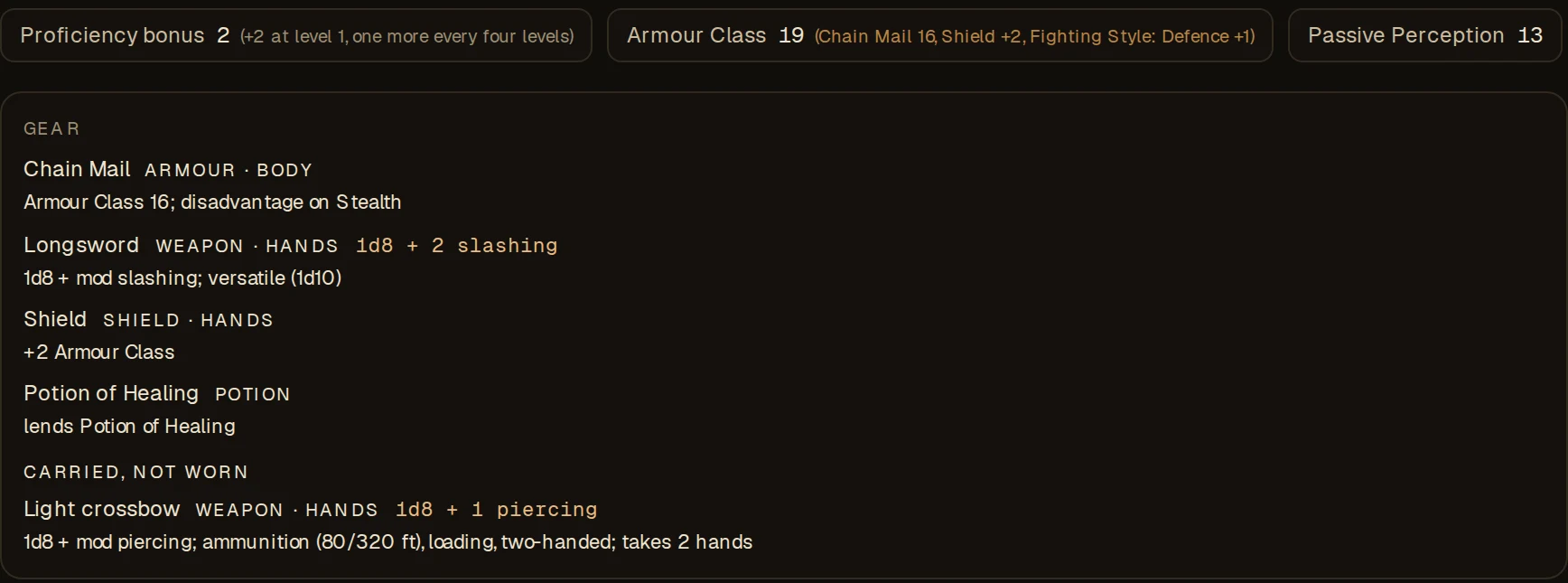
The storyteller is told what they wear and wield and the numbers it sets, and names the weapon of each blow, so the story and the dice agree. Storyteller
Classic d20's gear
From the SRD 5.1: the thirteen armours and the shield, the thirty-six weapons with damage, and a dozen magic items whose numbers are plain: rings and cloaks of protection, bracers of defence (only without armour), gauntlets that make Strength 19, boots and cloaks of elvenkind, a flame tongue, wands of magic missiles and fireballs, potions of healing. Ammunition and weight aren't counted: that is the paperwork code spares.
- Slots: body, two hands, head, neck, shoulders, wrists, gloves, waist, feet, two rings.
- Armour Class is a derived value,
10 + @dex.modbare: armour sets it, a shield adds 2. - A weapon's magic goes on the attack roll as
@weapon.bonusand on the damage. - With no weapon the rules know, a blow does
1d8 + Strength or Dexterity: an unlisted blade still cuts.
Building your gear
- The Studio
- Studio › Rules › Gear: the catalog grouped by kind, one line each saying what it does; open one to change any of it. Slots sets where things are worn.
- The library
- Classic d20 (and copies of it) can add the SRD's armour, weapons and magic items from the library.
- Hob
- “Ironbark armour: medium, AC 14 plus Dex up to 2, and it resists fire” writes one; “add the magic items from the library” adds them.
- Any system
- Gear isn't d20's: a Duality armour can add to the armour track's slots, a Forged item can add a die to an action, a d100 blade can add to Fighting. Modifiers change whatever numbers your system has.