
Rule systems
Rule cards
"When this happens, then that": every trigger and effect, before-cards that change a roll, chains, and ten cards from simple to intricate.
When this happens, then that
A rule card is one rule of your world, written as a sentence: when something happens, only while something holds, then code does something. They are how a system gets its own mechanics without code: a lucky break, a curse, a reputation, a blood-oath magic with a price.
Lucky break
When a roll is a critical → Inspiration +1.
Code watches for the trigger and applies the effects; nobody has to remember. The storyteller is told when a card fires and what it did, so the scene can show it, and the player sees it on the roll chip and the sheet. Engine
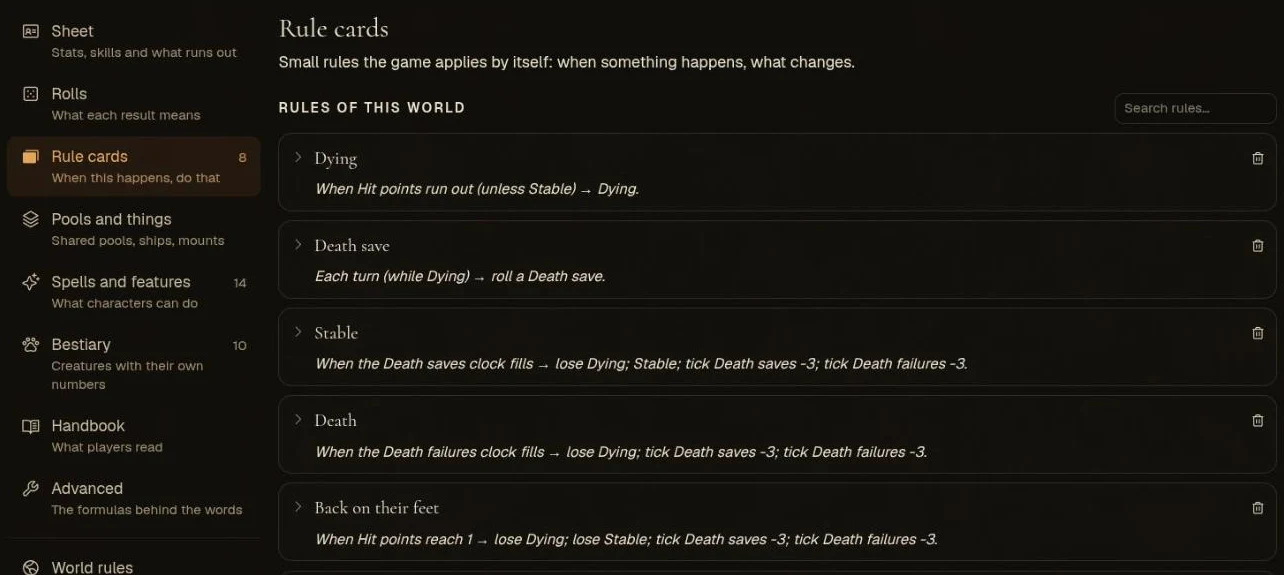
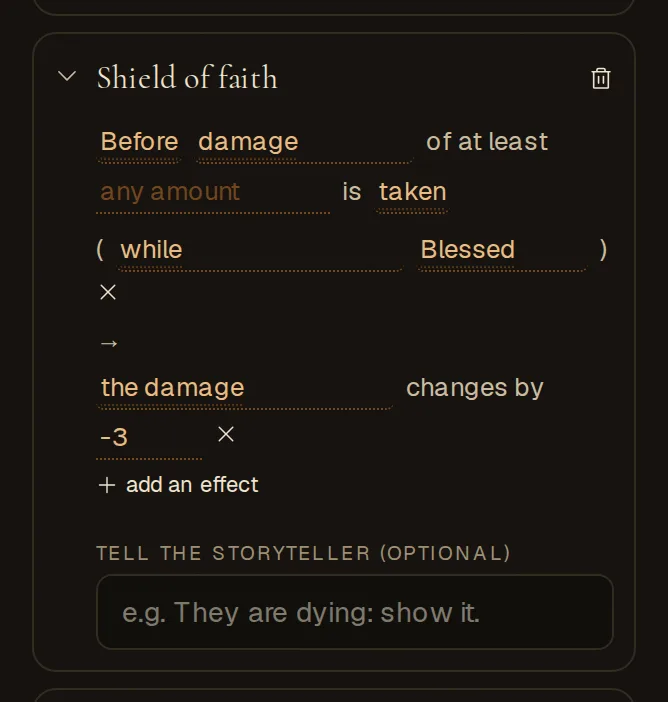
Tap a card and its sentence opens into the same words with a picker in each changeable place. The pickers only offer what your system has: its checks, tracks, conditions, clocks and pools. So a card can't name something that doesn't exist, and what you read is what runs.
Triggers: when a card fires
Every sentence below is exactly what the Studio shows for that card.
| Trigger | Example sentence | Fires |
|---|---|---|
| A roll lands | When a roll is a critical → … / When a Saving throw fails or fumbles → … / When an Ability check lands on Success → … | As the roll is read: any roll, one check, one band, or how it turned out. |
| A track | When Hit points run out → … / When Exhaustion fills up → … / When Hit points drop below half → … / When Hit points reach 1 → … | When the track crosses the line, whatever moved it. |
| A clock fills | When the Renown clock fills → … / When a clock fills → … | When the last segment is ticked. |
| A fight | When a fight starts → … / When a fight ends → … | At the first exchange, and when it's over. |
| A rest | When they rest → … | When a rest is taken. |
| Each turn | Each turn (while Poisoned) → Hit points −1. | Every turn the character takes; almost always with an "only while". |
| A level | When they gain a level → … | On levelling up. |
| A place | When they enter the Sunken Chapel → … / When they enter a settlement → … | Arriving at a named place, or any place of a kind. |
| Meeting someone | When they first meet a priest → … / When they first meet Odile → … | The first meeting only: by name, or by what they are. |
| An item | When they gain Moonsilver Blade → … / When they lose an item → … | Gaining or losing one named item, or any. |
| Damage | When they deal damage of at least 10 → … / When they take damage → … | Once per blow; the amount is @event.amount. |
| A defeat | When they defeat a foe → … / When they defeat Bridge raider → … | When a blow of theirs kills a foe. |
| A quest | When a quest step is done → … / When a quest is finished → … | As the quest log moves. |
| Something in the story Storyteller | When they keep a promise that cost them something → Inspiration +1. | After the scene is written, a judge reads the action and the scene and answers your question yes or no. |
Effects: what a card does
| Effect | In a sentence | Notes |
|---|---|---|
| Change a track | Inspiration +1 · Hit points −2 · Inspiration set to 1 | An amount or a formula (no dice). On a thing a character owns, too: the ship's Hull. |
| A condition or tag | Bloodied · Blessed for 3 turns · Frightened 1 · Frightened rises · lose Dying | Put on (with a level or a duration), take off, raise or lower a level. |
| Tick a clock | tick Renown 1 | The first tick creates it, with the size you give (4 if none). |
| Experience | +25 xp | |
| A pool | Doom +2 · Fear −1 | The storyteller's pools. |
| Roll a check | roll a Death save | Code rolls it now; its outcome's effects apply, and it gets a chip of its own. |
| Mark the stat | the stat is marked to improve | For systems that grow by improvement rolls. |
| Tell the storyteller | “Something old notices the oath is broken” | A line the storyteller must show in the scene. Storyteller |
| Change the roll | +2 to the roll · advantage · 3 less damage | Before-cards only (below). |
| Stop it | blocked: No spell can be cast inside the temple | Before-cards only: the roll isn't made (the action fails, and the storyteller is told why), or the damage doesn't land. |
A card can do several things at once; they apply in order, separated by semicolons in the sentence.
Only while
Any card can carry a condition that must hold when it fires. The common ones read as words; anything else shows the formula itself, so you can always read what it checks:
| Reads as | Formula |
|---|---|
| (while Blessed) | @cond.blessed > 0 |
| (unless Stable) | @cond.stable == 0 |
| (while Nerve is below 2) | @nerve < 2 |
| (when the Current die shows 6) | @group.Current.high == 6 |
| (when the Hunger die shows a 1) | @group.Hunger.ones > 0 |
| (when it is at least 8) | @event.amount >= 8, on a damage card |
| (while Blessed and Nerve is at least 3) | @cond.blessed > 0 and @nerve >= 3 |
Before-cards: changing a roll or a blow
Most cards fire after something has happened. A before-card fires just ahead of a roll or a blow, and can change it: add to the roll, give advantage or disadvantage, soften or harden the damage, or stop it altogether. Only two triggers can be before-cards: a roll about to be made, and damage about to land. Engine
The Witchwood
Before any roll in the Witchwood → disadvantage.
Shield of faith
Before damage is taken (while Blessed) → 3 less damage.
The temple's quiet
Before any roll in the Temple of Quiet → blocked: No spell can be cast inside the temple.
The roll chip shows every before-card that touched a roll by name (“The Witchwood: disadvantage”), and the maths line counts it (“+ 2 rules”), so nothing is hidden. Advantage and disadvantage from cards and conditions count once either way, like the storyteller's own edge.
Chains
Cards feed each other. When a card changes the sheet (puts on a condition, ticks a clock, empties a track), cards watching for that fire next, up to three steps deep. Each card fires at most once for any one moment, so a chain can't loop forever. Engine
Holy ground
When they enter the Sunken Chapel → Blessed for 3 turns.
Shield of faith
Before damage is taken (while Blessed) → 3 less damage.
The first card puts Blessed on; the second reads it. A ghoul's 7 damage lands as 4 for the next three turns.
Renown
When they defeat a foe → tick Renown 1.
A name in the capital
When the Renown clock fills → +100 xp; Known in the capital.
The fourth foe defeated fills the clock, and the second card fires on the same turn.
Ten cards, simple to intricate
These ten cards are real: each one validates and fires on the engine, under Classic d20 with a few conditions and a Doom pool added. Read them as recipes.
One-liners
Lucky break
When a roll is a critical → Inspiration +1.
Rewards luck with a resource the player can spend for advantage.
Trophy
When they defeat a foe → +25 xp.
Pays for fights on top of the system's own growth.
The Witchwood
Before any roll in the Witchwood → disadvantage.
A place with teeth. Every roll there, by anyone's character, is harder.
Bloodied
When Hit points drop below half → Bloodied.
Bloodied is a condition, so other cards (and the storyteller) can read it.
Two that chain
Holy ground
When they enter the Sunken Chapel → Blessed for 3 turns.
Shield of faith
Before damage is taken (while Blessed) → 3 less damage.
A reputation
Renown
When they defeat a foe → tick Renown 1.
A name in the capital
When the Renown clock fills → +100 xp; Known in the capital.
A whole magic: the blood oath
A condition (Blood-sworn), a pool (Doom, 0 of 6, which the storyteller must spend for hard moves) and two cards: power now, paid for later.
Blood price
Before any roll (while Blood-sworn) → advantage; Hit points −2.
The debt comes due
When Hit points run out (while Blood-sworn) → Doom +2; “Something old notices the oath is broken”.
Under the sentence
Every card is rules data, and the Advanced tab and Hob both work with it directly. Shield of faith, as data:
{ "id": "shield_of_faith", "name": "Shield of faith",
  "when": { "on": "damage", "dir": "taken" },
  "stage": "before",
  "if": "@cond.blessed > 0",
  "then": [ { "kind": "modify", "amount": "-3" } ],
  "note": "The blessing turns part of the blow." }
The note is what the storyteller is told when the card fires. Leave it out and the storyteller is told what the card did; put one in when the scene should show something specific.
For the values formulas can read, see the dice language. For asking Hob to write cards, see Building rules with Hob.