
Rule systems
How a roll works
The storyteller picks the words, code rolls the dice. A turn step by step, the roll chip, who throws, and the six systems you can start from.
Rules the storyteller can't bend
A world can play by Worldtable's own engine, where the numbers stay hidden, or by a rule system: stats on a sheet, dice you can see, and outcomes that come from the dice rather than from the storyteller's mood. You can start from one of six systems people already know, change any part of one, or write your own from nothing.
Every rule system follows one rule: the storyteller picks words, code picks numbers. When you try something risky, the storyteller reads the scene and answers a few questions in words: which skill, how hard, whether anything helps or hinders. Code turns those words into a roll, rolls it from a seed, reads the result against the system's bands and applies what the band says. Then the storyteller tells the scene, and has to tell the result the dice gave.
| What | Who |
|---|---|
| Whether this action needs a roll at all Storyteller | Judged against the system's own policy for when to roll. A walk, a chat or a look around never rolls. |
| Which check, which stat, how hard, any edge Storyteller | Picked from the system's own words (Easy, Hard, Disadvantage, Risky). Never a number: the storyteller can't say "DC 17". |
| The dice, the total and the outcome Engine | Rolled from a seed and read by the system's bands. The same seed always gives the same faces, so undo can't reroll. |
| What the outcome does to the sheet Engine | Hit points lost, a condition put on, a clock ticked, Hope gained. Code applies it. |
| The scene that follows Storyteller | Written after the roll, told the result. A failure written as a success is caught and sent back. |
| Rule cards, conditions, pools Engine | Fired by code when what they watch for happens. See Rule cards. |
A turn, step by step
Here is one action under the Classic d20 system, from the line the player types to the scene that comes back.
- 1The player acts“I sprint and leap for the far side of the burning bridge.”
- 2Does it need a roll?Eight strides over burning planks, with failure meaning a fall into the river: yes.
- 3The storyteller picks the wordsCheck: Ability check. Stat: Athletics. Difficulty: Hard. Edge: Disadvantage (the planks are giving way).
- 4Code builds the rollHard is 20 in this system; disadvantage rolls two d20 and keeps the lower:
2d20kl1 + Athletics. - 5The dice are thrownBy the player for a big moment like this one, in the 3D tray; by code for small things.
- 6Code reads the result
2d20kl1 (19, 7) + 5 = 12 vs 20: the Failure band. Its guidance: it does not work, and the world moves. - 7Code applies the bandAnything the band or a rule card does: here nothing on the sheet, the failure is the story's to tell.
- 8The storyteller tells it"Her boot finds the far edge, and the edge gives. She catches a root one-handed as the burning rope lashes her back."
Reading a roll
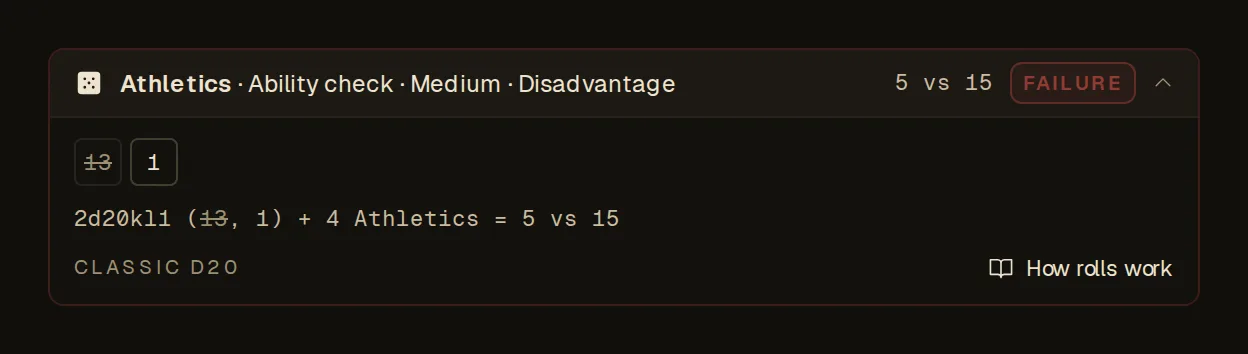
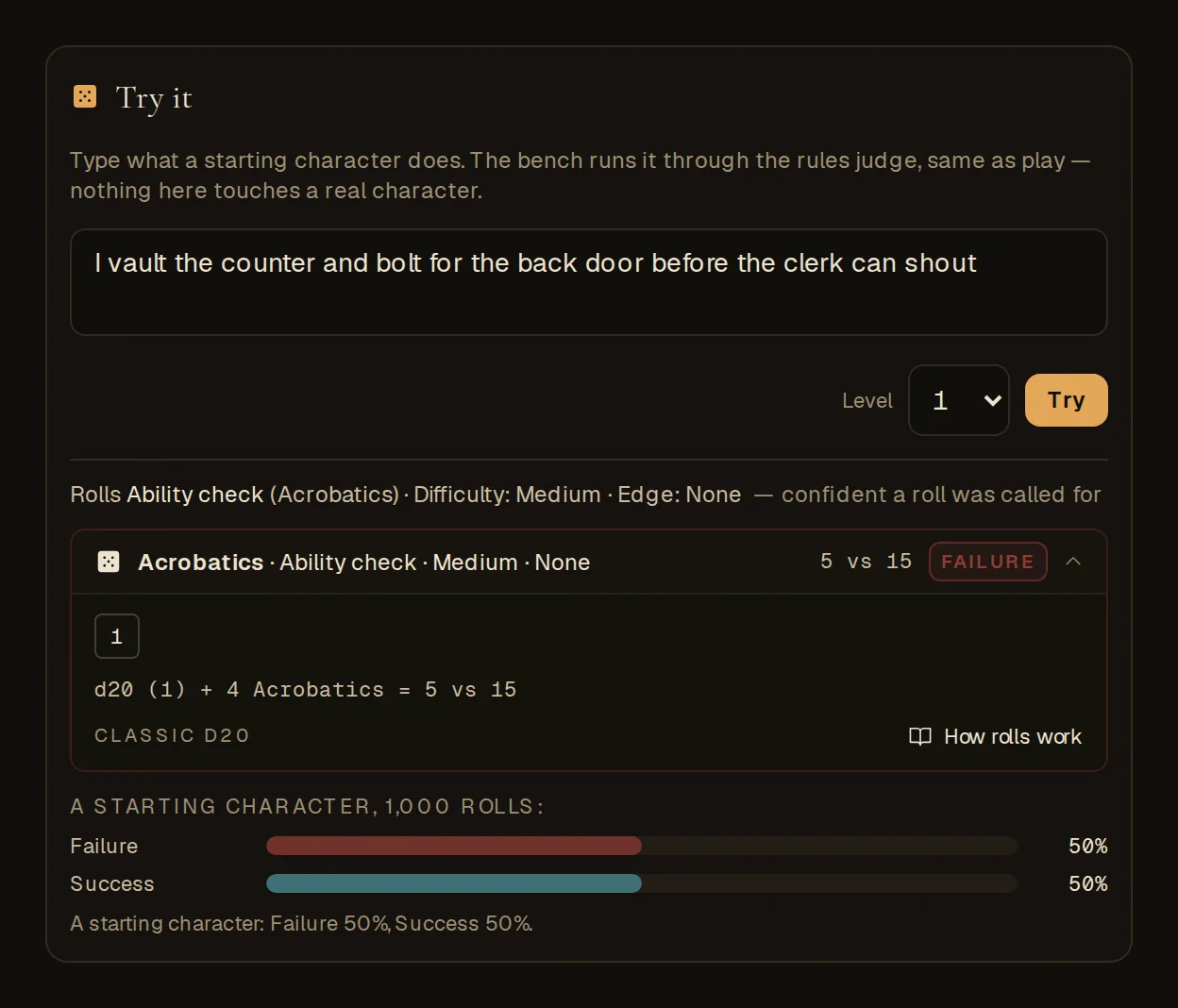
Every roll leaves a roll chip in the story, where it happened. It reads left to right: the stat, the check, the words the storyteller picked, the total against the target, and the outcome.

- The maths line
- Every die and every bonus, in order:
2d20kl1 (19, 7) + 5 Athletics = 12 vs 20. Bonuses from conditions and rule cards are named (“+ 2 rules”, “− 1 conditions”). Builders choose whether it shows always, on a tap, or never. - The outcome
- The band the roll landed in, coloured by how it went: gold for a critical, green for a success, amber for a mixed result, red for a failure.
- A colour word
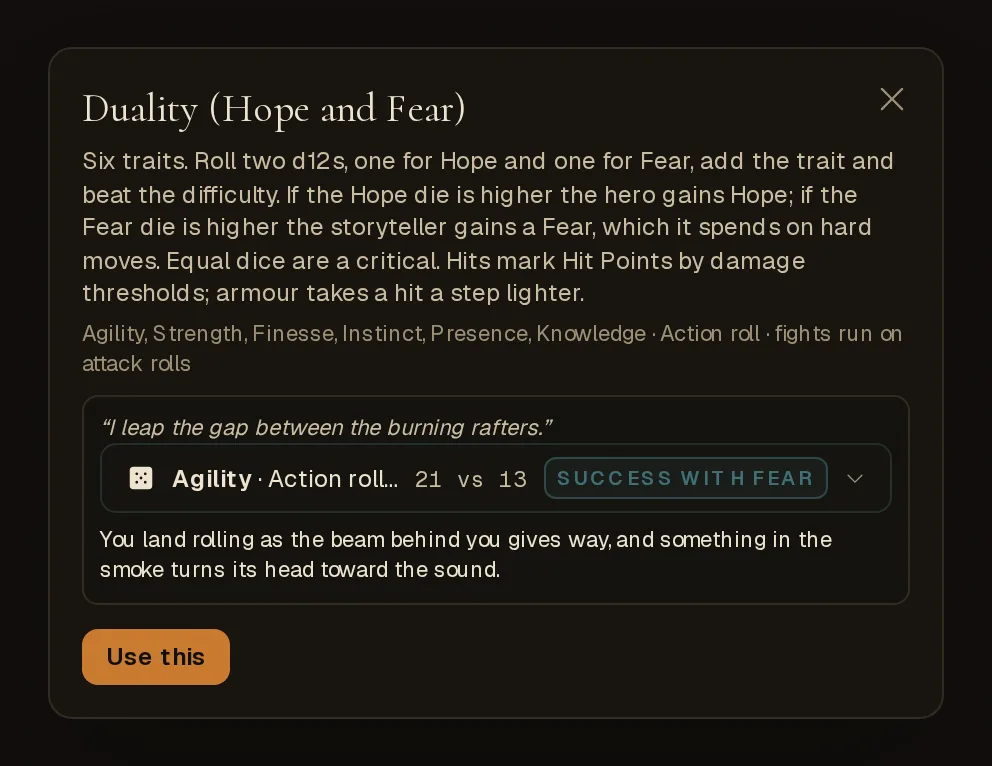
- Some systems add a word after the outcome: Success with Fear in Hope and Fear, from which of two named dice came up higher.
- What it changed
- "Inspiration +1", "Stress +2", "Renown 3/4": the sheet changes the roll caused, so nothing happens off screen.
- Secret rolls
- Some stats (noticing, reading people) can be rolled in secret. You see that a roll happened and learn what you notice, but not the number.
Who throws the dice
Players can throw their own dice. The dice are the product's own 3D dice, and the result is still decided by the seed. A flick in the tray just shows you the faces. The builder picks one of three modes in the Rules tab:
| Mode | What happens |
|---|---|
| Players, for big moments (the default) | A risky or hard attempt waits for the player: anything the dice give less than even odds, anything intense, and anything that happens TO them (a save, a nerve test). Small things roll themselves. |
| Players, every roll | Every check waits for the player's throw. |
| The game rolls | Rolls happen by themselves and show in the story. Fastest. |
When a roll waits for you, a roll card shows what is being rolled and your chance. Before you throw it can offer two kinds of choice, both from the sheet: Engine
- Another stat that fits the action as well, with its own chance, if the storyteller thought more than one could apply.
- Spends the system allows before a roll: Inspiration for advantage, two Stress for an extra die, a Hope for a d6. Each shows what it costs and what it does to your chance.
A waiting roll throws itself after a minute, so a party is never held up by someone who stepped away.
Six systems to start from
Each preset is a whole system: stats, checks, outcomes, fights, enemies for every role and tier, growth and character creation. Pick one in the Studio's Rules tab and change whatever you like. Your world keeps its own copy, so a later fix to the preset never changes your world until you take it.
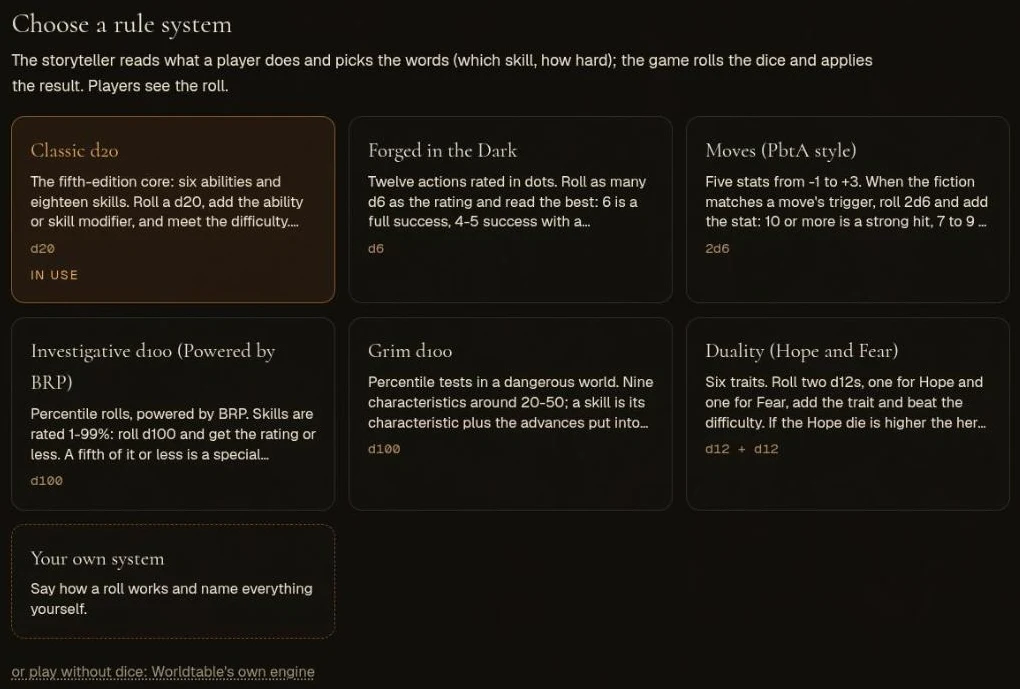
| System | The roll | Plays like |
|---|---|---|
| Classic d20 | d20 + modifier vs a difficulty; advantage rolls two and keeps the higher | The fifth-edition core: six abilities, eighteen skills, death saves, initiative, an action and a bonus action a turn. From the SRD 5.1 (CC-BY-4.0). |
| Forged in the Dark | A pool of d6 by your rating, the best die read: 6 clean, 4-5 at a cost, 1-3 bad | Twelve actions in dots, position and effect, consequences instead of attack rolls, stress and trauma. From the Blades in the Dark SRD (CC-BY 3.0). |
| Moves (PbtA style) | 2d6 + stat: 10+ strong hit, 7-9 a hit with a cost, 6- the world moves | Five stats from -1 to +3, a handful of moves with triggers, xp on a miss. |
| Investigative d100 | d100 at or under the skill; a fifth of it is a special success, a twentieth a critical, the worst failures fumble | Characteristics and percentile skills, Easy doubling the chance and Difficult halving it, Sanity and Luck rolls, experience rolls to improve. |
| Grim d100 | d100 at or under the chance plus the difficulty; success levels from the tens digits | Nine characteristics with skills built on them, success levels that say how well or badly it went, a dangerous world. |
| Hope and Fear | d12 Hope + d12 Fear + trait vs a difficulty; the higher die colours the result | Six traits, damage thresholds, armour slots, and a Fear pool the storyteller must spend to make a hard move. |
The Rules tab
Once a world has a system, a bar across the top of the Rules tab says which, with who throws the dice, Change system and Try it. Under it, the parts of the system are listed down the left: Sheet, Rolls, Rule cards, Pools and things, the world's abilities, the Bestiary, Handbook and Advanced, with the world's own rules (death, heroes, the game master) as one more entry. Try it slides the bench out on the right. Every edit is checked as you make it, and nothing is saved until you press Save changes.

The player's handbook
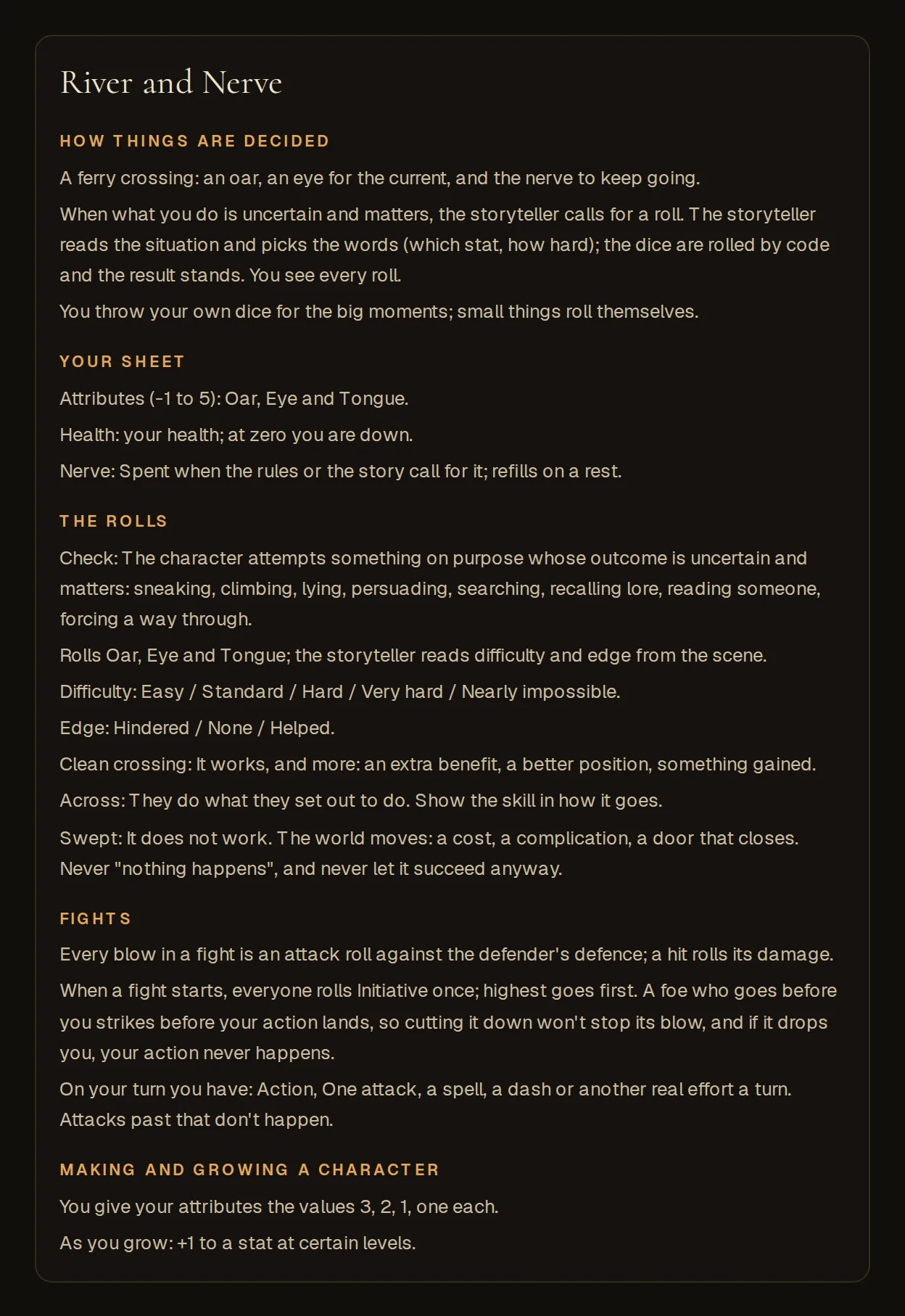
Every system writes its own handbook: how things are decided, the sheet, each check and its outcomes, the conditions, how fights work, every rule card as a sentence, the storyteller's pools, and how characters are made and grow. It lives in the Rules tab's Handbook, and it is generated from the rules themselves, so it can't fall out of date. Engine
Switching a world that's already running
Characters keep their story when their world changes system. Each one gets a proposed sheet under the new rules, worked out from their backstory the same way character creation suggests one, and the player reviews it: accept it, or adjust it within the system's creation method. Until they do, they play on the system's starting sheet. Engine
Switching back to Worldtable's own engine is always safe: a character's native strength and magic were kept all along and take over again.
Where to go next
- Making your own system: the six ways a roll can work, with their odds, and three systems built end to end.
- Rule cards: “when this happens, then that”, from a lucky break to a blood-oath magic.
- Building rules with Hob: describe what you want and let Hob build it.