
Rule systems
Making your own system
Six ways a roll can work, your own dice (mixed if you like), stats, skills and outcomes, with real odds for each and three systems built end to end.
From nothing to a system that plays
You don't need a preset. In the Studio's Rules tab, press Change, pick the dashed Your own system tile and then Start from scratch. You answer four questions in words, and code builds a whole system from your answers:
- 1How a roll worksOne of six engines: beat a number, roll under, a pool read by its best die, bands, counting hits, or two named dice.
- 2The diceWhich dice, and any extra dice in every roll: a d6 called Momentum, a d4 of Doubt taken away.
- 3The sheetYour stats, each with what it covers; skills, if your engine has them; what health is called; anything else a character can run out of.
- 4Outcomes and fightsYour own names for the outcomes, best first, and which stats a blow uses and which defends.
A preview beside the steps shows the system as it stands: a sample roll on a starting character, the summary players will read, and the outcome bands. When it's right, press Create this system. If the world already had one, the Studio asks first; characters keep their story and get a proposed sheet under the new rules.
The composer, step by step
1 · How a roll works
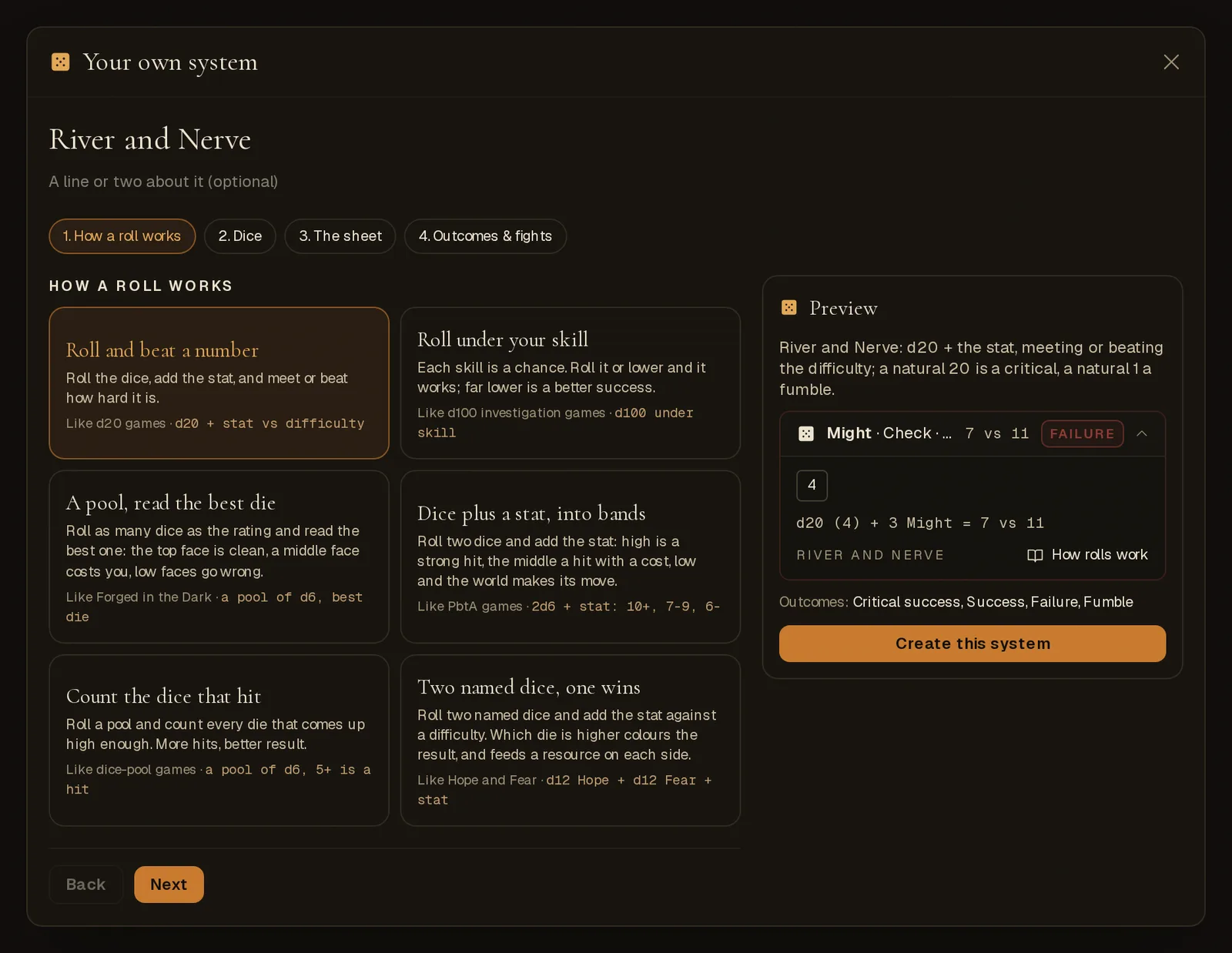
The six engines, each with a sentence, the games it plays like, and its dice. Pick one; you can come back and change it.
2 · The dice
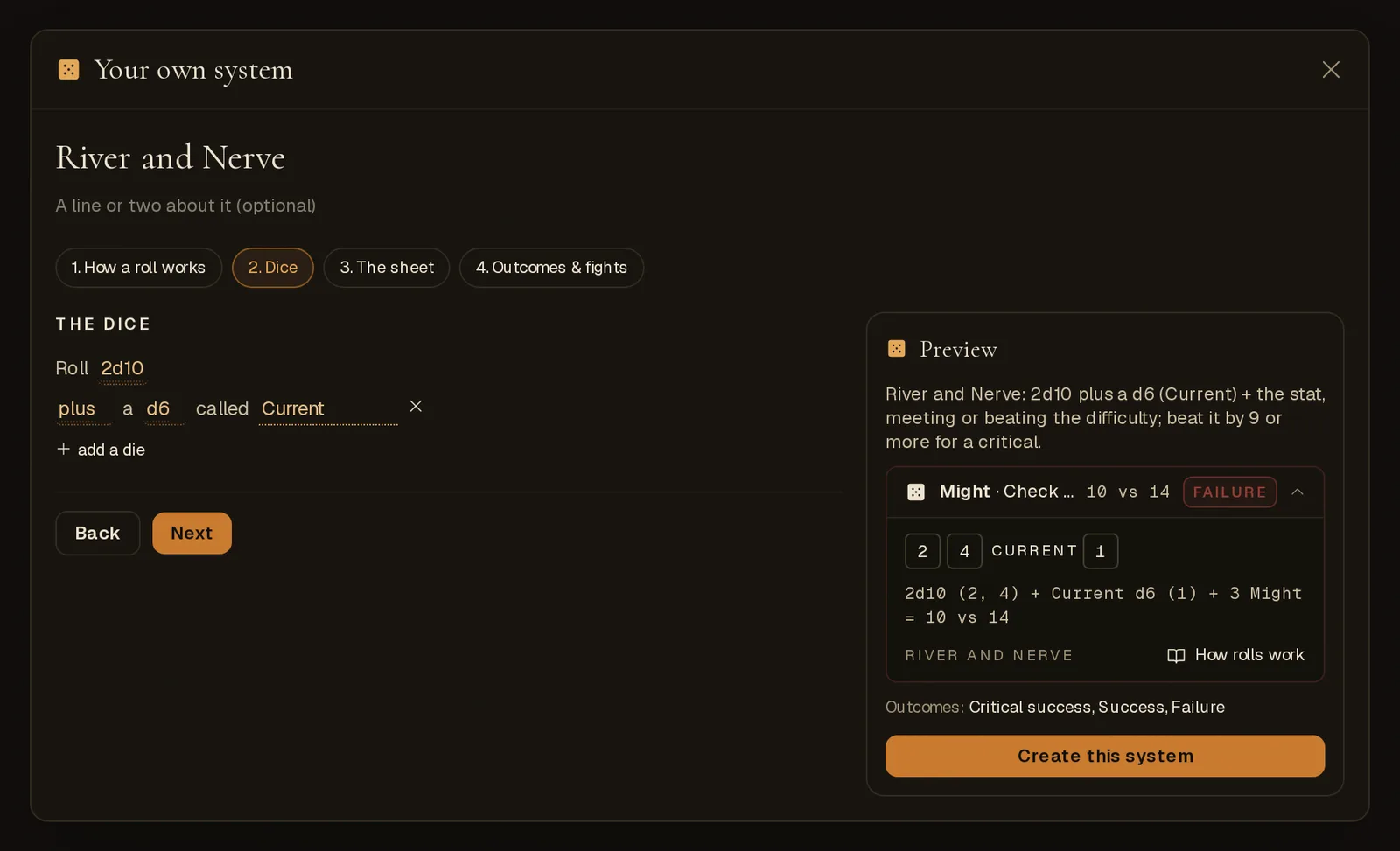
The dice step reads as a sentence that changes with the engine: Roll [2d10], then plus a [d6] called [Current] for each extra die (up to three, added or taken away). Under a pool engine it reads A pool of [d10]; under two named dice, Roll a [d12] called [Hope] and a [d12] called [Fear].
3 · The sheet
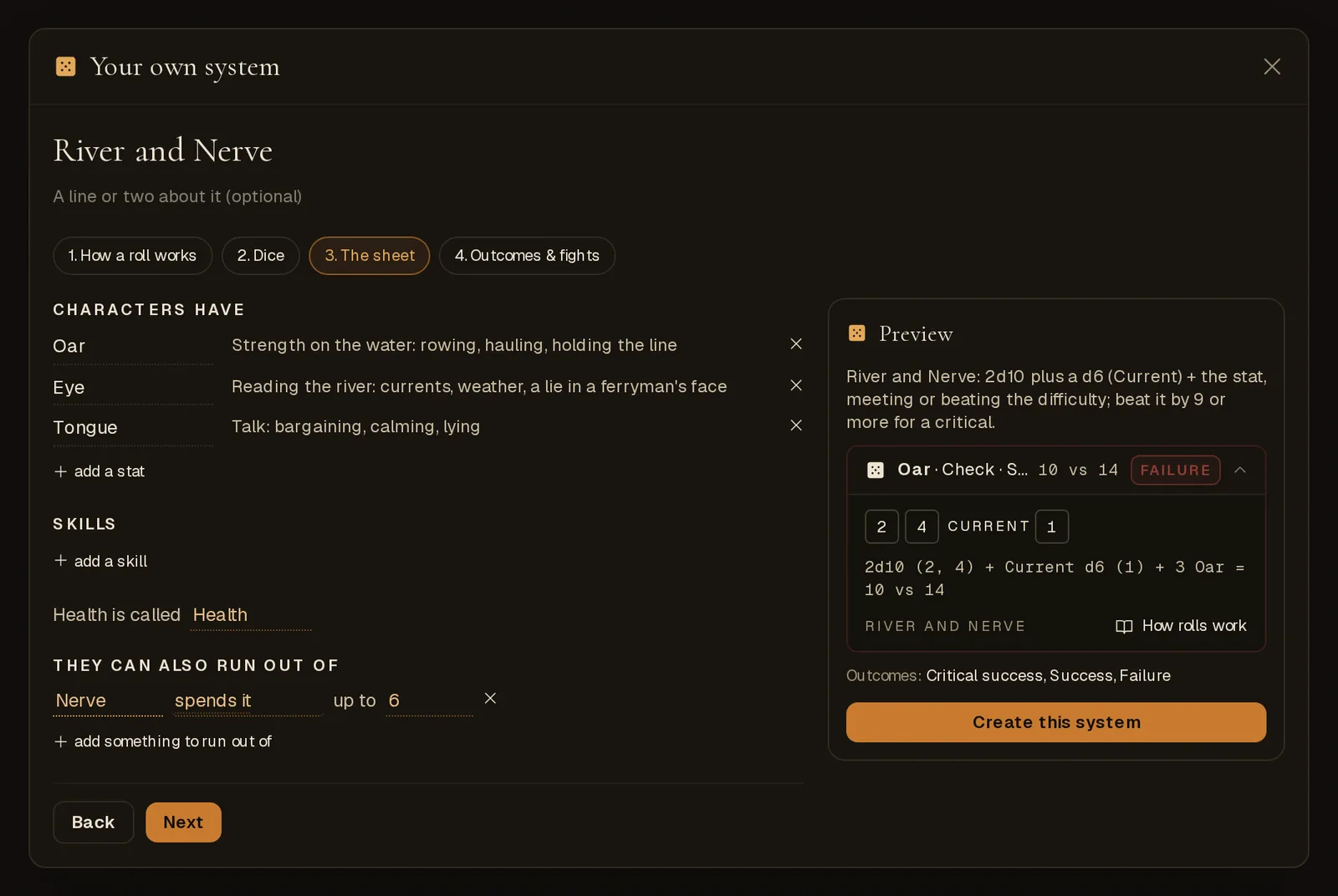
Characters have: your stats, each with a line on what it covers. That line matters: it is what the rules judge reads to pick a stat for an action, so “Eye: reading the river, currents, weather, a lie in a ferryman's face” gets Eye rolled for spotting a lie. Then skills (for engines that have them), what health is called, and other things a character can run out of or fill up.
4 · Outcomes and fights
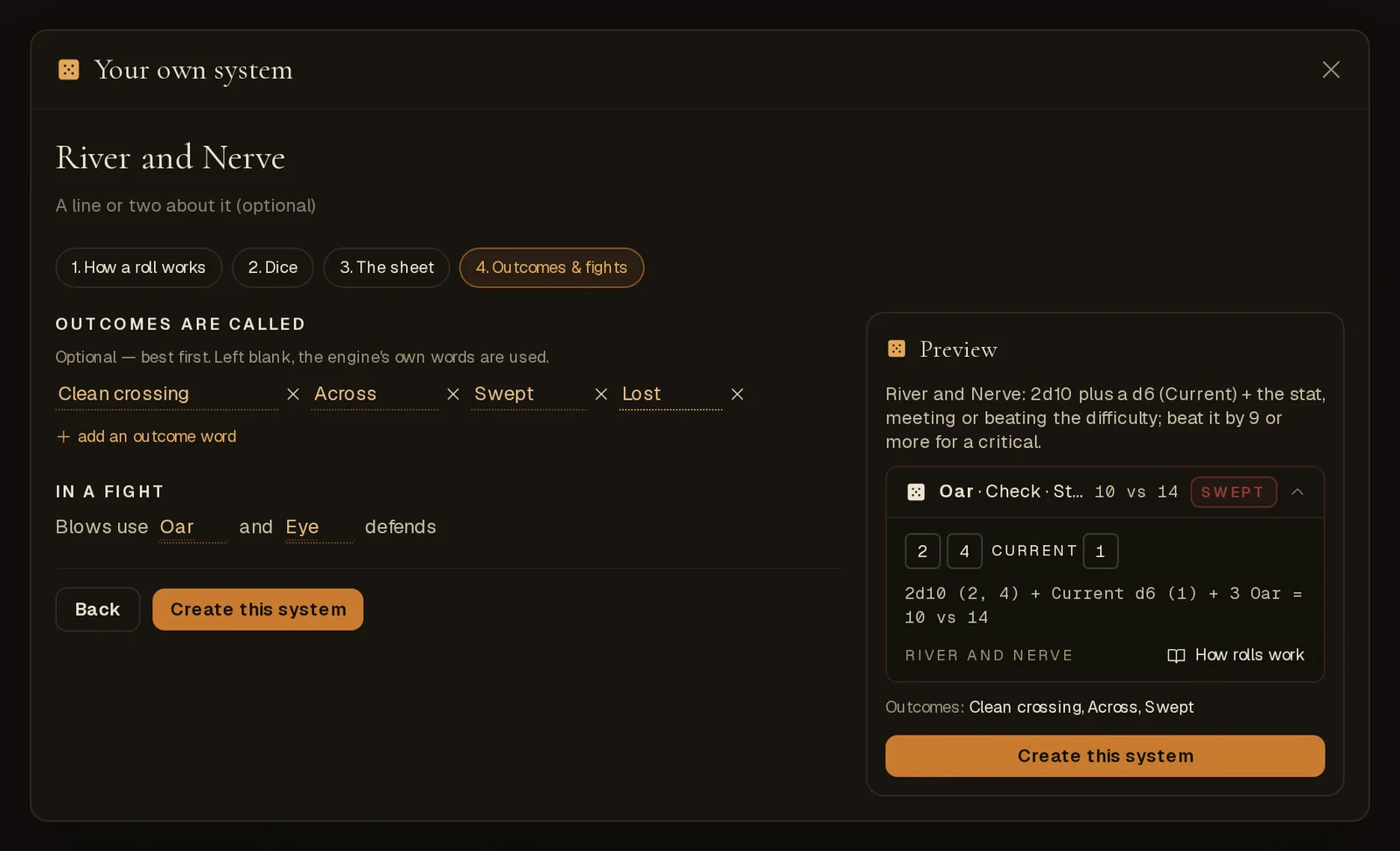
Name the outcomes, best first, or leave them for the engine's own (Critical success, Success, Failure). An engine has as many outcomes as it has bands; extra names are ignored. Then In a fight, blows use [Oar] and [Eye] defends.
The six ways a roll can work
Each engine below says what the roll is, what the storyteller picks, the outcomes, and real odds: every number on this page comes from rolling the engine thousands of times on the same code that runs your world.
Roll and beat a number
Roll the dice, add the stat, meet or beat the difficulty. The storyteller picks a Difficulty (Easy, Standard, Hard, Very hard, Nearly impossible) and an Edge (Hindered, None, Helped). Stats run from -1 to +5 and add straight to the roll; skills, if you name any, add on top of the stat they lean on (0 to 3). Engine
- The dice
- Any of
d20,d12,d10,2d10,3d6,2d6,2d8,2d12, plus up to three extra dice. - The difficulty ladder
- Sized to your dice, so Standard means the same thing on 3d6 as on a d20: a +2 hero passes about 60-75% of the time.
- Edge
- With one die: two of it, keep the better (Helped) or worse (Hindered). With several: a small die added or taken away (
+ d4on 2d6,+ d6on 3d6). - Criticals and fumbles
- With one die of ten sides or more: the top face is a critical, a 1 a fumble. With several dice: beating the target by about two spreads of the dice is a critical (8 on 2d10, 6 on 3d6), and there is no fumble.
| Stat | Easy | Standard | Hard | Very hard | Nearly impossible |
|---|---|---|---|---|---|
| +0 | 69% | 50% | 34% | 15% | 5% |
| +1 | 74% | 54% | 39% | 20% | 5% |
| +2 | 80% | 60% | 44% | 25% | 10% |
| +3 | 84% | 65% | 50% | 29% | 15% |
| +4 | 90% | 69% | 54% | 34% | 20% |
| +5 | 95% | 74% | 60% | 39% | 25% |
| Edge | Success or better | Critical | Fumble |
|---|---|---|---|
| Hindered | 35% | 0% | 10% |
| None | 60% | 5% | 5% |
| Helped | 84% | 10% | 0% |
Flat or bell-shaped? A single die is flat: every face is as likely, so a weak hero still has a real chance at anything. Several dice pile up in the middle: skill matters more, and the extremes become rare. Here is a +2 hero on each, at the ladder each one gets:
| Dice | Easy | Standard | Hard | Very hard | Nearly impossible |
|---|---|---|---|---|---|
| d20 | 7 · 80% | 11 · 60% | 14 · 44% | 18 · 25% | 21 · 10% |
| d12 | 5 · 83% | 7 · 66% | 10 · 41% | 12 · 25% | 13 · 16% |
| 2d10 | 8 · 90% | 11 · 72% | 15 · 35% | 18 · 15% | 21 · 3% |
| 3d6 | 8 · 95% | 11 · 73% | 14 · 37% | 17 · 9% | 19 · 2% |
| 2d6 | 6 · 92% | 8 · 72% | 10 · 41% | 12 · 17% | 14 · 3% |
Roll under your skill
Each skill is a chance in percent. Roll d100: at or under the chance it works, a fifth of it or under is a hard success, a twentieth is a critical (01 always is), and 96 or more always fails. The storyteller picks a Difficulty that moves the chance: Easy +20, Standard 0, Hard -20, Very hard -40. Pick d20 instead and stats run 1 to 20, rolling exactly the stat is a critical and a 20 always fails. Your stats become the skills; skills you add sit under them as headings. A failed roll can be pushed once: rolled again, with a worse failure if it fails again. Engine
| Skill | Easy | Standard | Hard | Very hard |
|---|---|---|---|---|
| 30% | 50% (10%) | 31% (6%) | 10% (2%) | 1% (1%) |
| 50% | 70% (14%) | 50% (10%) | 31% (6%) | 10% (2%) |
| 70% | 90% (18%) | 70% (14%) | 50% (10%) | 31% (6%) |
| 90% | 94% (22%) | 90% (18%) | 70% (14%) | 50% (10%) |
A pool, read the best die
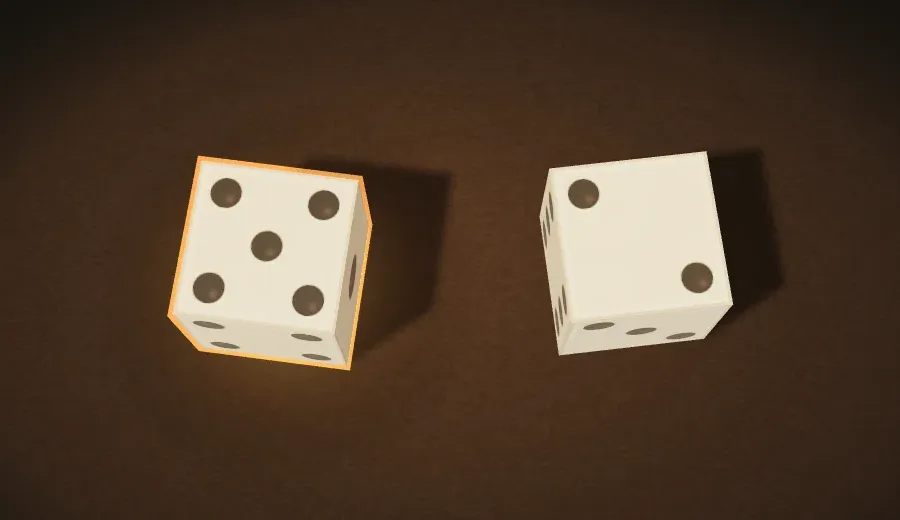
Stats are ratings from 0 to 4 dots. Roll that many dice and read the best: the top face is a full success, the upper middle a partial success with a consequence, anything lower a bad outcome; two top faces is a critical. With no dots, roll two and keep the lower. The storyteller picks a Position (Controlled, Risky, Desperate: how bad a failure gets) and an Effect (Limited, Standard, Great: how much a success achieves), and on a partial or bad outcome, the one consequence that fits best: a cost, a complication, less than hoped, getting hurt, a worse spot. If you add a track that fills up (a stress track), the roll gets Push yourself: two of it for an extra die. Engine
The pool can be d6 (6 clean, 4-5 partial), d8, d10 (10 clean, 7-9 partial) or d12. Fights have no attack rolls: see Fights under your rules.
| Dots | Bad outcome | Partial | Full success | Critical |
|---|---|---|---|---|
| 0 | 75% | 22% | 3% | 0% |
| 1 | 50% | 33% | 17% | 0% |
| 2 | 25% | 44% | 28% | 3% |
| 3 | 12% | 46% | 35% | 7% |
| 4 | 6% | 42% | 38% | 13% |
Dice plus a stat, into bands
Roll the dice (2d6 by default) and add the stat, from -1 to +3. A high total is a strong hit, the middle a weak hit with a cost, low a miss and the world makes its move. On 2d6 that is 10+, 7-9 and 6-; the bands scale with other dice. A miss marks experience. The storyteller picks an Edge. Fights run on consequences. Engine
| Stat | Miss | Weak hit | Strong hit |
|---|---|---|---|
| -1 | 59% | 33% | 8% |
| 0 | 42% | 42% | 17% |
| +1 | 28% | 45% | 28% |
| +2 | 17% | 42% | 41% |
| +3 | 9% | 33% | 58% |
Count the dice that hit
Stats are 1 to 5 dice. Roll them and count every die at or over the hit number (5 on a d6; on a d10, 6): no hits fails, one hit works at a cost, two works, three or more is a critical. Edge adds or takes a die. Fights run on consequences. Engine
| Dice | Failure | Partial | Success | Critical |
|---|---|---|---|---|
| 1 | 67% | 33% | 0% | 0% |
| 2 | 45% | 44% | 11% | 0% |
| 3 | 30% | 45% | 22% | 4% |
| 4 | 20% | 40% | 30% | 10% |
| 5 | 13% | 33% | 34% | 20% |
Two named dice, one wins
Roll two named dice and add the stat against a difficulty (Easy 9, Standard 13, Hard 17, Very hard 21, Nearly impossible 25 on two d12s). The total decides whether it works; which die came up higher colours it. When the first die wins, the hero gains a point of a resource named after it, which they can spend before a roll to add a d6. When the second wins, the storyteller gains a point in a pool named after it, and must spend from that pool to spring a hard move the roll didn't hand them. Equal dice are a critical. Engine
| Stat | Success or better | Critical (equal dice) |
|---|---|---|
| +0 | 58% | 8% |
| +1 | 65% | 8% |
| +2 | 72% | 8% |
| +3 | 77% | 8% |
| +4 | 83% | 8% |
Mixing dice
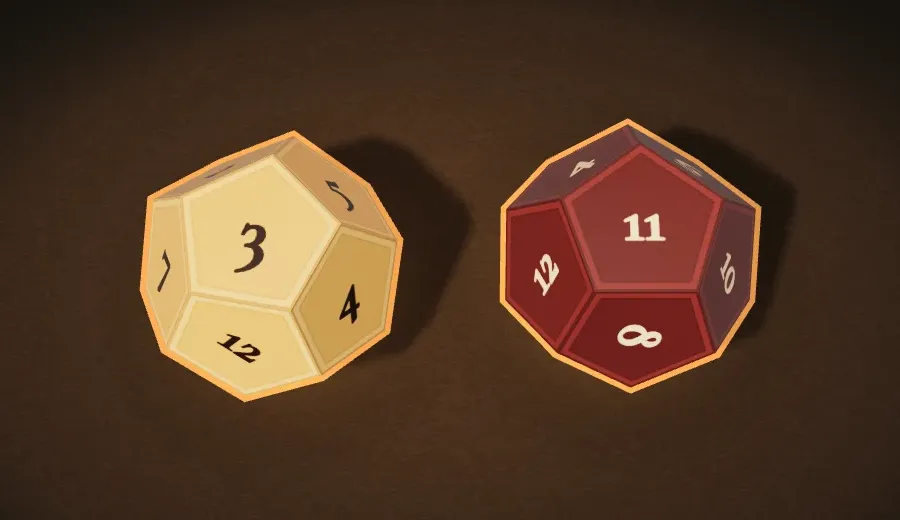
Under beat a number, bands and two named dice, every roll can carry up to three extra dice, each a size from d4 to d20, named, and added or taken away. Each shows as its own die in the tray and its own part of the maths line, and rule cards can read it by name. Engine
2d10 (6, 4) + Current d6 (1) + 3 Oar = 14 vs 14   → Across
d20 (13) + Momentum d6 (5) - Doubt d4 (3) + 2 Grace = 17 vs 14
The difficulty ladder accounts for the extra dice: adding a d6 to a d20 moves Standard from 11 to 14, so a Momentum die makes rolls swingier, not simply easier. A +2 hero passes Standard 62% of the time with it, against 60% without.
What code builds for you
| Part | What it gets |
|---|---|
| The main check | Its "when to roll" wording, the storyteller's questions (difficulty and edge, or position and effect), the roll, how it's read, and the outcome bands with guidance the storyteller follows. |
| The sheet | Your stats on the engine's scale, skills, health, your tracks (with a line each saying what it's for), and two tag lists: Conditions and Traits. |
| Fights | Beat a number, roll under and two named dice: an attack roll against a defence (your fight stats), damage 1d8 + the attack stat, initiative once per fight, one action a turn. Pool, bands and count: consequences. |
| Enemies | A template for minions, standard foes, elites and bosses, at all six tiers: their stats, health, defence, attack and damage, or the harm it takes to put them down. |
| Character creation | An array to hand out (3, 2, 1, …) or dots to spread, sized to your number of stats. |
| Growth | Levels with +1 to a stat at each, or a new dot every 8 xp for pool engines. |
| The rest | A summary in plain words, a policy for when to roll, who throws the dice, and the handbook. |
All of it is ordinary rules data. Open any part of the Rules tab and change anything: rename a band, give a track a maximum that grows with level, add a second check for saving throws, write rule cards. Advanced shows every formula.
Three systems, built end to end
River and Nerve: a ferry-crossing game
2d10 (6, 6) + Current d6 (4) + 3 Oar = 19 vs 14   → Across
2d10 (3, 1) + Current d6 (4) + 3 Oar = 11 vs 14   → Swept
2d10 (6, 4) + Current d6 (1) + 3 Oar = 14 vs 14   → Across
Then three rule cards turn Nerve and the Current die into the game:
Steady hands
When they rest → Nerve +2.
White water
Before any roll in the Weir (while Nerve is below 2) → disadvantage.
The river gives back
When a roll is a critical → Nerve +1.
The Current surges
When a roll is made (when the Current die shows 6) → Nerve −1; “The current grabs the boat”.
The last card reads the named die: a 6 on the Current die costs Nerve whatever the total did. Each card is a few taps in the Rules tab, or one sentence to Hob.
Ash and Ember: hope and fear, renamed and reshaped
Ember d12 (7) + Ash d12 (7) + 3 Iron = 17 vs 13   → Critical success (equal dice)
Ember d12 (4) + Ash d12 (1) + 3 Iron =  8 vs 13   → Failure with Ember
Ember d12 (7) + Ash d12 (5) + 3 Iron = 15 vs 13   → Success with Ember
Want stress like Forged in the Dark on top? Ask Hob. It can read the Forged preset and copy its Stress track (nine boxes; when it fills they take a Trauma and the stress clears) and its Trauma list into Ash and Ember whole, rather than writing its own version. See Borrowing from a preset.
The Hollow Crown: a pool of d10s
A d10 pool is harsher than a d6 pool: a full success needs a 10 rather than a 6, so the partial band does most of the work. That suits a game of hard bargains; if it's too hard, open the Rolls tab and widen the partial band, or give a dot more at creation.
Good to know
- Sizes. Up to 16 stats and 30 skills; up to three extra dice; up to eight extra tracks. Skills are for beat a number and roll under; other engines read the stats alone.
- Names. Stats can be called anything, even words the dice language uses (“Edge”, “Level”): code gives them ids of their own. A system can't be named after another game whose licence doesn't open its name.
- Starting again. Start again from scratch replaces the whole system, rule cards included, and can't be undone from the composer. Changes Hob makes can be undone from Hob's panel.
- Who can. Owners and builders of a world. While rule systems are being tested, the Rules tab may say the Worldtable team sets them for now.