
Playing
Dungeons
Real places under the map: walking them, trying anything, what notices you, and digging your own.
A real place, and your own ideas
A dungeon is a place under a landmark, played through the same turns as everywhere else, by the character you already have: your health, your pack, your powers, your companions. You walk it on a map, the fog lifts as you go, and when something is in the way you say what you do, in your own words.
The line between the two sides is sharper here than anywhere else in Worldtable. Everything about the place is decided before you arrive and kept by the engine. The storyteller's job is to judge what you try and to tell it well.
| What | Who |
|---|---|
| The layout: every room, door, stair and secret Engine | Laid out once from the dungeon's design, the same for every player and every visit. |
| Who is down there and what they carry Engine | Real characters with real packs. If the warden has the key, killing or robbing the warden gets you the key. |
| Whether the dungeon can be finished Engine | A checker proves it before anyone plays: every lock has a way through, nothing strands you, the goal can be reached. |
| Where a free walk takes you, and where it stops Engine | Code walks you and stops you at anything that needs the story. |
| How well your idea went Storyteller | Judged against how the room really works: what the people there sense, want and fear, what burns, what breaks. |
| What that outcome costs Engine | Each room's clean, costly and botched outcomes were priced when it was designed. Code applies them. |
| How much the place has noticed, and how long you've been there Engine | Two dials, kept by code. When the first fills, hunters set out. |
| Who moves, and where to Engine | Patrols and hunters are walked by code. When the story sends someone somewhere, the storyteller names who and where, and code checks the way and moves them. |
| Fights Engine | Ordinary fights on the battle map, drawn from the dungeon level itself. See Fighting. |
Finding one
- Under a landmark. A builder can dig a dungeon under any landmark on their map. On the world map its marker gets a small “steps down” badge, and its card says There is a way down here, with how many levels deep. Going there and going in puts you at its entrance. Engine
- Where the story leads. If the world allows it, the storyteller can open a new dungeon when play goes underground: a sinkhole, a cellar under a ruin you found. The dungeon becomes a place of its own below the one it was found under, named after the dungeon, and you go in when you head down. It only does this under a wild place the story made, never a town, a building or a builder's landmark, and code limits how many there are and how often each character finds one. Engine
A dungeon nobody has drawn yet is drawn the first time someone heads there. That takes about two minutes. If you arrive first, the place stays the landmark meanwhile, and the stage says The way down is still being drawn. with what it's doing. The writing (room names, what you see from a doorway) is done once, before you reach each level, and then never changes.
Inside, the storyteller keeps to the dungeon. Your quests, the threads the world is weaving around you and anything on its way to find you wait outside until you climb back out. Engine
Walking
Click anywhere on the map and you walk there, without a turn and without waiting for the storyteller. Empty passages and rooms you've already dealt with cost nothing. The walk stops on its own: Engine
- at the doorway of a new room with people, a trap, a hazard or something to take;
- at a locked, sealed or barred door, and at a room that still blocks the way;
- wherever a patrol is, and at the doorway of any new room once the level is roused;
- and it tells you why, in a note on the map where you clicked.
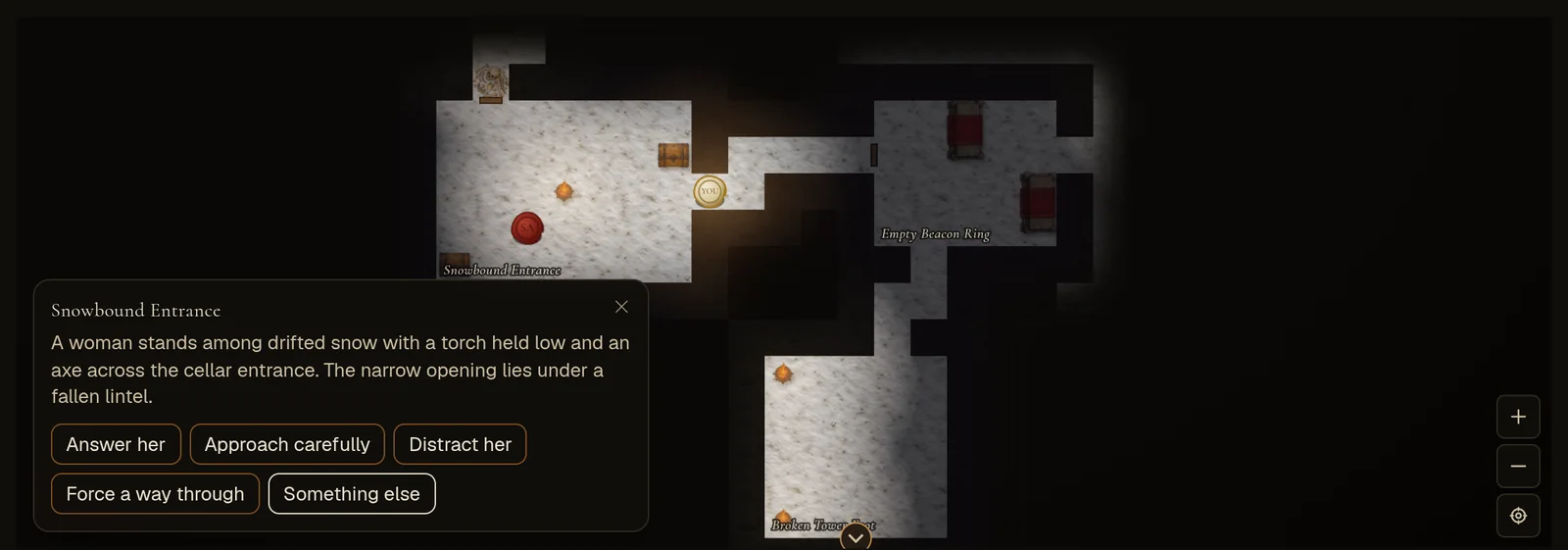
Where it stops, a card shows what you can see from the doorway. Looking in lifts the fog on that room and brings whoever is visible in it into the scene. The buttons are ways in, each a whole turn's words in your own voice: tap one to send it. Something else hands you the action box. Two of the ways are written for your character from your sheet, your powers and your companions, and see only what you can see. Storyteller
Trying anything
A room says how it works. The undead hound in a kennel hears living heartbeats and feels warmth through stone; fire and runes hurt it. A guard watches for one thing and listens for another. A floor is rotten, a rope is fraying, a draugr can't cross running water. You never see these words; the storyteller does, and judges your idea against them, whatever your idea is. Storyteller
- If what you do really gets around what matters (unseen by things that look, silent past things that listen, fire on what burns), it goes clean, even if no one wrote that option down.
- If it only partly does (unseen, but the hound feels your warmth), it's costly.
- If it ignores how the room works, it's botched.
- A power does only what your sheet backs. An idea you learned upstairs (the words that open a seal) counts: knowing the answer makes it clean.
What each outcome costs was set when the room was made, and code applies it, not the prose. Typical prices: Engine
| Room | Clean | Costly | Botched |
|---|---|---|---|
| People in the way | Past them, or they stand aside | Through, but roughed up, and the noise carries | It comes to blows: a fight |
| Hazard | Across without a scratch | Across, but it took skin | A fall, a soaking, a crash that echoes |
| Trap | Spotted, walked round | A glancing blow | It springs full on you, and it's heard |
| A captive | Free and quiet; they tell you what they know | Free, but someone heard | The alarm goes up, and the captive doesn't make it |
| A lever, winch or sluice | It works | It works, loudly | It works, takes skin, and everything nearby heard |
| A rite under way | Broken before it finishes | Broken, but it lashes back | They turn from the rite to fight |
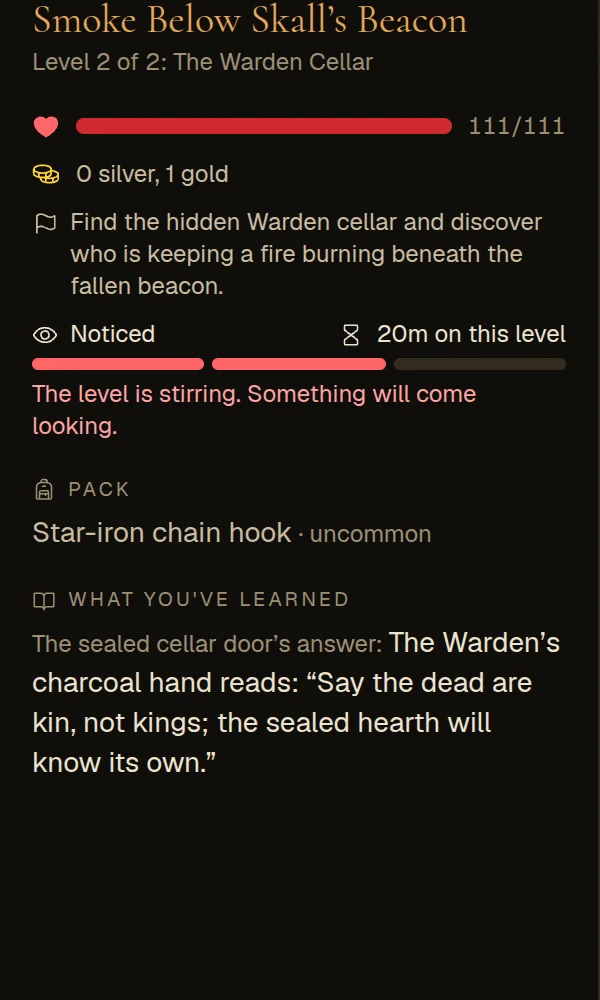
In the example above, holding a bare hand over the warden's torch to show she was facing someone living and warm settled the door clean. Thawing a frozen winch with a torch and hauling it with a hook went costly: it worked, the chain rattled through the stones, and the level heard it.
What the place keeps on you
Four things, all kept by code: Engine
- Noticed
- Three marks. Noise fills them: a costly or botched outcome, a fight, a loud way of doing something, a trap. At two the level is stirring. When it fills, hunters set out for you (below) and the dial starts again.
- Time
- Minutes on this level. Everything you do takes some, and a turn with nothing in it still takes a few. Every 30 minutes the level stirs and Noticed goes up one: every 20 for a loud character, 45 for a quiet one, 60 for one who is hard to notice at all.
- Harm
- Your ordinary health. Costs land on whoever bore them, so a companion can be the one who got hurt.
- Spent
- Torches, rope, potions: things you use up leave your pack, through the same tools as anywhere else.
People on the move
Down here people don't stand still on their squares.
Idle life
Bystanders drift a square or two, guards pace a short beat, beasts shift and settle. It's the same for everyone watching, it never blocks a doorway or your square, and it stops during a scene or a fight. It's only for the eye: their real square doesn't change. Engine

When the story sends someone somewhere
Throw something burning into the kindling and a hound that hunts by sight may bolt for it. A frightened captive runs for an alcove; a guard goes to check the noise next door. The storyteller says who goes and where (a room, a thing in the room like “the cookfire”, “away” or “to me”), and code finds the way over open doors, moves them and plays it on the map. Someone who has left a room no longer blocks it. Engine

Hunters
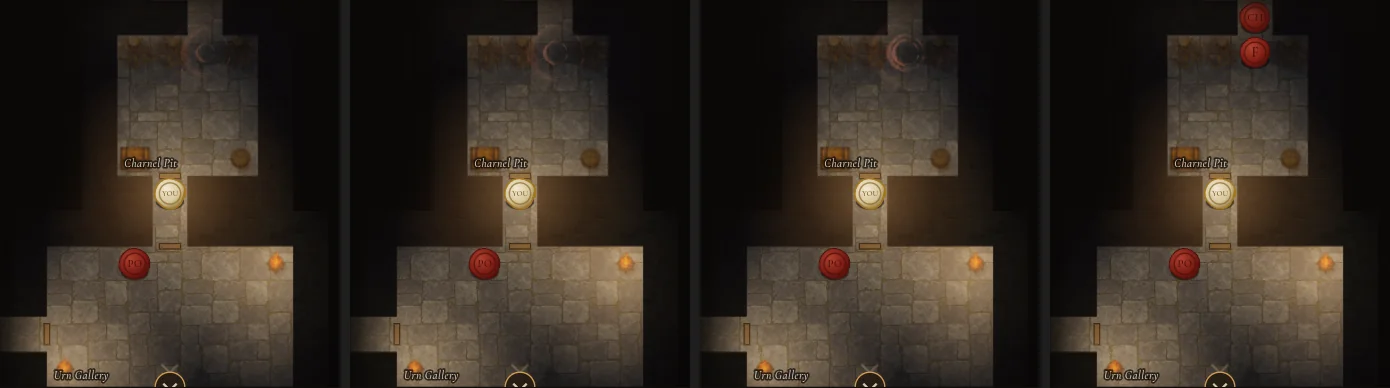
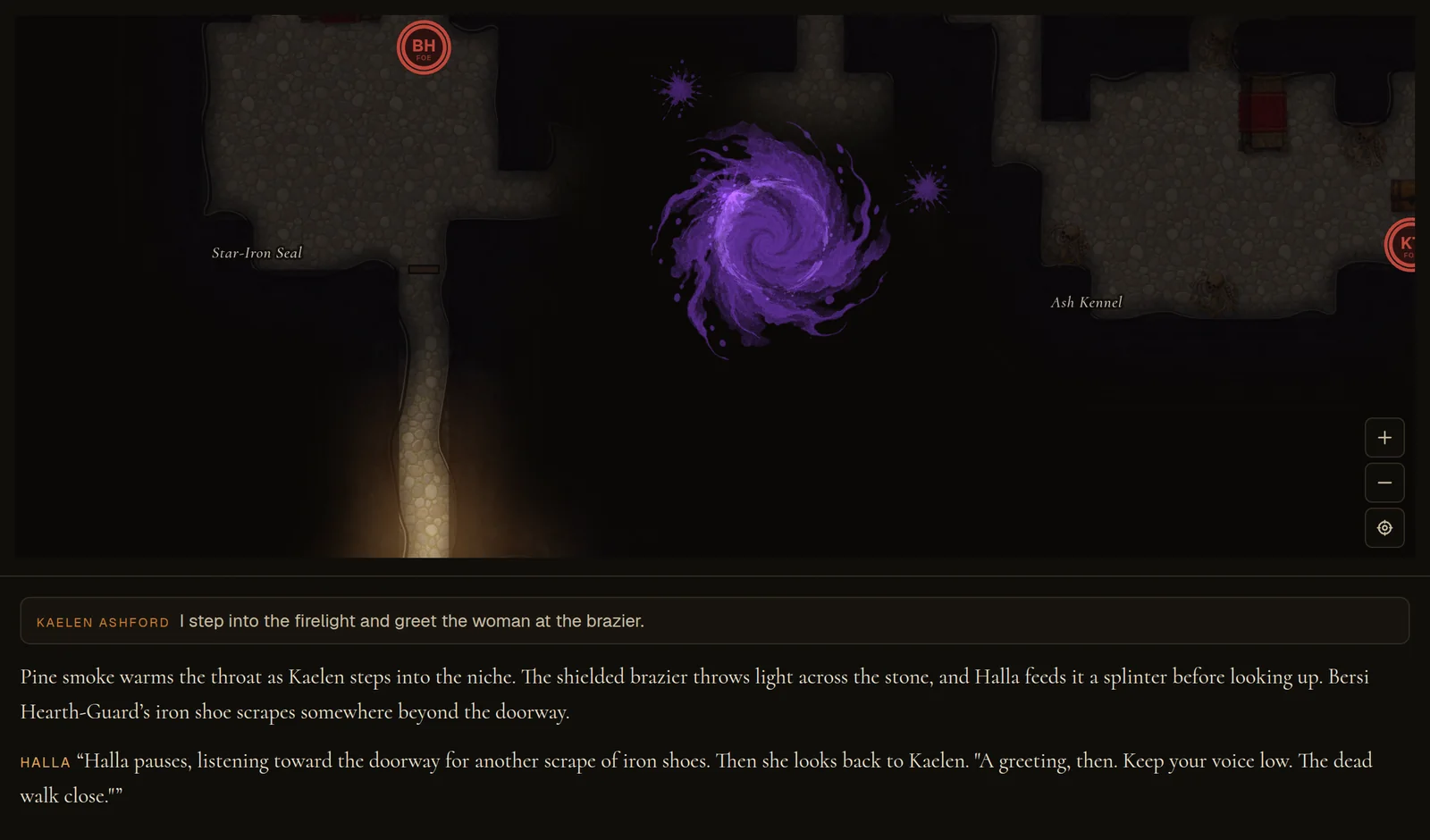
When Noticed fills, hunters from the dungeon's own hostile people set out from a far room and close in along the real route: four squares for each thing you do, more if it took long. You hear them before you see them. In rooms you've seen they show as a dim red glimmer; still in the dark, as a ripple on the nearest ground you know, so the fog never gives away a square you haven't found. When they reach you, it's a fight. Engine
Patrols
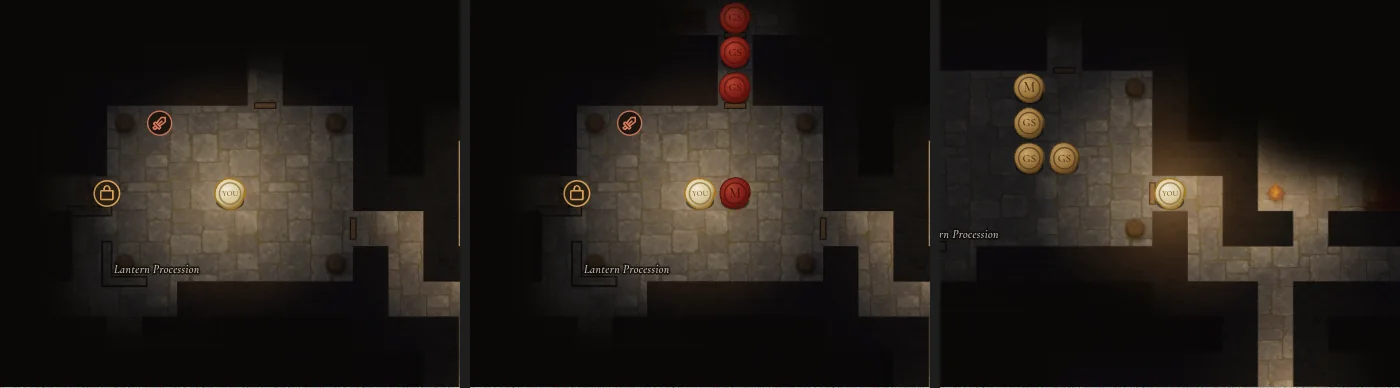
A patrolled room's people walk a fixed round through the rooms nearby, two squares a minute, one square at a time, so they never skip past you. You meet them wherever they are: a free walk stops short of them, and dealing with them comes first. Got past them cleanly, they walk on. Engine
Locks, seals and the goal
What stands between you and the rest of a dungeon is one of a small set of things the checker understands: Engine
- Lock and key
- Someone carries the key, or it lies somewhere you can reach first. Keys are items: take, steal or loot them.
- Seal and answer
- The answer is written or learned somewhere before the seal. What you learn is kept under What you've learned.
- Lever
- A winch, sluice or lever in one room opens a way somewhere else, even on another level. You see SOMEWHERE, A WAY OPENS.
- Tokens
- A core that wants every wing's token, or some of them.
- Guarded pass
- A person is the gate: talk, pay, sneak or fight.
- Hazard
- A chasm, flood or fire that costs something to cross. Always crossable.
- Secret way
- A hidden door with a tell in the room that hides it. Searching finds it.
- One way
- A drop, a slide, a door that shuts behind you. The checker proves there's still a way on.
- Shortcut
- A door that only opens from the far side, to save the walk back.
Every dungeon has one goal. The panel shows it, and marks it Done. when it is: Engine
| Goal | What it looks like |
|---|---|
| Beat what's below | Something waits at the bottom. Its weakness is findable above it. |
| A heist | Take it from under its nose, and get out. Taking it sets something off. |
| A rescue | Someone is held down there. Get them out alive. |
| Stop a rite | It finishes whether you're there or not. |
| An escape | You wake at the bottom. |
| Find someone | Clues lead to who or what is hidden. |
| Pick a side | Two sides down there; the end depends on whom you back. |
When the place changes
A dungeon's designer can set things to happen: take the idol and the level is roused, free the captive and the warden wakes, pull the lever and the flood drains. Clocks run on their own: water rising, a search party, a rite with three bells. Code fires them, they play on the map where they happen (OPENS, SLAMS SHUT, FLOODING, CAVE-IN, AWAKE, THE LEVEL STIRS, THEY ARE COMING), and the camera goes to look when it's out of view. Engine
Fights
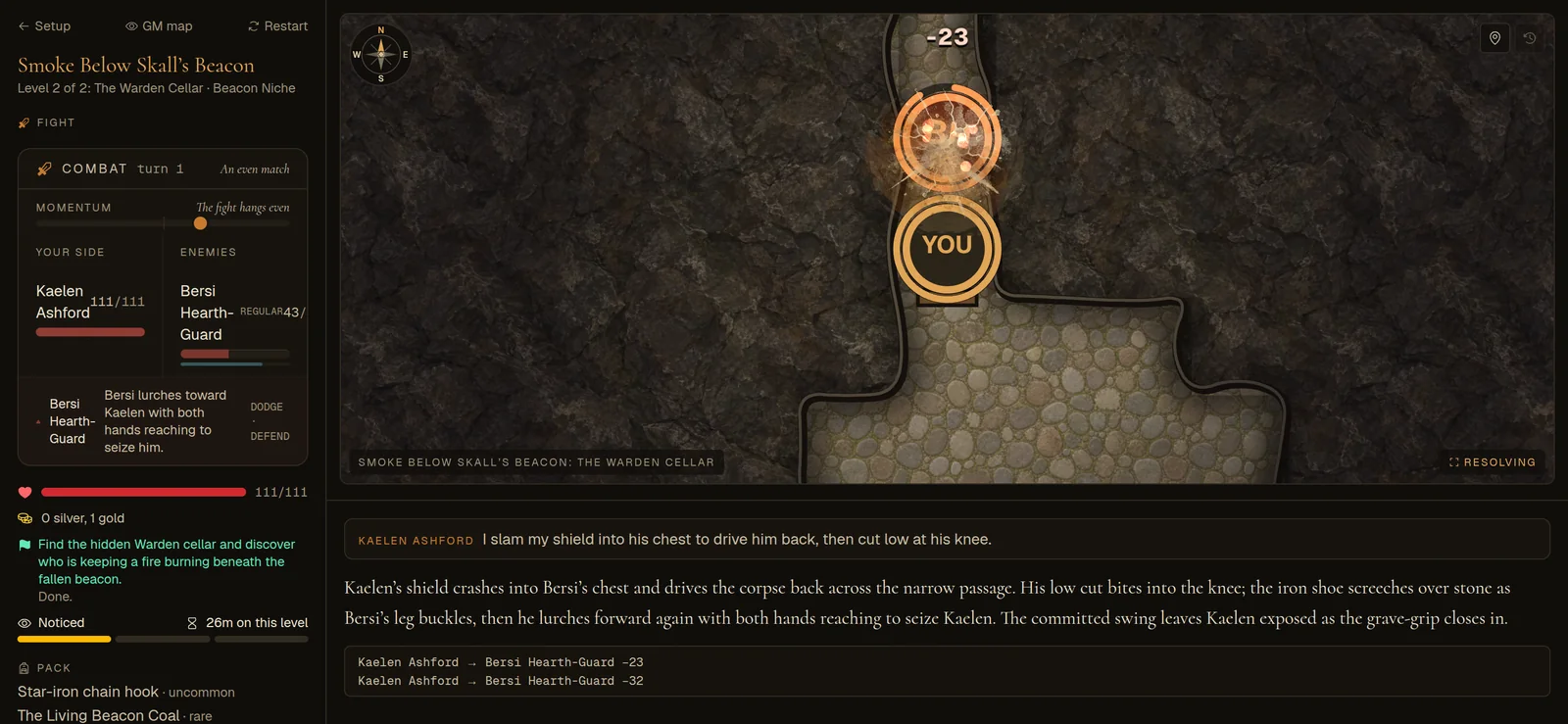
When it comes to blows, the fight is an ordinary one on the battle map, drawn from the dungeon level itself, with the room's real occupants on their squares (and any hunters who found you). Everything in Fighting applies. Winning clears the room for good. Engine
Treasure, rest, bargains and company
- Treasure is named. No loot tables: what lies in a room, or in someone's pack, was decided when the dungeon was made, and taking it gives you exactly that. Engine
- Rest. Some rooms are somewhere to rest. It heals some wounds, and time passes for the things that live there. Engine
- Bargains. A shrine offers something and names its price before you agree: a safe way through the level, for the warmth of your hands. Accept or refuse. Engine
- Companions come with you. Anyone following your character walks beside you, gets a word in at doorways, can scout ahead, and can be the one who pays a cost. Engine
Leaving, coming back, and death
- Walk out through the entrance to be back at the landmark on the world map. Stairs take you between levels.
- Your run is your own and is kept: come back and it's as you left it. A room you cleared stays cleared. Engine
- If the builder redraws or edits the dungeon, a run started on the old version starts over on your next visit, with a line saying the place has changed. Engine
- Undo last turn is off inside a dungeon, for now. Engine
- The world's usual rules on falling and death apply. See World rules.
Building: digging one under a landmark
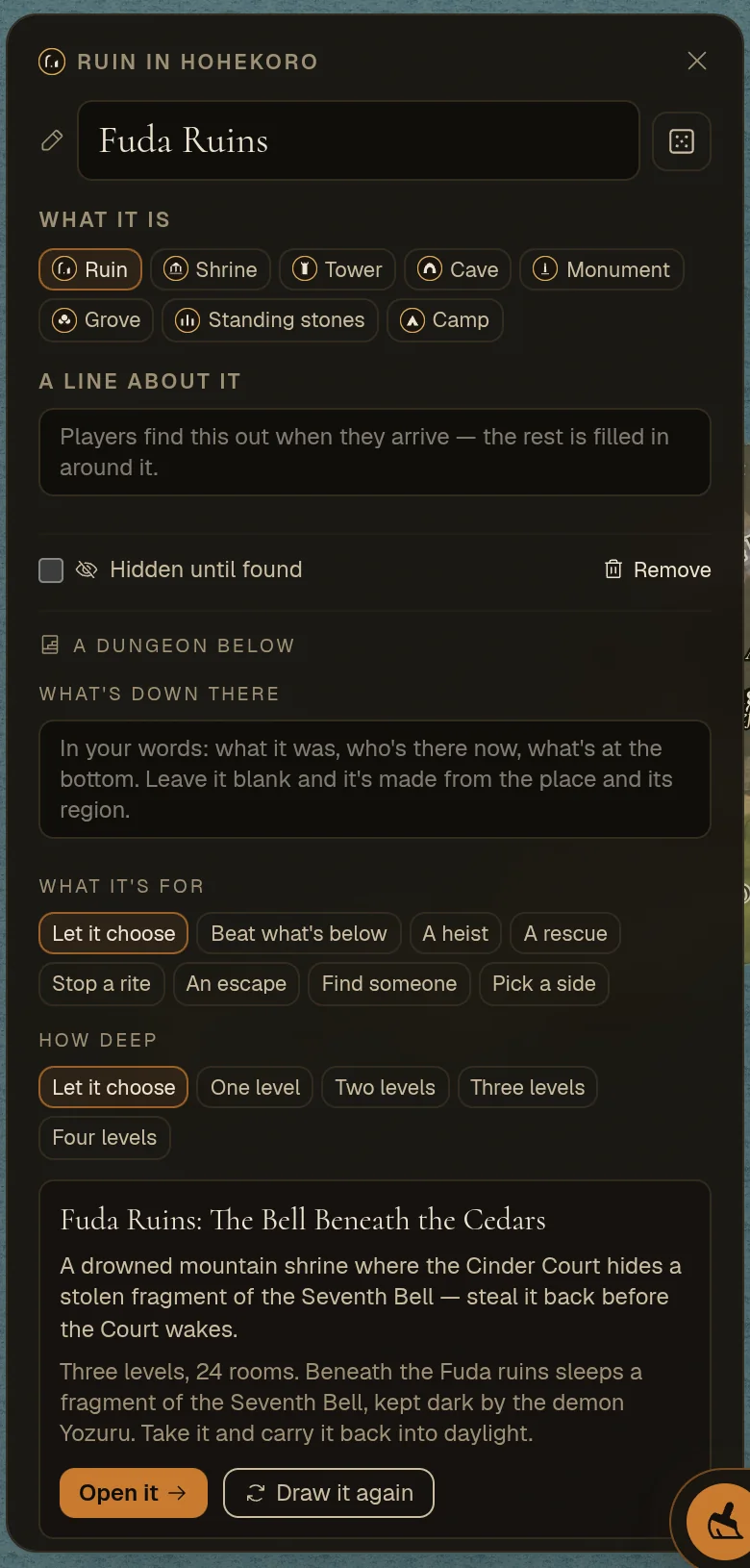
In the Studio's Map tab, click a landmark, then Dig a dungeon under it. You say three things, all optional:
- What's down there, in your words: what it was, who's there now, what's at the bottom. Leave it blank and it's made from the place and its region.
- What it's for: one of the goals above, or Let it choose.
- How deep: one to four levels, or Let it choose.
Draw it now designs it from your world's own material: the place and its region, their history, your peoples and creatures, your cast. It takes about two minutes and carries on while you work. Or don't: a planted dungeon nobody drew is drawn when a player first heads there. Storyteller
Every design goes through the checker before it's kept. If the AI's draft can't be finished, it gets the problems in plain words and one try to fix them. If it still can't, nothing is kept: the card says what went wrong and you can try again, and a player who arrives meanwhile gets a dungeon dealt from Worldtable's own stock of rooms rather than waiting at the door. Engine
When it's drawn, the card shows its name and pitch, how many levels and rooms it has, and its goal, with Open it and Draw it again. Drawing it again starts over anyone who has been inside.
Building: the dungeon editor
Open it shows the whole dungeon: each level's map in GM view (every room, foe, lock and the goal), and beside it, in words, everything it's made of. Click a room on the map to edit it.
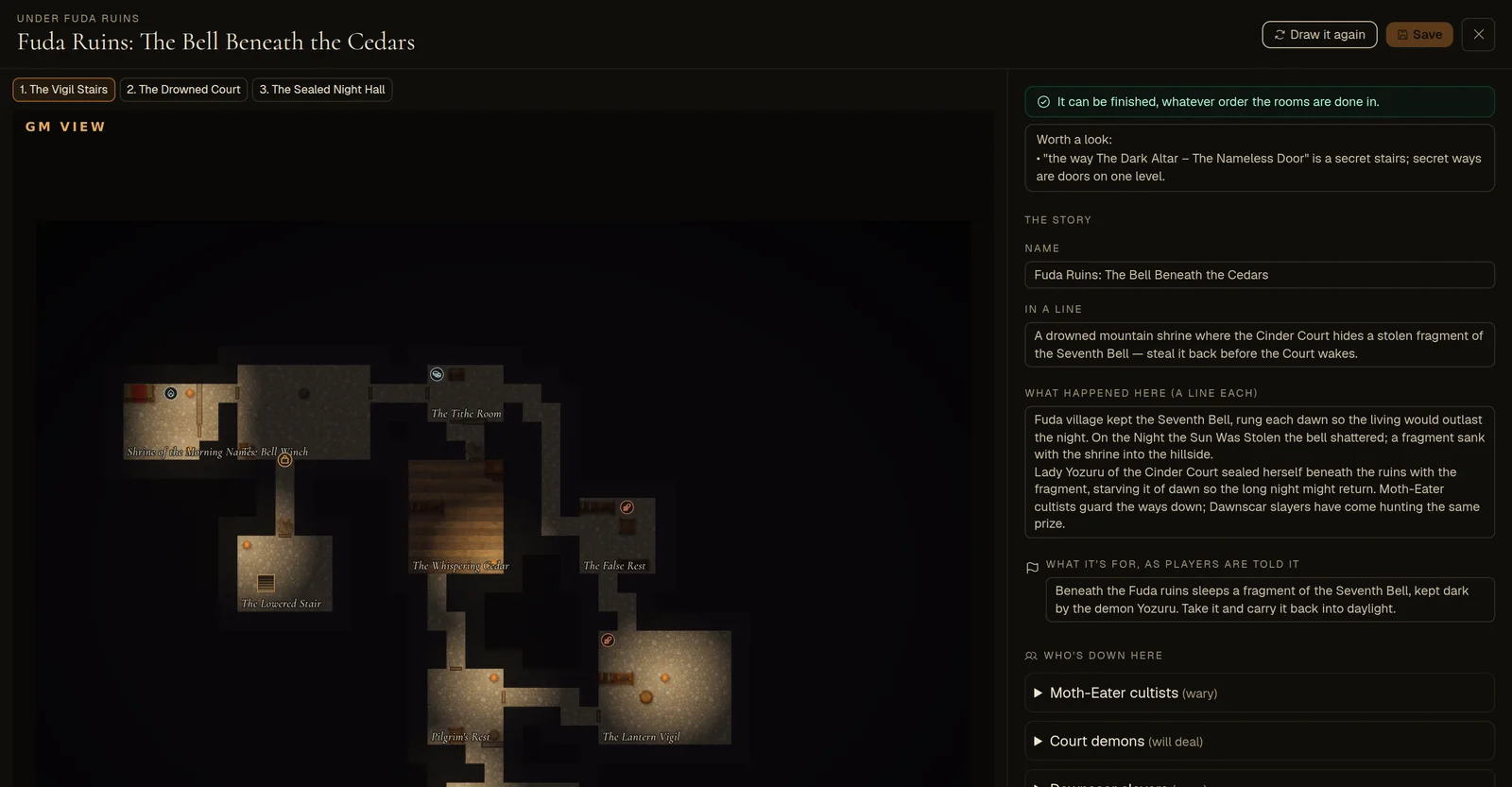
- The story: name, a line, what happened here, the goal as players are told it.
- Who's down here: peoples (look, how they sense things, what they want and fear, whether they talk) and named persons (what they carry, where they are).
- Rooms: what kind, what it is and how it works, who's in it and how dangerous, what's lying there, a trap or puzzle and its answer.
- Ways through: each way between rooms as a sentence, and what stands in it: a lock, a seal, a lever, hidden, one way.
- Triggers and clocks: their words, as players will read them.
The checker and the layout run in your browser after every change. Problems are listed in names and marked on their room; Save waits until there are none. A structural change (a new room, a removed way) lays the level out again. Saving starts over anyone who was inside. Engine
Room kinds
| Kind | What it is |
|---|---|
| Quiet | Nothing to deal with: atmosphere, maybe a small find |
| Guarded | People holding it: talk, bribe, sneak or fight; blocks the way on |
| Patrolled | People passing through on a round; blocks |
| Ambush | People hidden and waiting; nothing looks wrong from the door |
| Lair | A beast, often asleep; can be left alone |
| Two sides fighting | Two groups at each other right now |
| Hazard | Ground that costs to cross: a chasm, water, rubble |
| Trap | A mechanism with a tell; blocks |
| Puzzle | A riddle or mechanism with an answer; often beside the sealed door it opens |
| A captive | Someone held, to free |
| Someone to deal with | A leader who wants to talk; blocks |
| Rivals | Other delvers after the same thing |
| Treasure with a catch | Say what the catch is in the truth |
| Shrine | A power that offers a bargain for a price |
| Somewhere to rest | Heals; time passes |
| Something to learn | Teaches a clue on walking in |
| Hidden vault | Treasure behind a secret way |
| Setback | Something goes wrong on walking in |
| Mechanism | A lever, winch or sluice that opens a way elsewhere |
| A rite under way | To be broken, often against a clock |
| A sight | A view: the goal across a chasm, a mural of what's below |
| The one at the bottom | Settled only by a fight |
| Where the prize lies | The thing at the bottom |
| The way in | One, on the top level; the way out too |
| Stairs | A room with the way down in it |
Writing how a room works
This is the field that matters most. The storyteller judges every idea against it, so write what a clever player could use: what the occupants notice and what they don't, what they want, what they fear, what's fragile, flammable, rotten or loose. “Sleeps through noise but wakes to light” makes a different room from “feels warmth through stone”. A people's senses apply to all of them, everywhere in the dungeon.
Building: asking Hob
Hob, the Studio's helper, can dig a dungeon under a landmark, have it drawn, read it, and change it from a description: “add a drowned chapel off the beacon ring, with a priest who keeps the store key”. It edits rooms, ways, people, items, clues and trigger words. Every edit goes through the checker; one that would make the dungeon unfinishable, or cut a room off, is refused, and Hob tells you why in names. Engine
Building: letting the story find its own
The Rules tab has The story finds dungeons of its own: Never, only mine, Rarely, Now and then or Often. Beyond the dungeons you dig, the storyteller may then open one when play leads underground, under a wild place the story made. Code holds the pace: a few per region at most, and a while between finds for each character. Such a dungeon is designed and kept exactly like yours. Engine