
Features
AI RPG battle maps
Describe your move in words. A model grades it for tactics and risk, the engine rolls, and code works out where everyone stands and what every blow did before the narrator writes a line. Enemies show their attacks a turn ahead, so stepping out of the way works.
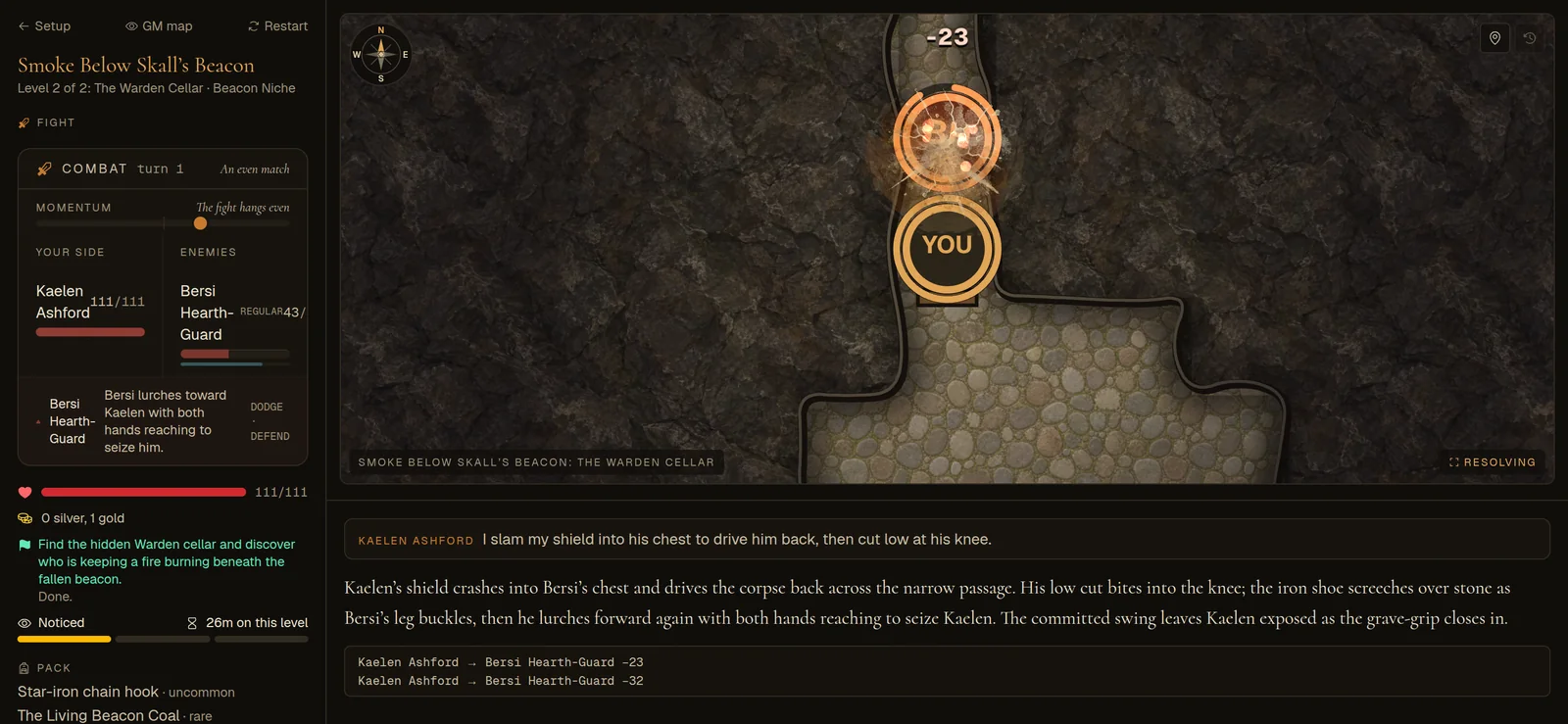
The game's own battle map, playing a scripted turn in your browser. No AI was asked.
A fight, turn by turn
Every single-player fight gets a map, indoors and out. The map is the place you're in: a tavern fight happens around that tavern's tables and doors, and a roadside ambush gets the road, the trees and the river by the bridge. A turn goes like this.
- You write what you do. “Shove him off the bridge.” “Step back out of reach, then throw the lamp.” You don't pick from a menu. Tap a fighter or a spot on the map to drop its name into your action.
- It's graded. A model reads your action: how good the plan is, how much risk you took, how hard the target is, where you move and which way you dodge. Storyteller
- The engine rolls. The grades become a hit chance, a d100 decides how it lands, and a formula sets the damage. Effort is a currency: pour more stamina or mana into a blow and it hits harder, and leaves you with less in the tank. Engine
- Code applies the ground. Reach, line of sight, cover, chokepoints, a dodge into a wall, a shove into a crate or over an edge, a blast you already stepped out of, a run for the exit. Engine
- The map plays, then the prose arrives. Positions and damage are settled first. The map starts playing the turn while the narration is still being written, and the narrator is handed the rulings so its words agree with what you just watched.
- The enemies show their next move. Their attacks for next turn appear on the map, aimed at squares. They land on wherever you end up after your next action. Engine
Why the AI can't hand you the fight
Most AI storytellers decide outcomes by writing them, which means they drift toward whatever makes a nice scene: the lucky dodge, the villain who misses, the wound that's gone by the next paragraph. Here the storyteller's job in a fight is to judge your plan and describe the result. It doesn't get a vote on the result.
- Damage is applied by the engine. On a battle map the storyteller's own damage and kill calls are thrown out and the engine's go in, so it can't skip a hit that landed or add one that didn't. Engine
- The grades are fixed. The roll lands somewhere from CRITICAL (×1.4 damage) through SOLID and GLANCING down to WHIFF and BACKFIRE (nothing, and a blow to your side's momentum). Engine
- Power counts. A far stronger fighter can't do worse than GLANCING against a much weaker one, and a far weaker one can't do better than SOLID. Tiredness costs accuracy too. Engine
- Tone notes don't change it. Asking the storyteller to make a scene grim or lighter changes how it's written, never health, injuries, death or how a fight resolves.
The judgement at the start is still a model's, so a clever plan can be under-rated. But a careful, specific attack lands more often than “I hit him”, and no amount of eloquence turns a miss into a hit. The full numbers are in Fighting.
Enemies announce their blows
An enemy declares its attack a turn before it lands. You see it in the narration and on the map, with a chip for each incoming blow; tap one to see exactly where it falls. Then you choose: dodge, block, parry, get out of the way, or hit first.
- Your defence is rolled once per turn and compared with each attack. A good one turns a blow into a WHIFF or caps it at GLANCING; a botched one makes it land a grade better. Engine
- Moving works. Step out of reach and the maul swings at empty air. A blast hits the squares it was aimed at, not you, if you've left them. Engine
- The warning is a promise. An announced blow shows what it's worth while it winds up, and it can't quietly deal more. If the storyteller forgets an announced attack, code adds it back. Engine
- Some attacks can't be dodged or blocked, and they say so before they land. Covering several attacks with one defence is harder for each extra one.
Enemy abilities
The people and creatures you fight carry their own kit, and their moves come from it rather than being made up on the spot. The storyteller chooses what an enemy attempts; the dice decide whether it works.
Enemies play by the same map rules you do. A heavy blow, a charge or a tail sweep can shove you, throw you or drag you in: into a wall and you're slammed, over a drop and you fall, into deep water and you flounder. How strong they are is held by the world: a builder sets how dangerous each figure in the cast is, and a ceiling on the most dangerous thing the storyteller may ever create. Engine
The ground remembers
- Things break. Throw someone through a cart and the cart is wreckage. Wreckage inside a building stays for an in-game day, so come back that night and the tables are still smashed. Engine
- Spells change the ground in a world with magic. Fire leaves the floor burning, ice walls block a charge, roots pin people in place, and smoke, thorns and frost stay on the squares where they landed.
- Your companions fight beside you on the map.
- It looks hand-painted. The map is ink and watercolour (or a darker table style, where the same art glows), and every slash, spell and step is painted in the same style, then fades like drying paint.
Fights inside a dungeon are ordinary battle-map fights too, drawn from the dungeon level itself.
On a phone, and on a desktop
Phone
The map is a strip across the top of the story, about a quarter of the screen. It keeps you, the nearest enemy and any blow aimed at you in frame, grows while a turn plays and settles back when it's done. Tap a fighter or a named spot to put its name in your action, without the keyboard jumping up over the map; tap anywhere else to open the map full screen.
On iPhones and in Safari, the still parts of the map are drawn once into a single picture, and only the fighters and effects move on top, so a fight stays smooth. Worldtable runs in the browser and can be added to your home screen like any other app.
Desktop
The map sits above the story while a fight is on, so the board you read to choose your move is right over the words that describe it. Drag its bottom edge to make it bigger or smaller.
What a world's builder decides
If you build a world in the World Studio, these rules shape every fight in it. You pick them in words, and the engine holds the storyteller to them. Start from a feel (Heroic is forgiving, Grim is harsh) and change only what you want different.
- When a hero falls Engine
- They die for good, or they're beaten and wake later. Plus how long others have to save a fallen hero: moments, hours, half a day, a full day or days.
- Aim Engine
- Heroes' base chance to hit, from shaky to unerring, and enemies' aim, from clumsy to relentless.
- Can the weak hurt the strong? Engine
- Not two ranks up, not four ranks up, or any blow can land. Past the gap, nothing the weaker side does lands.
- Reaching past your limit Engine
- Pushing past your stamina or mana on purpose can kill, can maim but never kill, or only tires you.
- How much a hero can take Engine
- Health for a given strength, from fragile to tough as oak, and how much magic adds to a caster's.
- The most dangerous thing Engine
- From rabble and footsoldiers up to cataclysms. Nothing the storyteller creates, your cast included, can be stronger.
- Companions Engine
- How many companions can follow one hero, from none to any number.
Every choice is described in World rules.
What it doesn't do yet
- Group fights have no map. A battle map is for a fight with one player in it. When two or more players fight together, the fight is graded and rolled the same way, without the board.
- It's for fights. Outside a fight there's no outdoor board to walk around. Dungeons have a map of their own to walk.
Questions
- Is there an AI RPG with a battle map?
- Worldtable has one. Every fight with one player in it plays out on a map of the place you're in: a tavern's tables and doors, a road with the trees and the river by the bridge, a cave, a pier. You write what you do in plain words, the engine rolls it and works out where everyone ends up, and the map plays the turn while the narration is written.
- Is combat turn-based?
- Yes. Each turn you write your action. It's graded, rolled and resolved, then the enemies announce what they'll do next, and those blows land on your following turn. Each turn waits for your action, and turns run in the background, so you can close the tab and come back to the result.
- Can I lose a fight?
- Yes. The engine rolls, and it isn't rooting for you. At zero health you're downed, and someone has to stabilise you before a clock runs out. What happens then is the world's rule: in some worlds the hero dies for good, in others they're beaten and wake later, barely alive.
- Does the battle map work on phones?
- Yes. On a phone the map is a strip at the top of the story that keeps you and the nearest enemy in frame, and grows while a turn plays. Tap a fighter to put their name into your action, or tap anywhere else on the strip to open the map full screen. Worldtable runs in the browser and can be installed to your home screen.
- Can I fight with friends on a battle map?
- Not yet. Battle maps are for fights with one player in them; your companions stand on the map with you. When two or more players are in the same fight, it's graded and rolled the same way, without a map.
- Does the AI decide who wins?
- No. A model reads your action and grades the plan, the risk and the target. After that it's code: the grades become a hit chance, a d100 settles the outcome and a formula sets the damage. On a battle map the storyteller can't apply damage at all; the engine does, and the storyteller only describes it.
Build a world and see it run.
Six questions get you a drafted world in a minute or two. Building is free, and your first $1 of AI is on us.