
Features · Dungeons
An AI dungeon crawler where the dungeon is real
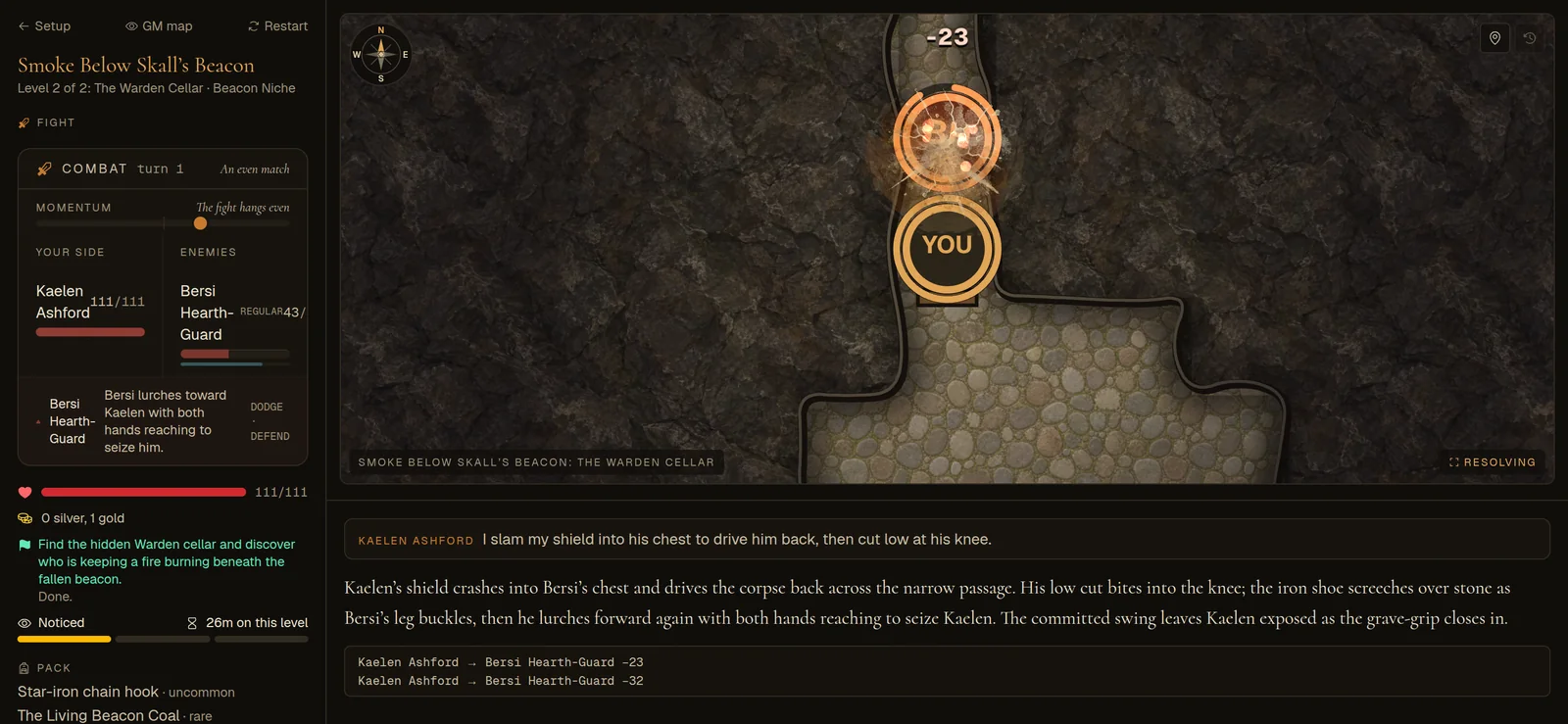
Under some landmarks there is a way down. You walk it on a map with the character you already have, and when something is in the way you say what you do, in your own words. Every room, door, key and occupant was decided before you arrived, and the game keeps them.
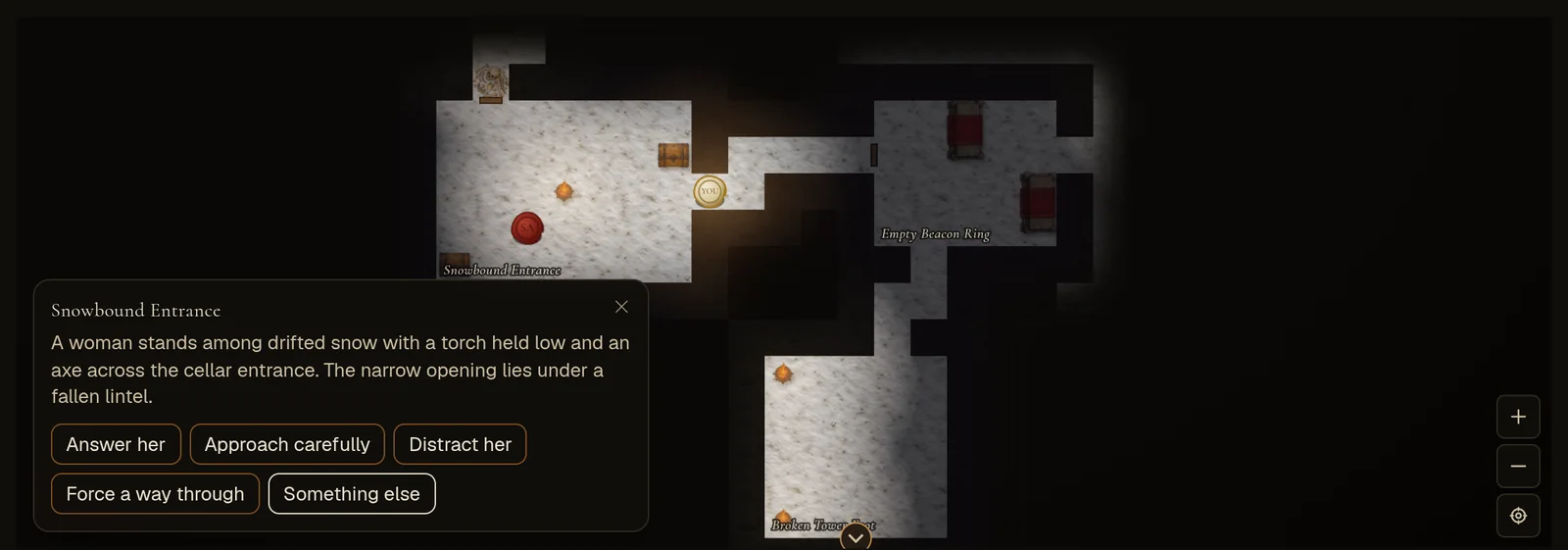
A place, not a prompt
A dungeon in Worldtable is a real place under a landmark on the world map. It's played through the same turns as everywhere else, by the same character: your health, your pack, your powers, your companions. You walk it on a map, the fog lifts as you go, and rooms you've cleared stay cleared.
The split between game and AI is sharper here than anywhere else. The game holds what the place is. The storyteller judges what you try and tells it well.
| What | Kept by |
|---|---|
| Every room, door, stair and secret Engine | Laid out once, the same for every player and every visit |
| Who is down there and what they carry Engine | Real characters with real packs. If the warden has the key, robbing the warden gets you the key |
| Whether it can be finished Engine | A checker proves it before anyone plays: every lock has a way through and nothing strands you |
| Where a free walk stops Engine | Code walks you, and stops you at anything that needs the story |
| How well your idea went Storyteller | Judged against how the room really works |
| What that outcome costs Engine | Priced when the room was made, applied by code |
Everything decided before you arrive
When a dungeon is made, everything about it is settled at once: the rooms and how they connect, the doors and what locks them, the keys and who carries them, the secret ways and the tell that gives each away, the peoples who live there and how they sense the world, and the treasure in every room and every pack. Engine
- No loot tables. What's in a room or in someone's pack was named when the dungeon was made, and taking it gives you exactly that.
- Written once. Room names and what you see from each doorway are written before you reach a level, then never change.
- Provably finishable. Before anyone plays, a checker searches every way through and proves there's no lock without an answer and no drop that strands you.
- One goal. Each dungeon has one, shown on your panel and marked done when it is: beat what's below, pull a heist, rescue someone, stop a rite, escape, find someone, or pick a side.
Finding one
- Look for the steps. A landmark with a dungeon under it has a small “steps down” badge on the world map, and its card says There is a way down here, with how many levels deep. Go there and head down. Engine
- Or follow the story underground. If the world's builder allows it, a sinkhole or a cellar under a ruin you found can open into a dungeon of its own. It only happens under wild places the story made, never in a town or under a builder's landmark, and code limits how often. Engine
Click to walk
Click anywhere on the map and your character walks there: no turn, no waiting on the AI. Empty passages and rooms you've dealt with cost nothing. The walk stops on its own when the story is needed, and a note on the map says why: Engine
- at the doorway of a new room with people, a trap, a hazard or something to take;
- at a locked, sealed or barred door, or a room that still blocks the way;
- wherever a patrol is;
- and at every new doorway once the level is roused.
Where it stops, a card shows what you can see from the doorway. Its buttons are ways in, each a whole turn in your own voice. Two are written for your character from your sheet, your powers and your companions, and Something else hands you the action box. Storyteller
Try anything
Every room knows how it works: what its people notice and what they don't, what they want and fear, what burns, what's rotten, what's loose. You never see these notes. The storyteller does, and judges your idea against them, whatever your idea is. Storyteller
- Clean
- Your idea really gets around what matters: unseen by things that look, silent past things that listen, fire on what burns. You get through, even if nobody wrote that option down.
- Costly
- It only partly does. You get through, but you're hurt, or it's heard.
- Botched
- It ignores how the room works. Expect a fight, a fall or an alarm.
What each outcome costs was set when the room was made, and the game applies it, not the prose. Engine Wounds are a share of your health, so they scale with you. A power does only what your sheet backs, and something you learned upstairs, like the words that open a seal, counts.
| Room | Clean | Costly | Botched |
|---|---|---|---|
| People in the way | Past them, or they stand aside | Through, but roughed up, and the noise carries | A fight |
| Trap | Spotted, walked round | A glancing blow | It springs full on you, and it's heard |
| A captive | Free and quiet | Free, but someone heard | The alarm goes up, and the captive doesn't make it |
| A rite under way | Broken before it finishes | Broken, but it lashes back | They turn from the rite to fight |
What the place keeps on you
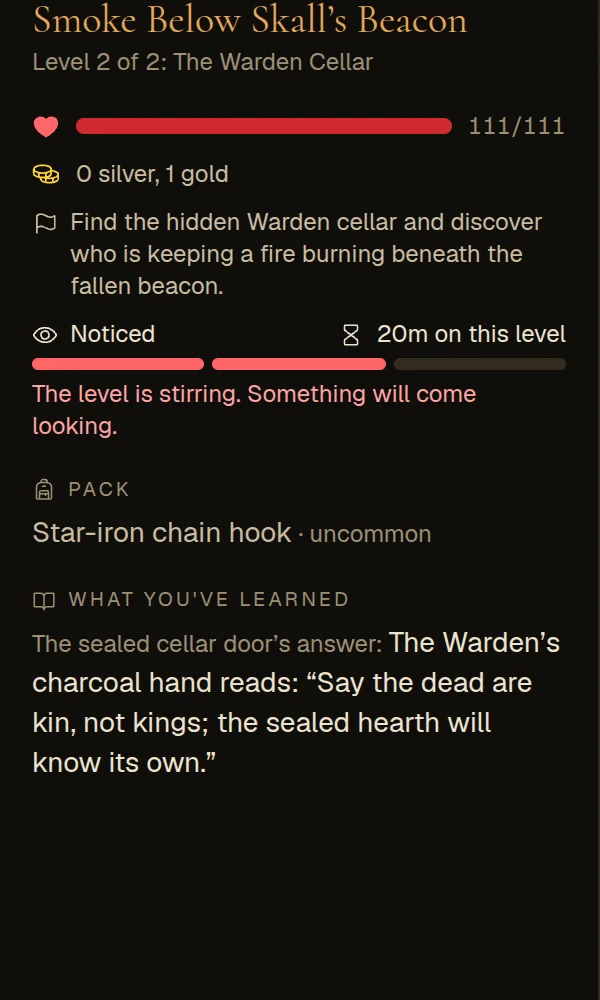
Four things, all kept by code: Engine
- Noticed
- Three marks. Costly or botched outcomes, fights, traps and loud ways of doing things fill it. At two the level is stirring. When it fills, hunters set out for you.
- Time
- Minutes on this level. Every half hour the level stirs on its own: sooner for a loud character, later for a quiet one.
- Health
- Your usual health. A companion can be the one who takes the hurt.
- Your pack
- Torches, rope and potions you use up leave it.
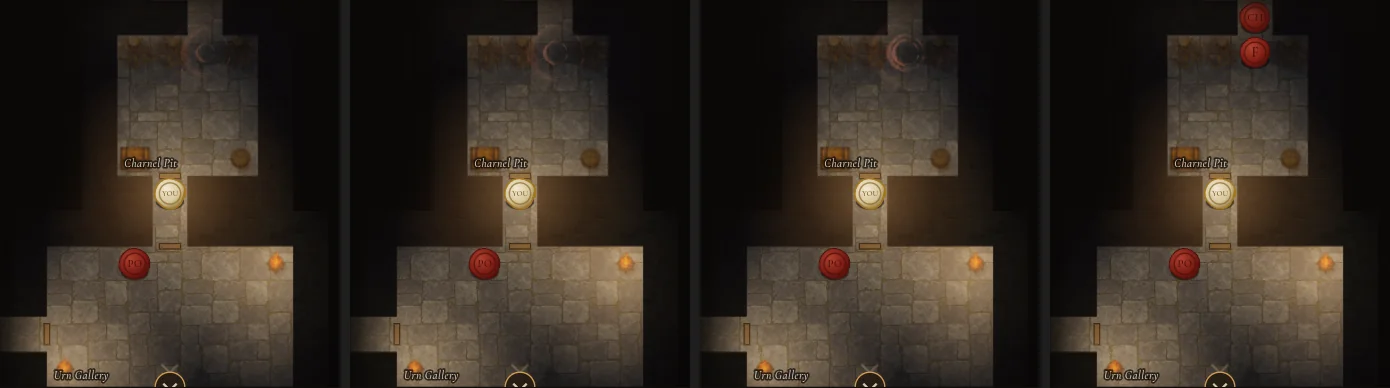
Nobody stands still
- Idle life. Guards pace, beasts shift and settle, bystanders drift.
- The story can move people. Throw something burning into the kindling and a hound that hunts by sight may bolt for it. The storyteller names who goes where; code finds the way and moves them. Someone who leaves a room no longer blocks it. Engine
- Hunters come from the dungeon's own hostile people and close in along the real route. You hear them before you see them: a ripple in the dark, then a red glimmer in rooms you know. When they reach you, it's a fight. Engine
- Patrols walk a fixed round through nearby rooms. Deal with them cleanly and they walk on. Engine
What fools or frightens someone depends on how they sense the world. A mastiff chases a thrown torch. An undead hound that feels warmth through stone doesn't.
Locks, seals and levers
- Keys are things people carry. If the warden has the key, robbing the warden gets you the key. A plain lock can also be picked if you carry picks, or forced, which hurts and is heard. Engine
- Seals have answers, written or learned somewhere before them and kept on your panel under What you've learned. A seal answers to nothing else. Engine
- Levers, winches and sluices open ways elsewhere, sometimes on another level.
- Also: guarded passes, hazards to cross, secret doors with a tell, drops you can't climb back up, and shortcuts that open from the far side.
When the place changes
Take the idol and the level wakes. Free the captive and the warden stirs. Pull the lever and the flood drains. Some dungeons have clocks of their own: water rising, a search party, a rite with three bells. Code fires them, and when something happens out of view the map's camera goes to look. Engine
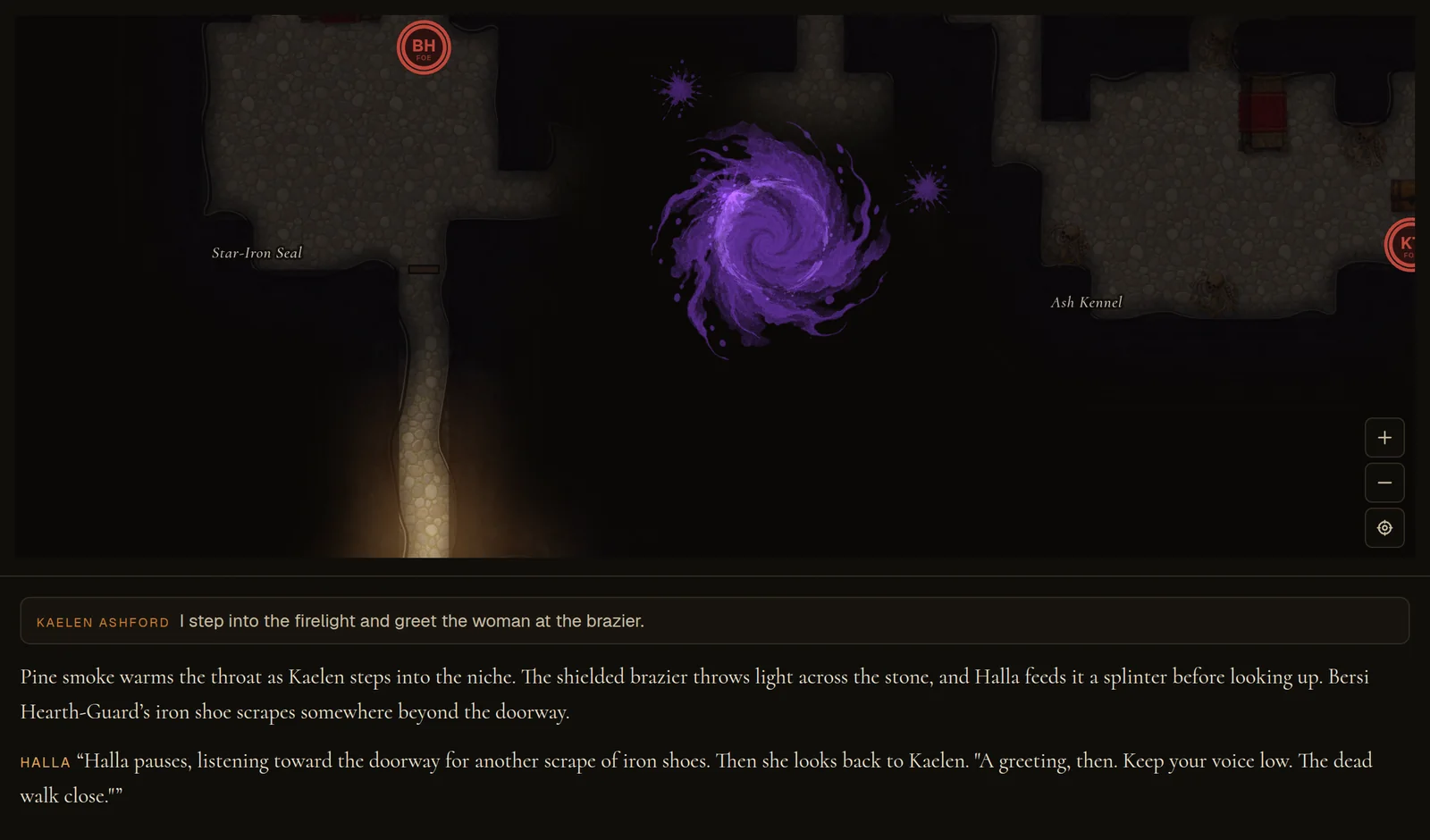
Fights, treasure and rest
- Fights are ordinary battle-map fights, drawn from the dungeon level itself, with the room's real occupants and any hunters who found you. Winning clears the room for good. Engine
- Some rooms let you rest, while time passes for the things that live there. Shrines offer bargains and name the price before you agree.
- Your run is kept. Walk out and come back later, and it's as you left it. Engine
What builders control
In the World Studio's Map tab, click any landmark and dig a dungeon under it. You can say three things, all optional: what's down there, what it's for (one of the goals above) and how deep it goes, one to four levels. Leave them blank and it's made from the place and its region. Either way it's designed from your world's own material: the place, its history, your peoples and your cast.
- Open it to see every level in GM view and edit it in words: the story, who's down there and how they sense the world, every room and how it works, every way through, the triggers and clocks.
- The checker runs as you type, and Save waits until the dungeon can be finished. Engine
- Ask Hob, the Studio's helper: “add a drowned chapel off the beacon ring, with a priest who keeps the store key”. Hob refuses an edit that would make the dungeon impossible to finish, and says why. Engine
- Let the story find its own. The Rules tab sets how often the storyteller may open new dungeons under wild places: never, rarely, now and then, or often. Engine
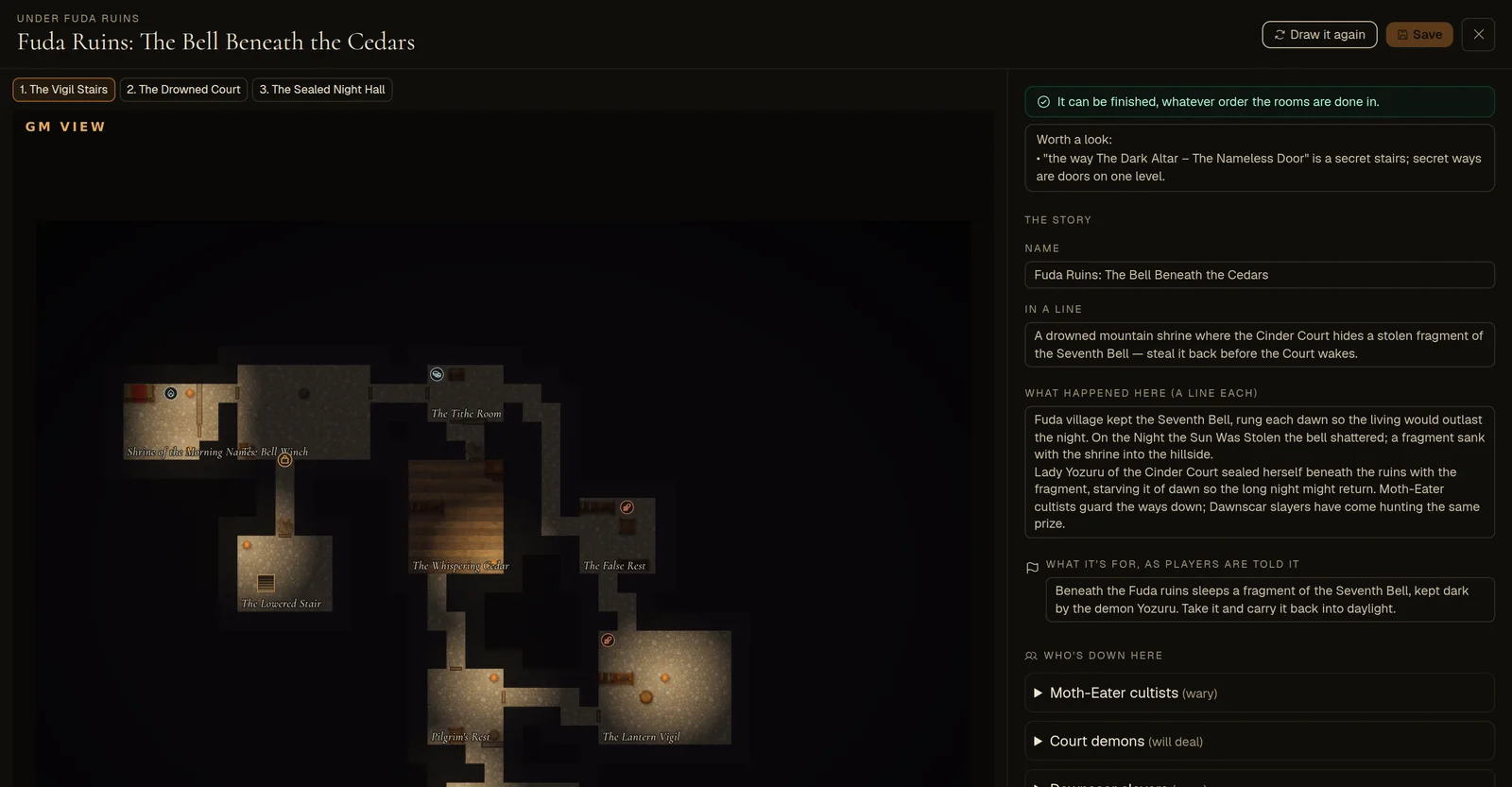
The field that matters most is how each room works. “Sleeps through noise but wakes to light” makes a different room from “feels warmth through stone”, and the storyteller judges every idea against it. Redrawing or saving a dungeon starts over anyone who was inside.
Why not just ask a chatbot for a dungeon?
You can ask any chatbot to “generate a dungeon” and get a good-looking list of rooms. The trouble starts when you play it. The model forgets the locked door it described two turns ago, invents a second key when you ask nicely, lets a good speech open anything, and quietly heals the wound the trap gave you.
| A chatbot's dungeon | A Worldtable dungeon | |
|---|---|---|
| The layout | Whatever the last few messages say | Stored, and the same on every visit |
| A locked door | Opens if the story wants it to | Opens to its key, picks, force or its answer |
| Treasure | Made up when you look | Named when the dungeon was made |
| Getting hurt | Up to the prose | A share of your health, applied by code |
| Can it be finished? | Nobody checked | Proved by a checker before anyone plays |
| Your character | Retyped into the prompt | The one you already play, pack and all |
The AI is still doing what it's good at: reading your idea, deciding whether it beats the room, and voicing everyone down there. For how that works outside dungeons, see an AI dungeon master that keeps the rules.
Honest limits
- A dungeon nobody has seen takes about two minutes to draw on the first visit.
- Quests and the world's other threads wait outside while you're underground.
- Undo last turn is off inside a dungeon, for now.
- Each character's run is its own: friends can't share one run as a party yet.
- The storyteller still judges how well your idea went. It's told how the room works, but that call is the AI's, not code's.
The full guide, for playing and building, is the Dungeons page in the docs. Fights are covered in Fighting, and the world-level setting in World rules.
Questions
- Is there an AI dungeon crawler where the dungeon doesn't change?
- Yes. In Worldtable a dungeon is designed once, checked, and stored. Every room, door, key, secret, occupant and piece of treasure is fixed before anyone plays, and the room descriptions are written once and kept. The AI narrates and judges what you try, but it can't move a wall or add a room. The only thing that changes a dungeon is its builder redrawing or editing it, and then runs started on the old version start over.
- Can the AI make up a key or a door?
- No door: the layout is stored, and on a dungeon turn the storyteller isn't given the tools that make new places. A locked door opens when the game finds the key it names in your pack, when you carry lockpicks, or when you force it, which hurts and is heard. A sealed door opens only to its answer, learned somewhere before it. Keys are named items carried by real people down there, and the storyteller can't bring in a character who isn't there.
- Is it a dungeon generator?
- It designs dungeons, but not on the fly. When a builder digs one under a landmark, or a player is the first to head down, the Studio designs it from that world's own places, peoples and cast. That takes about two minutes. A checker then proves it can be finished before anyone walks it. If the design fails the check twice, nothing is kept, and a player who is waiting gets a dungeon dealt from Worldtable's own stock of rooms instead.
- Do I need a new character for a dungeon?
- No. You go down with the character you already play: the same health, pack, powers and companions. What you use up leaves your pack, what you find goes into it, and you walk back out to the landmark on the world map.
- Can I play dungeons with friends?
- Not as a group yet. Your friends can play in the same world, but each character keeps its own run through a dungeon, so there is no shared party run underground. NPC companions who follow your character do come down with you: they walk beside you, speak up at doorways, can scout ahead and can take a cost for you.
- Is it free?
- Building a world is free, and your first $1 of AI is covered. After that a world runs on its builder's own AI key, so the builder pays the provider directly. Players never pay.
Build a world and see it run.
Six questions get you a drafted world in a minute or two. Building is free, and your first $1 of AI is on us.