Make any game you can imagine
Build a rule system from an idea, write its rules as sentences, bring in a rulebook, or mix it with Worldtable's own engine. Beta.
What if magic cost memories? What if every roll was your luck against your ruin? What if your ship could bleed?
A world on Worldtable can now play by a rule system: stats on a sheet, dice you can see and throw yourself, and outcomes that come from the dice. Or keep Worldtable's own engine for fights and lay your rules on top of it. You can build a system from an idea, write its rules as sentences, bring in the rulebook of a game you already love, or start from one of six ready-made systems. Rule systems are in Beta, and they're open to every builder.
How it plays
When a player tries something risky, the storyteller reads the scene and answers a few questions in words: which skill, how hard, whether anything helps. Worldtable rolls the dice, reads the result against your system's outcomes and applies what they say. Then the storyteller tells the scene, knowing how it went.
- Dice you can see. Every roll leaves a chip in the story with the stat, the check and the total. Tap it to see the full maths.
- Dice you can throw. For big moments the roll waits for the player, who throws their own 3D dice.
- Choices before the roll. A sheet can offer something to spend first, like Inspiration for advantage, or two Stress for an extra die.
Build a system from an idea
In the Studio, open Rules, press Change system and pick Your own system. Answer four questions:
- How does a roll work? Pick from seven ways: beat a number, roll under your skill, a pool read by its best die, dice plus a stat read in bands, counting hits, two named dice where the higher one matters, or stats that are dice themselves (a d6 that grows to a d12).
- Which dice? Add up to three extra named dice to every roll, like a d6 called Momentum or a d4 of Doubt.
- What's on the sheet? Name your stats and say what each covers, then add health and anything a character can run out of.
- What are the outcomes called, and how do fights work?
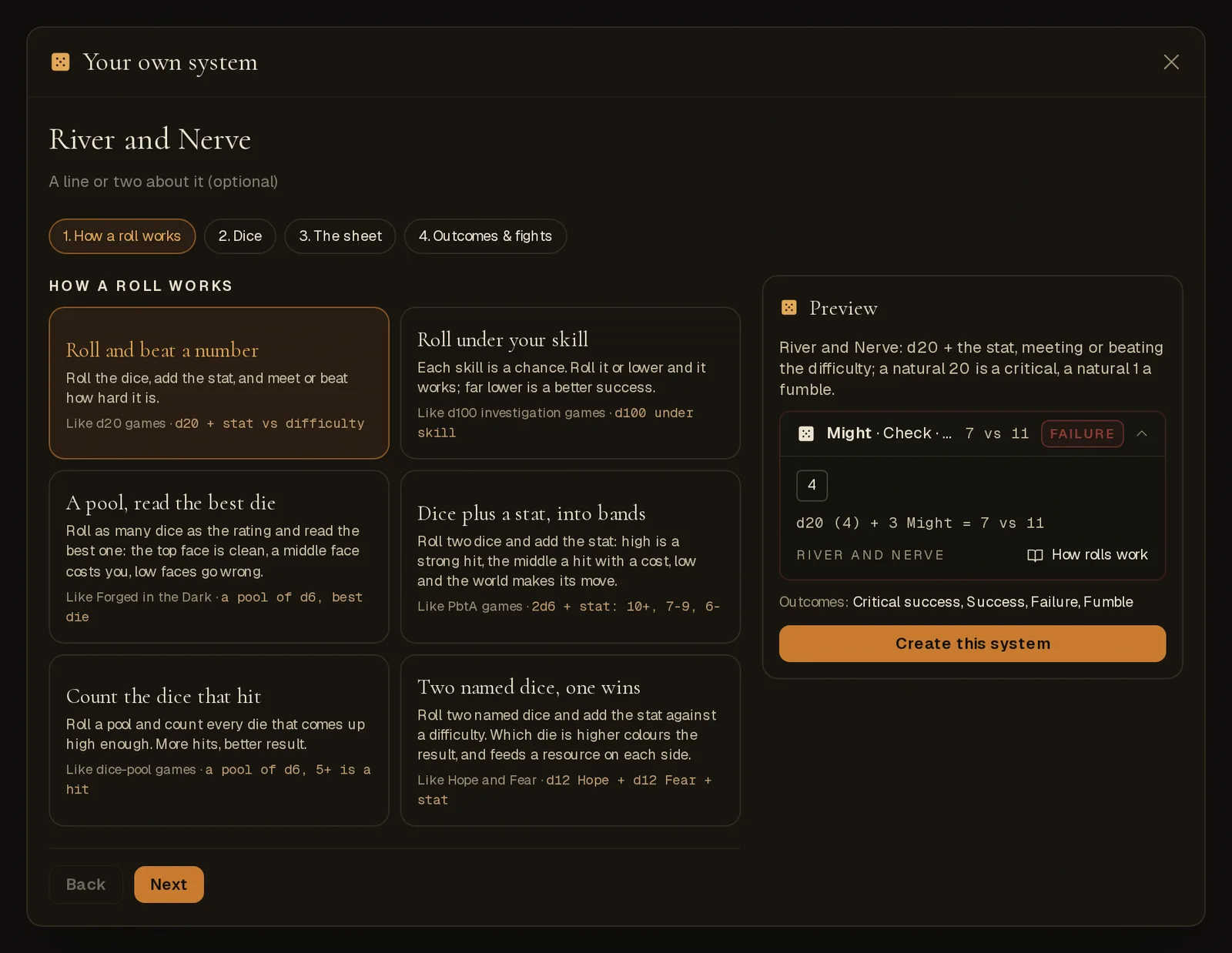
What comes out is a complete system that plays on the next turn. It has a difficulty ladder sized to your dice, outcome bands, fights with turn order (or fights on Worldtable's own engine, below), enemies for every role at every tier, character creation, levelling and a handbook. A preview beside the steps rolls a real sample as you change your answers.
Write your rules as sentences
A rule card is one rule of your world, written as a sentence: when this happens, then that.
- When Luck is higher → Luck +1.
- Before any roll (while Blood-sworn) → advantage; Hit points −2.
- When the Renown clock fills → 100 xp; Known on every contract board.
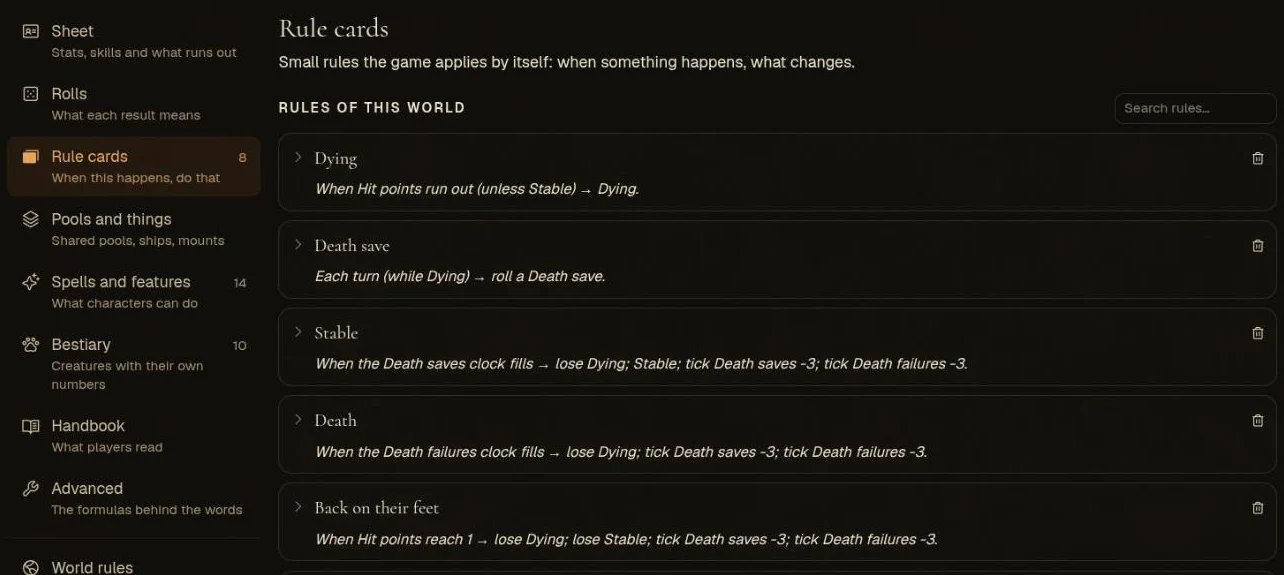
Cards can watch rolls, tracks, clocks, rests, levels, places, people, items, damage and defeated foes. They can also ask a yes-or-no question about the scene: "Did they keep a promise that cost them something?". Some cards act just before a roll or a blow and change it, give advantage or stop it altogether. Cards feed each other, so filling one clock can fire the next card.
Code applies every card, so nobody has to remember them. The storyteller is told what fired, and the player sees it on the roll chip and the sheet.
You don't have to use the editor either. Ask Hob, "when the Current die shows a 6, take a point of Nerve", and Hob writes the card, checks it and shows you the sentence.
Bring the game you already love
Open the Studio's Import & Export tab and drop in a rulebook: a PDF, a Word file, Markdown, text or a saved web page. A core book and its supplements can go in together, up to six at once, and they're read as one book.
Worldtable turns the book into a rule system: how rolls work, then its conditions, spells and abilities, creatures, gear, classes and rule cards. It keeps the book's own words for stats, outcomes and difficulties. Any setting in the book comes out as lore entries you can pick from.
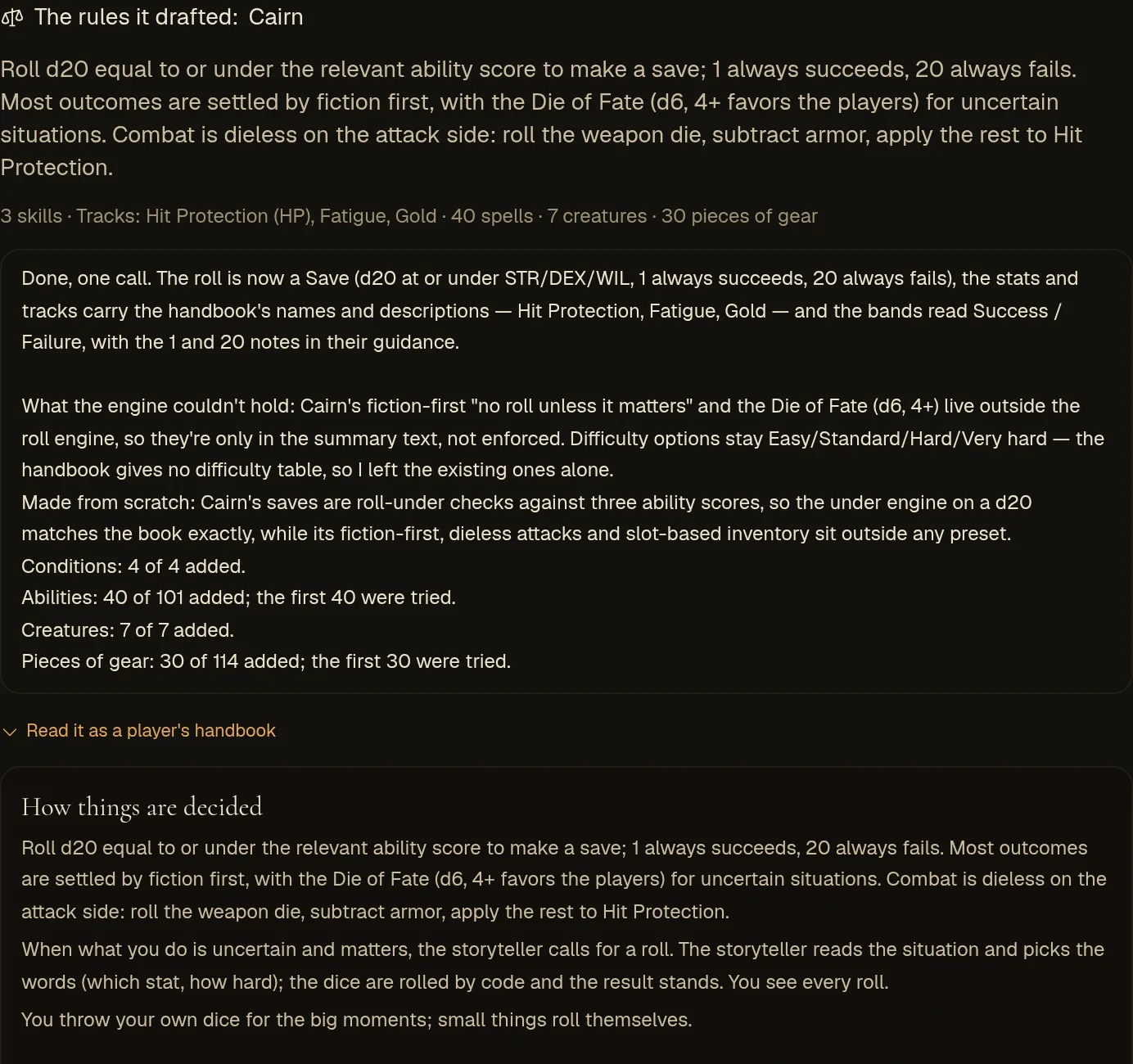
- Nothing is saved until you say so. You read what came across first, and an import can be undone.
- Stand-ins are marked. If the book leaves something out that a system needs to play, like a level table, Worldtable fills it in and marks it as a stand-in. You can keep it or change it. The storyteller never presents a stand-in as the book's rule.
- You see the price first. The Studio shows the most a book can cost before it starts, and gives back whatever isn't used. With your own AI key, it costs nothing.
- Only bring in books you have the right to use. Open licence credits (Creative Commons, OGL, ORC) are kept on the system.
Mix it with Worldtable's own engine
A rule system doesn't have to replace everything. In Rules › Rolls, set Fights are fought to by power, on the native engine, and fights play the way they do in a world without a rule system: power against power, where the gap between the two sides decides who can hurt whom.
- Characters keep their native powers. Strength and magic, stamina and mana, kinds of magic, skills, training and transformations all stay on, and characters grow with levels as before.
- Your system stays on top. Its peoples and their traits, its creatures, tracks, lists and rule cards all still apply, and so do any checks outside a fight.
- Creatures can carry a threat word, from rabble to the end of the world. It sets how strong they are in a fight, past the usual tiers if you want something no new hero can scratch.
- Switch back any time. Fights can move to the system's own rolls again, and each character's health follows on their next turn.
The same update lets any world choose how magic is cast, in Studio › Magic. Magic can be free-form, where a caster can work anything their kinds of magic cover. Or it can come from a spellbook, where casters only know the spells they've learned in the story.
Or start from one of six
Each of these is a whole system, with classes, abilities, conditions, starting gear, foes and a library to add more from:
- Classic d20: fifth-edition style, from the SRD 5.1.
- Forged in the Dark: dice pools and stress, from the Blades in the Dark SRD.
- Moves (PbtA style): 2d6 and a stat, from the Dungeon World SRD.
- Investigative d100: percentile skills, powered by BRP.
- Grim d100: percentile tests in a dangerous world.
- Duality (Hope and Fear): two d12s, written for Worldtable.
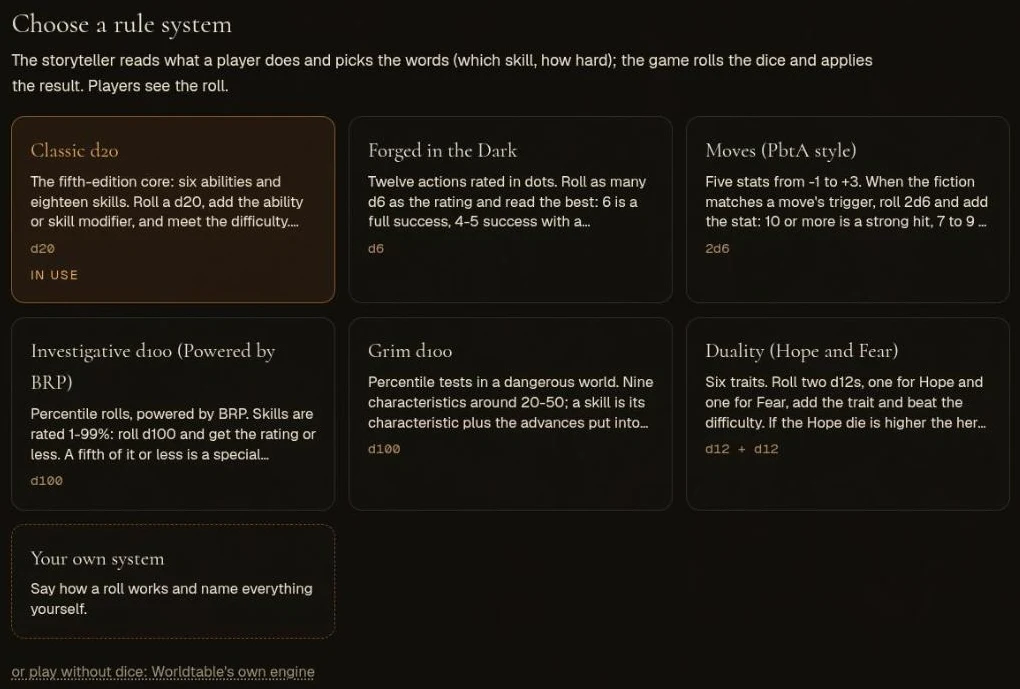
Your world keeps its own copy of the system, so change anything you like.
Change anything, and try it first
Every part of a system can be changed in the Rules tab: rename an outcome, give a track a maximum that grows with level, add a check for saving throws, or edit the formulas underneath. Every edit is checked as you make it.
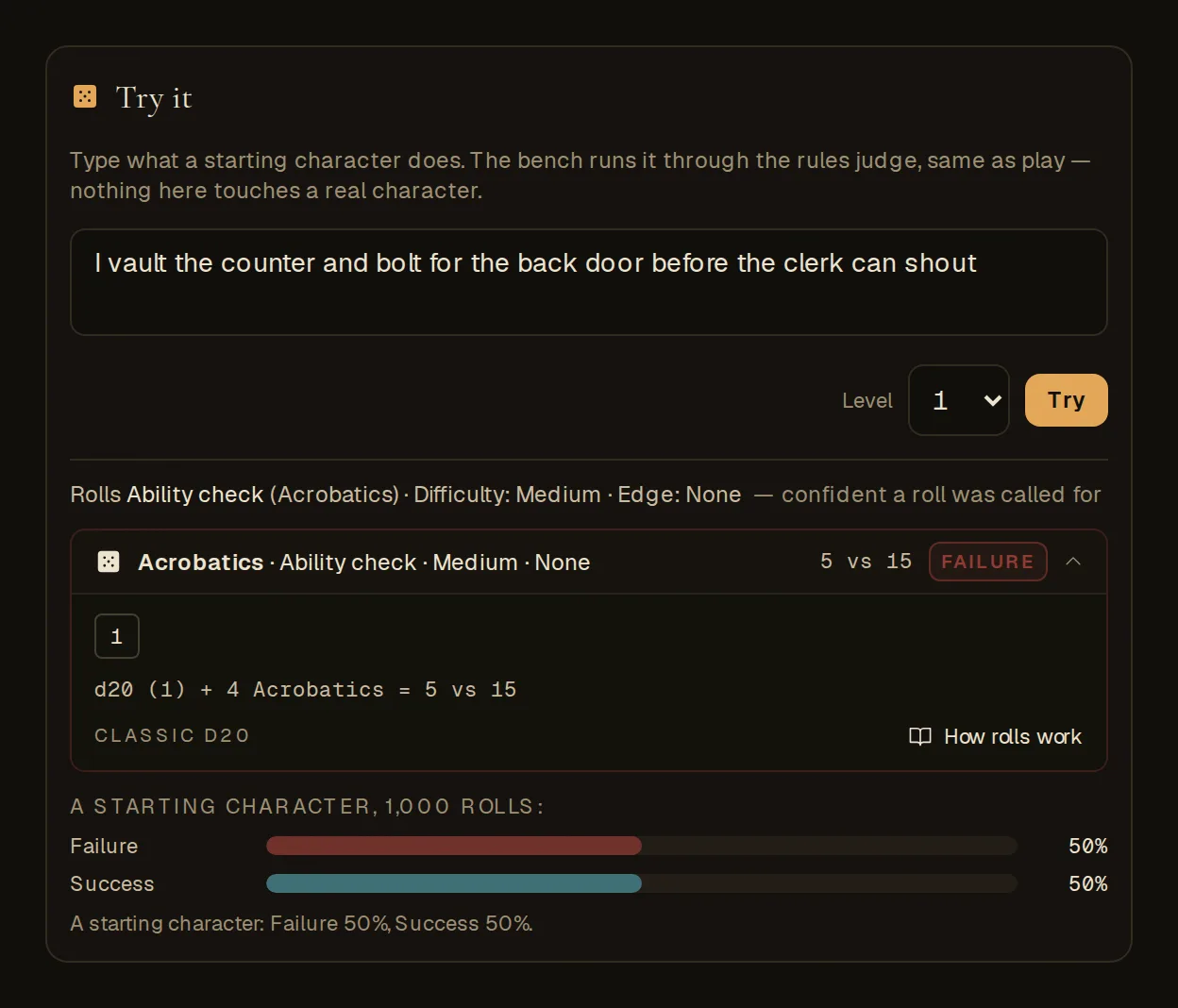
The Try it bench runs a line of play through the same rules as the game, on a starting character. It makes one real roll and shows how a thousand rolls would land, using your unsaved changes.
Every system also writes its own handbook for your players, from its rules, so it can't fall out of date. You can download it from Import & Export.
For players
More and more worlds will play differently from one another: different dice, a different sheet, different ways to win and to lose. If a world you're playing in changes its system, your character keeps its story and gets a sheet under the new rules for you to review.
It's a Beta
Rule systems are new, and some rules are still told to the storyteller rather than enforced by code. Some of what's not there yet:
- Hit locations, where each body part has its own wounds.
- Some fifth-edition class features, like legendary actions and feats. The storyteller is told about them, but code doesn't enforce them.
- A Studio form for conditions and some combat settings (ask Hob for those for now).
If a rule doesn't hold, or a book doesn't come across the way it should, tell us in Discord. A screenshot or the book's name helps.