Worlds with laws of their own
Worlds can now run plugins: small programs that make a world's own laws happen in play. Every official world has one, and Hob writes new ones from plain words.
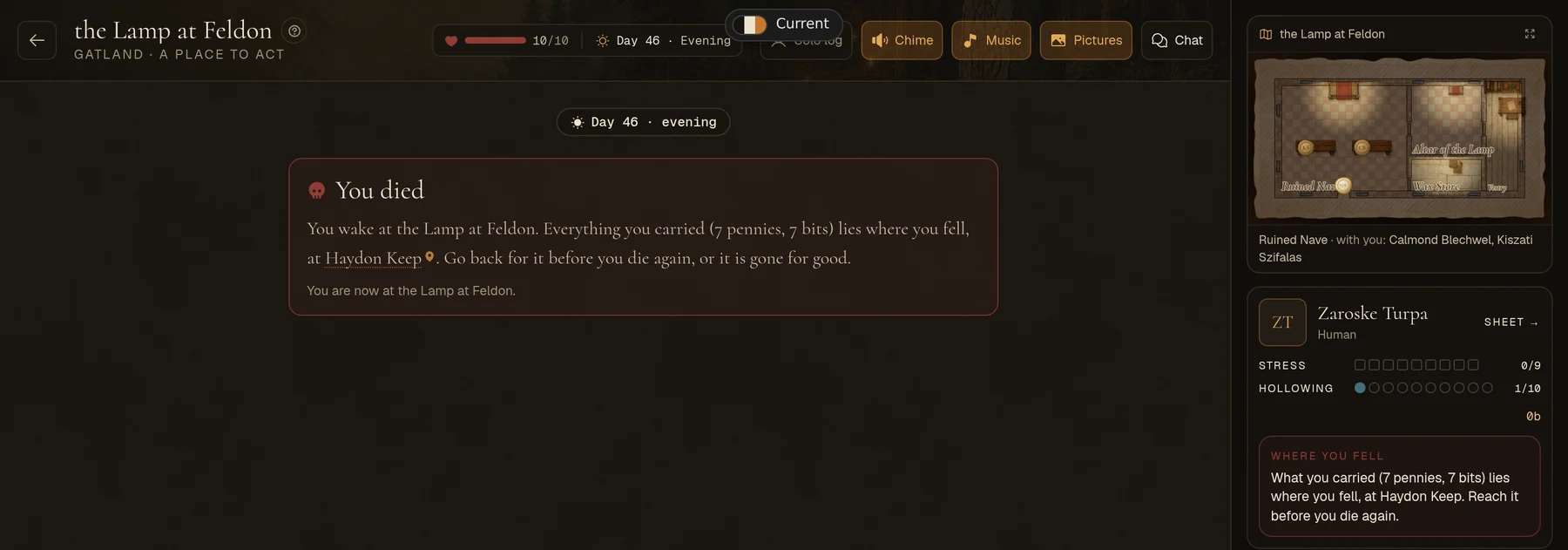
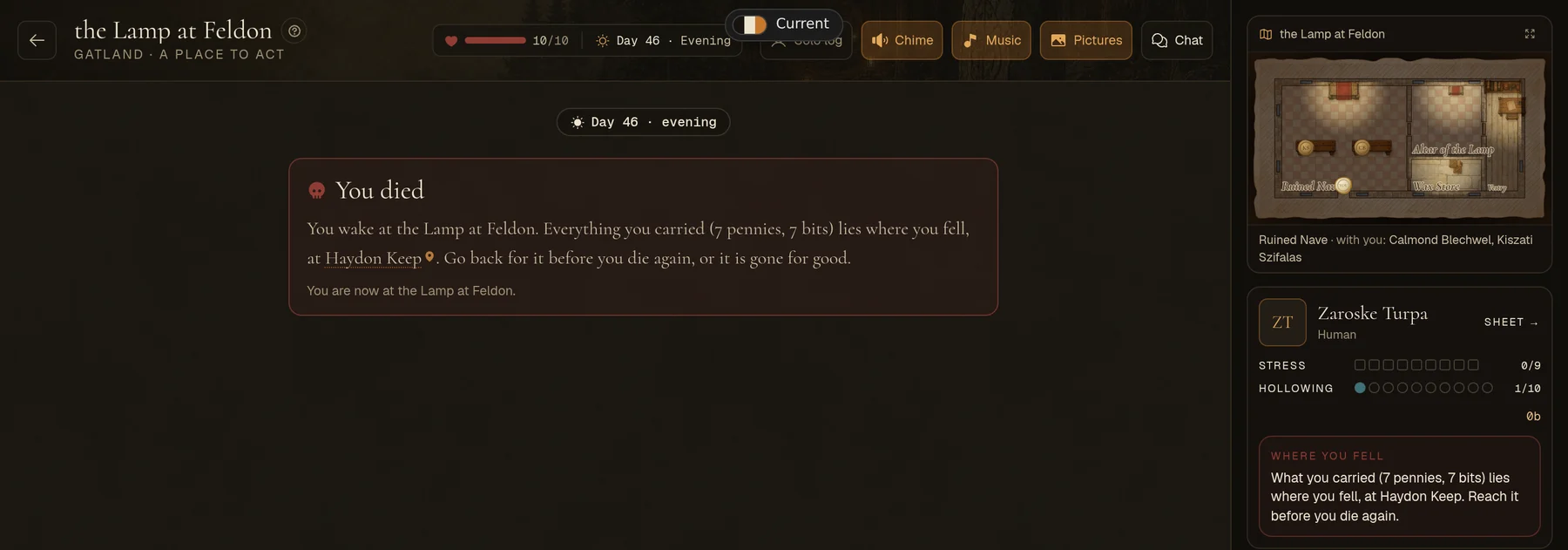
In one world, death isn't the end: you wake at the last Lamp you rested at, and everything you carried is left where you fell. In another, an hour at a fae revel can cost you seven years. In a third, the job board says wolf, and it isn't a wolf.
Rules like these are now real rules. A world on Worldtable can run plugins: small programs that watch what happens in play and make the world's own laws happen, every time, for everyone. Plugins are in Beta, and the official worlds already play with them.
What a plugin does
A plugin listens for moments in play: a character dies, rests, arrives somewhere, takes a blow, wins a fight, rolls the dice, levels up, a new day begins, or a player presses a button. Then it acts:
- Moves things. It can take or give money, move a character, heal them, hand over items, add a status, or turn the clock.
- Asks for dice. It can roll one of the world's checks, or put a roll in front of the player to throw themselves.
- Shows the player. It can put a card in the story with up to four buttons, add a section to the character sheet, mark a place on the map, or keep a board everyone can read, like a tavern's rankings.
- Remembers. It keeps its own records: a stain left where someone fell, a bounty that keeps climbing, the recipes a cook has learned.
- Plans ahead. It can schedule something for days later. The hunters arrive wherever you are by then.
- Changes foes. It can weaken a monster, cripple it, or bring in someone new, named by the world's own name tables.
- Works with other plugins. It can announce a moment of its own ("a bounty was raised"), and other plugins can react to it, or answer back by changing it.
- Tells the storyteller. It hands the storyteller plain facts, like "they woke at the Lamp, their purse is empty". The storyteller tells the scene and keeps to them.
Code keeps the state, so nobody has to remember the rule, and the storyteller can't forget it either.
What changes in the official worlds
Each official world now has a mechanic that's its own:
- Kelister. Death is a setback, not an end. Dying leaves what you carried as a stain where you fell, and you wake at the last Lamp you rested at, at nightfall. Get back to the stain and it's yours again; die first and it's gone for good. Players can also scratch short messages where they stand ("Try fire", "Beware, ambush ahead"), and whoever comes next finds them.
- Telora. Time runs strangely at the fae revels. Leave one and the dice decide how long you were really gone: a night, a week, a season, or seven years. The world shows you what changed.
- Frohland. A button lets five, ten or twenty years pass between adventures. The children you helped are grown, the old heroes are older or gone, and the songs about you get it wrong. Long-lived peoples feel it differently.
- Kryvan March. A monster contract is rarely what the villagers posted. The world secretly decides what's really out there, and the storyteller leaves clues until you work it out.
- Tokura. Every demon was once a person who was wronged. Find its old name and answer the wrong, and it can be released. Kill it unanswered, and something rises there later.
- Yavaria. The first player in the world to beat a named foe, or to reach a place nobody has reached, gets a title no one else can ever hold.
- Hildyard. Every monster you bring down is a choice: cut out its core and sell it, or cook it. Cooking heals you and fills your recipe book, and the tavern keeps a board of who has brought down the most.
- Treva. Your backstory decides your side. Navy characters start at the navy's port, take orders and earn promotions. Pirates start among outlaws, and the bounty on their heads climbs with every deed the navy hears of.
- Cydanas. Your monster's next forms sit on its sheet, with what each one asks of you (eat metal, beat something bigger in a fair fight). Earn one and grow enough, and you choose what you become. And as your notoriety grows, the Surface sends hunters who really do come for you.
Ask Hob for one
You don't need to write code. Open Hob in the Studio and say what should happen, in plain words: "when someone dies, they should wake at the last shrine they slept at, and lose the coin they carried."
Hob reads the plugin guide, writes the plugin and tries it before it ever meets a player. It tests on your own character, or on one it makes up for the test, like a slime that hatched yesterday or a navy recruit. Then it explains what it built in words, not code. When you want a change, Hob edits just the lines that need it.
Every plugin is loaded and checked before it's saved, so one that doesn't run comes back as a problem with the reason, and nothing changes.
The Plugins tab
Everything a world runs is listed in Studio › Plugins.
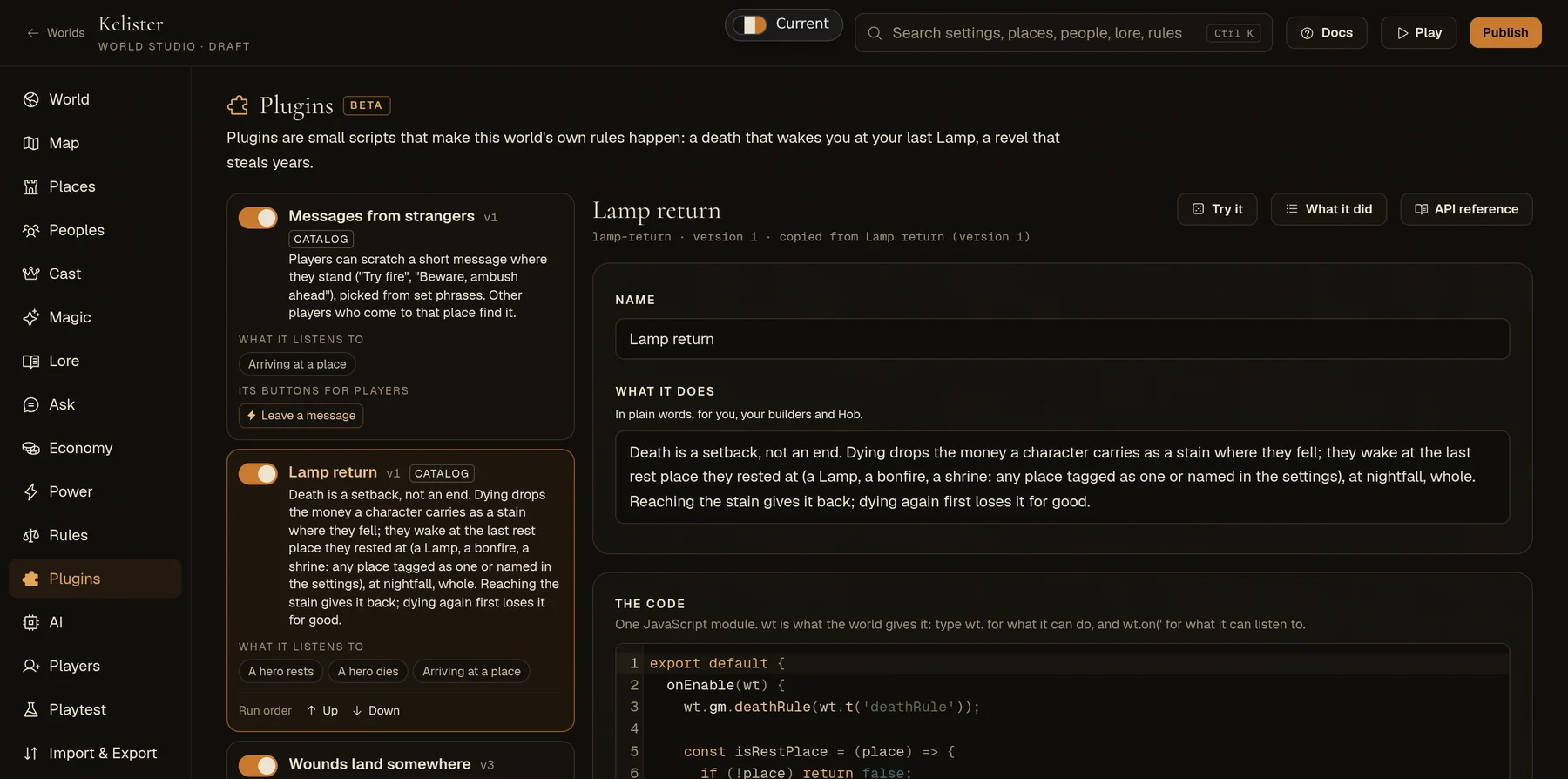
- What each one does. You get a sentence in plain words, the moments it listens to, and the buttons it gives players.
- Settings and words. Each plugin's choices (a tag, a list of names, a number of years) are a form you can change. Every line it shows players can be reworded without touching the code, so a Lamp can become a bonfire and a revel a ghost market. Language editions translate those words too.
- Try it. Run the plugin against a moment on your own character, as a dry run. You see everything it would do, and nothing changes.
- What it did. Its latest runs in play: what happened, for whom, and why it stopped if it did.
- The catalog. Eleven ready-made plugins, one for each signature mechanic above. Add one to any world and rename it to fit.
- The code. For builders who want it, there's a JavaScript editor that completes what a plugin can do as you type. If you build with your own agent over Worldtable's MCP connection, it gets the same tools as Hob.
Plugins work in any world. With a rule system they can also bring their own tracks, conditions, classes and rule cards, like a Hollowing track that rises with each death.
Safe by design
A plugin runs in a sealed box. It can't reach the internet or anything outside the world it belongs to, and it has a strict time budget for each moment. A plugin that keeps failing switches itself off and says why.
It's a Beta
Plugins are new. Some of what isn't there yet:
- Writing your own. For now, writing and changing plugins is open to Worldtable's operators, and it opens to every builder soon. Until then you can open the Plugins tab to see what a world runs, and Hob can read and explain any plugin.
- Undo. Undo can't reverse a plugin's changes yet. If a plugin changed something in a turn, undo refuses that turn and says which plugin it was.
- Party fights. During a party fight's rounds, the start and end of each turn don't reach plugins yet.
If a world's rule doesn't hold the way it says it does, tell us in Discord. A screenshot of the story helps.