A Codex for every world
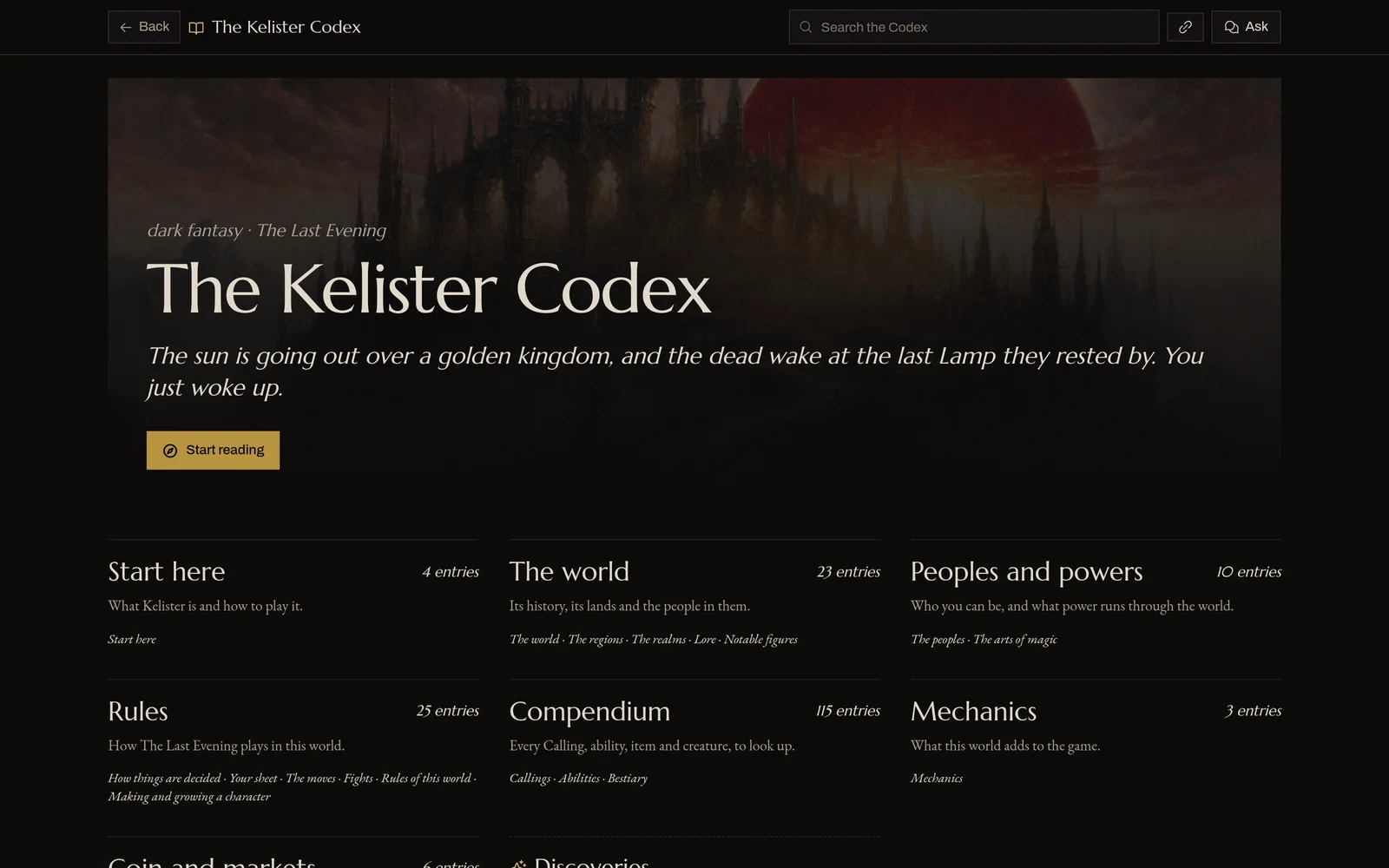
Every world's Codex is now written from the world itself: its lands, peoples, magic, rules, classes, creatures and plugins, with its own pictures, a Game Master to ask, and a link for every page.
The Codex used to be one book, written by hand for Khorvale. In every other world it got a few chapters swapped in, and the rest still talked about Khorvale's ranks and Khorvale's gold. A world with its own dice, its own classes and its own plugins had a Codex that knew none of them.
Now every world's Codex is written from the world itself. It covers its lands and peoples, its magic, its rules down to every roll, and the things its plugins add. Change the world, and the Codex changes with it.
What's in it
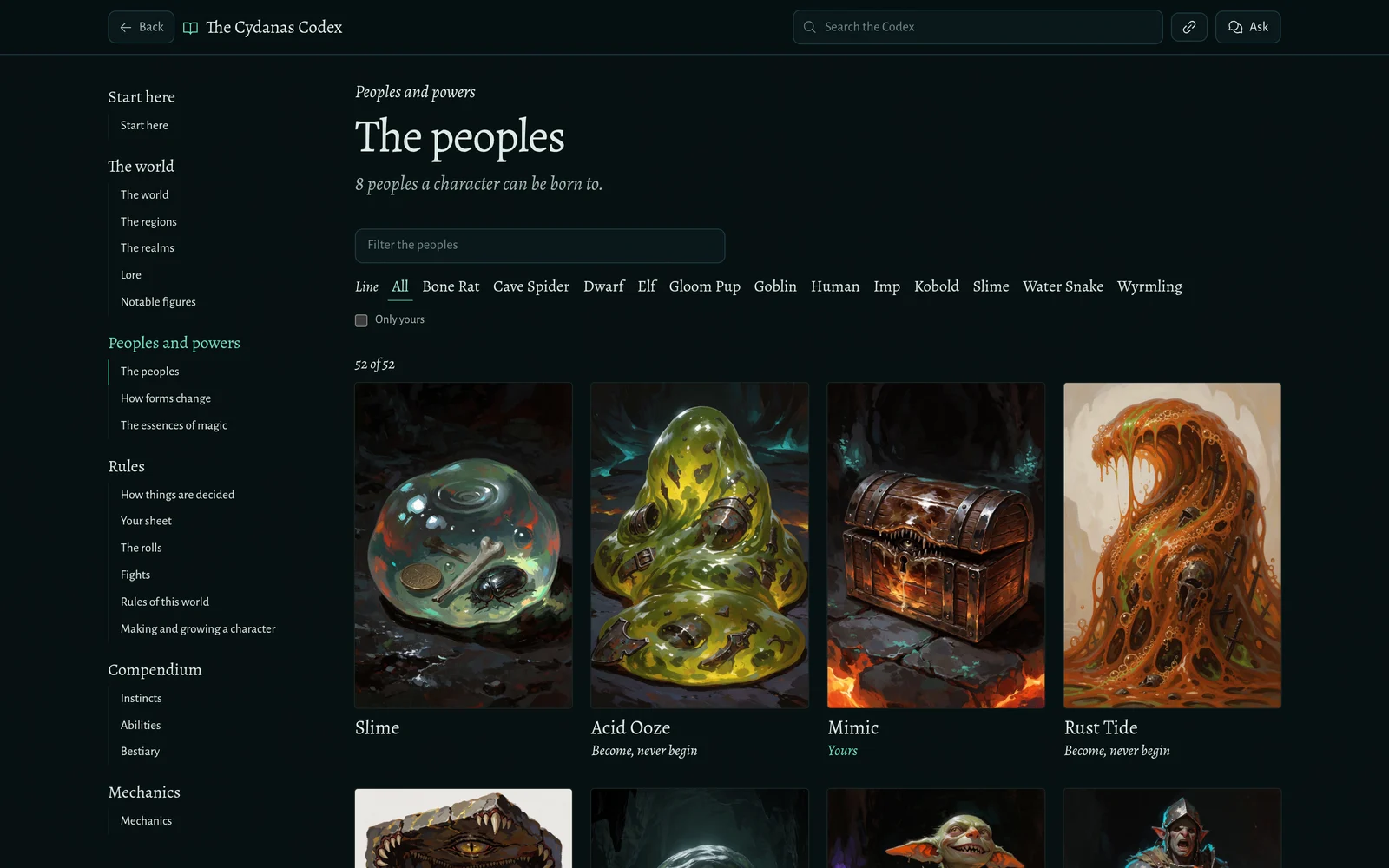
Open the Codex from the map, or from the side of the story while you play. It's sorted into books:
- Start here. What the world is, how a turn works, how to talk to the table out of character, and the table's own rules: whether death is real, how big a party can be, whether players can fight each other.
- The world. Its history, every region (who holds it, what's forbidden there, which magic runs stronger or weaker), the realms beyond, the world's written lore, and its notable figures.
- Peoples and powers. Every people and what they bring under the world's rules, and every school of magic.
- Rules. How things are decided here: your sheet, every roll and what each result means, conditions, fights and growing a character. In a world on Worldtable's own engine, it's the ranks, costs and overdraw as that world has set them.
- Compendium. Every class with what it gains at each level, every ability, item and creature, with filters to find one.
- Mechanics. What the world's plugins do, and the buttons they add to your screen.
- Coin and markets. The world's money, what things cost, and the towns that charge their own prices.
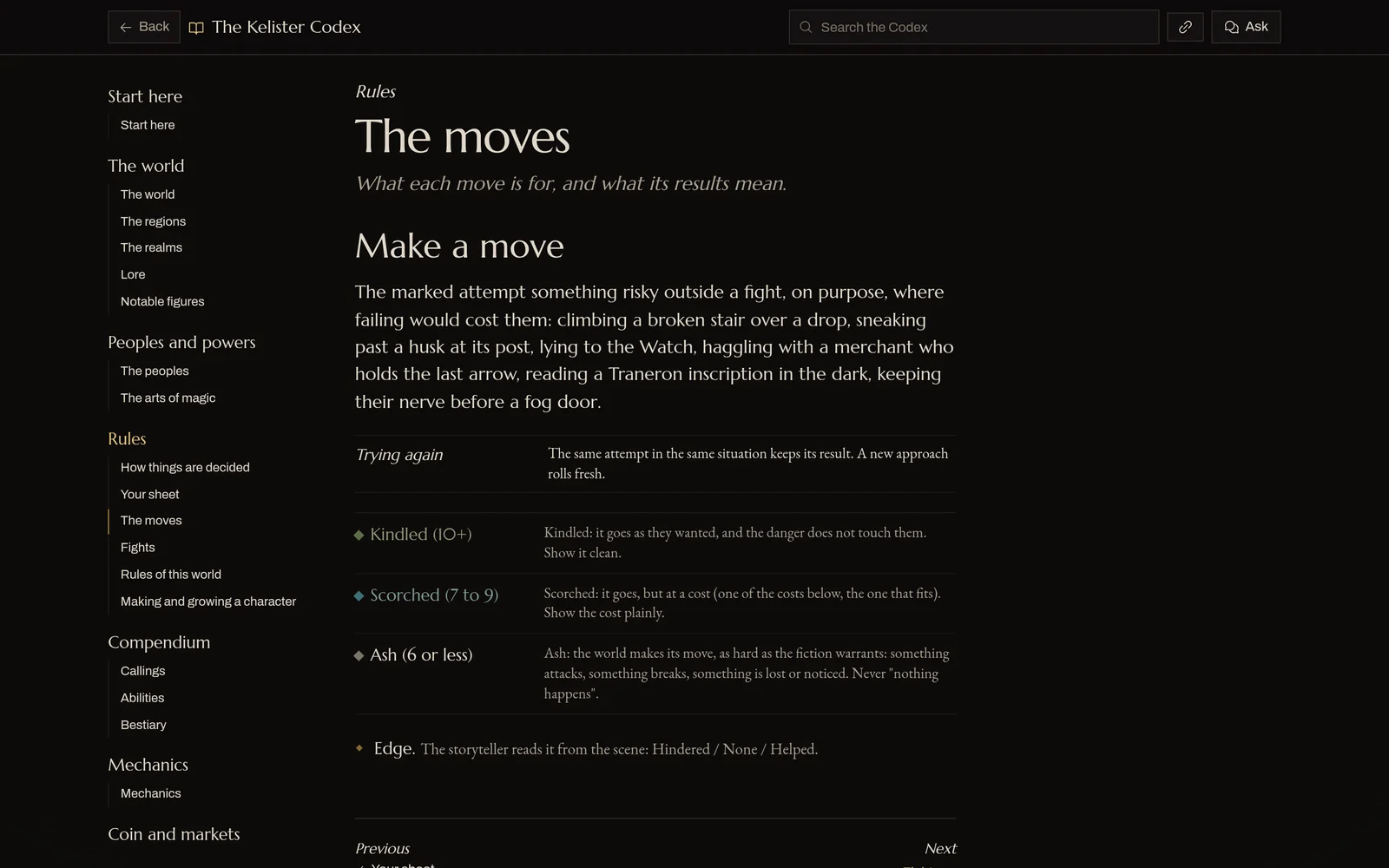
Names link to their own pages wherever they come up. Hover one to see what it is, or follow it. One search box covers the whole book. If you're signed in with a character, what's yours is marked: your people, your class, your abilities.
The world's pictures
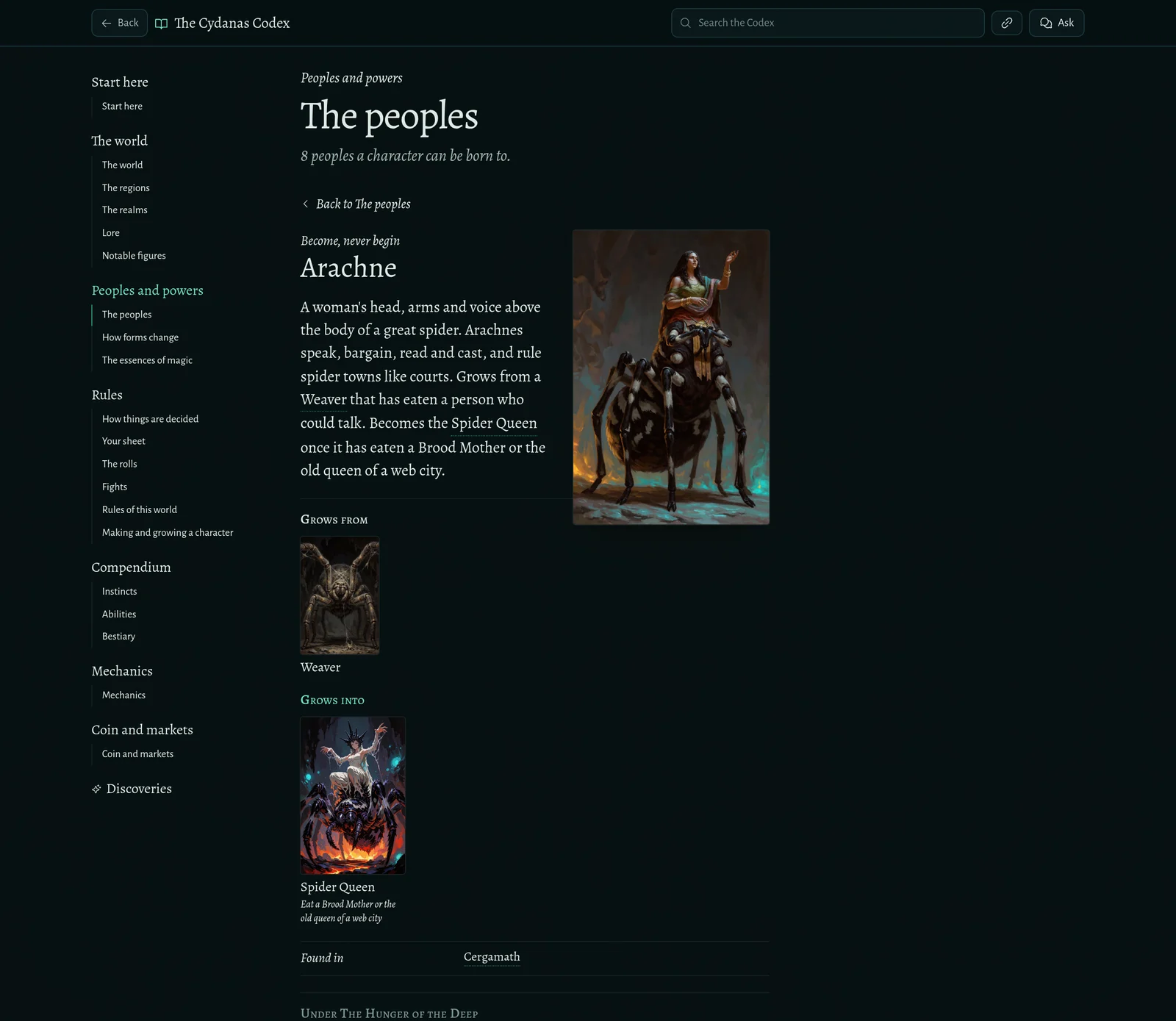
Where a world has art, the Codex uses it. Peoples and schools of magic open as a wall of their paintings, and each one's page has its picture beside the words.
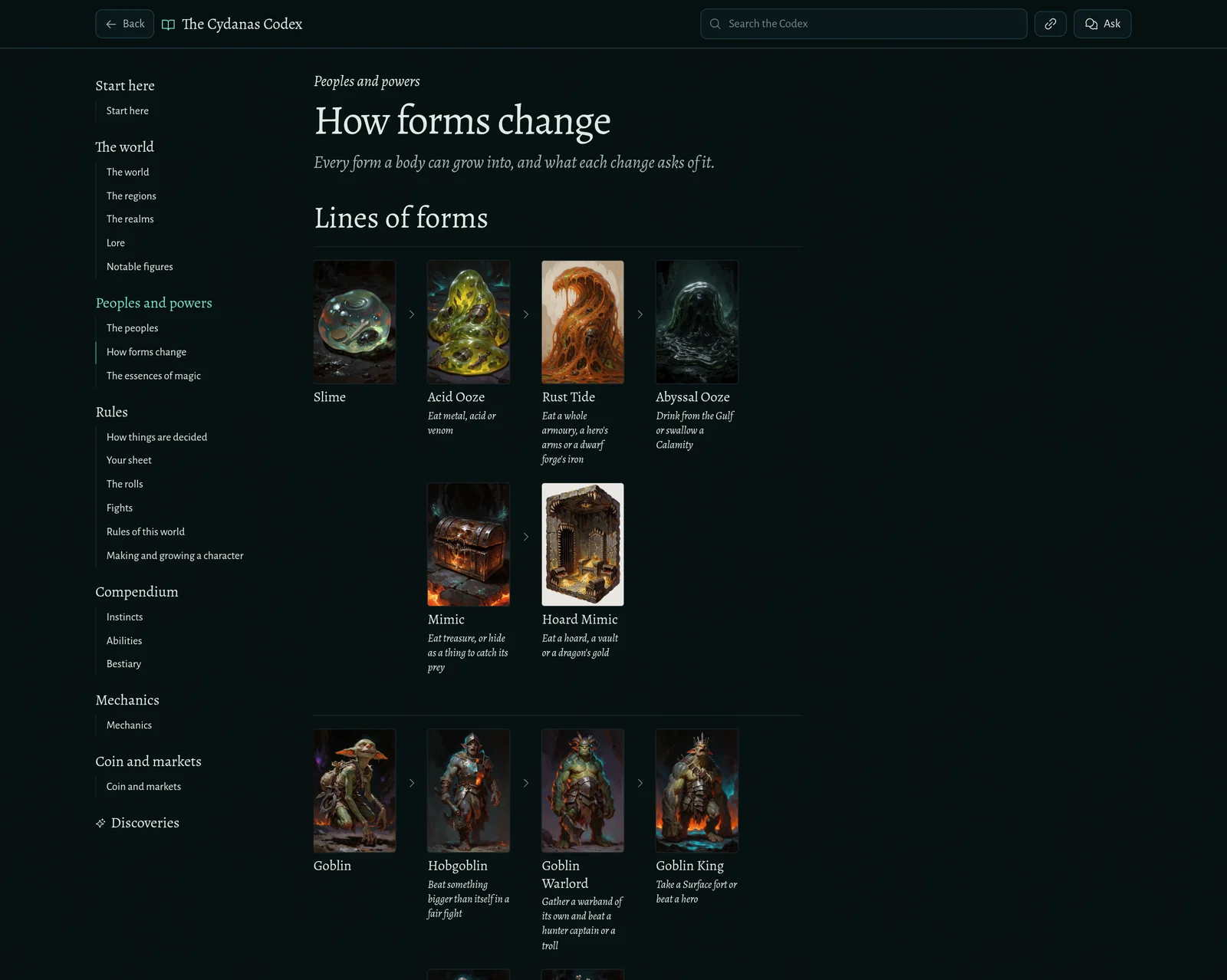
In Cydanas, where you play a monster that changes as it grows, every form shows what it grows from and what it can become, with what each change asks of it. How forms change lays every line out from the first form to the last.
Ask the Codex
Press Ask and put a question to the world's Game Master: "What happens if I die here?", "Which callings can heal?", "Is necromancy against the law in this town?" It looks the answer up in the Codex and links the pages it used. It only reads; it can't change your character or the story. For that, use Table talk in your story window. Asking is free.
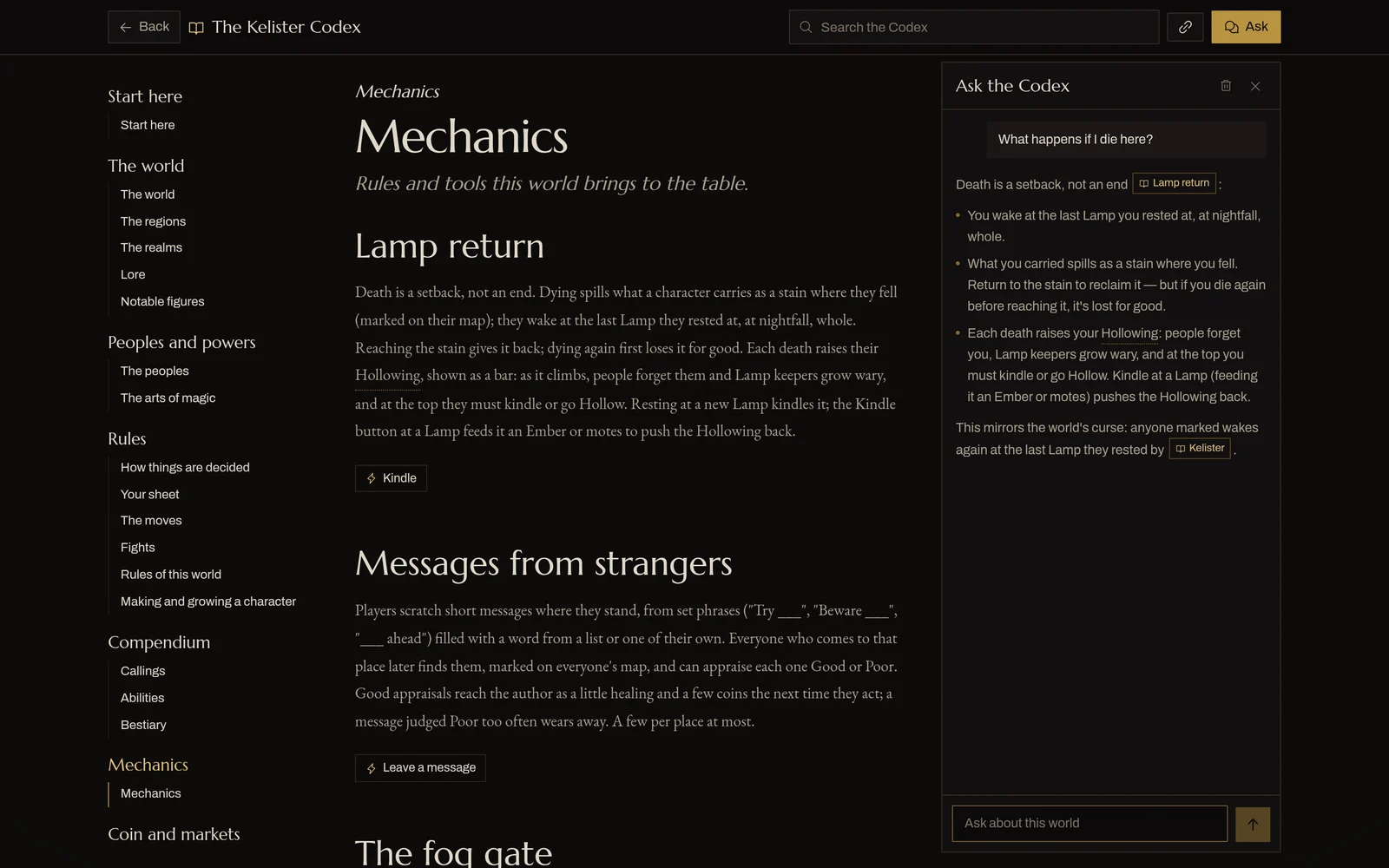
Beside the story
While you play, the Codex opens beside the story instead of taking you away from it:
- On a roll, How rolls work opens that roll's own page.
- An ability on your sheet links to its page.
- A school of magic in your panel links to its page.
Back takes you to the page you came from: open Arachne, follow one of its abilities, and Back brings you to Arachne again. A list keeps the filters you set while you read an entry.
A link for every page
Every page of every world's Codex has its own address, like /w/cydanas/codex/people-arachne. Copy it from the link button at the top, or the one beside an entry's name, and it opens the same page for whoever you send it to.
No spoilers
Notable figures and creatures appear in your Codex once your character has met them. Until then, the Codex says how many you haven't met, never who. Secrets and the builder's notes to the storyteller are never in it.
In your language
The Codex reads in the world's language. In a language edition, its pages are translated the first time they're read after a change. For a minute or two, a few lines may still be in English.
For builders
There's a new Codex tab in the Studio:
- A welcome. A few lines in your own words at the top of the book.
- Spoilers. Show figures and creatures once they're met, or everyone from the start. In Cast, mark someone whose name travels as Known to everyone.
- Thin spots. It lists what reads as a blank page, like a class with no description or a school with no ladder, and links to where to fill it.
- Preview. The book as players read it.
Hob can set the welcome and the spoiler switch for you. You never edit the Codex itself: it's written from what you build.
If a page in your world's Codex says something wrong, tell us in Discord. A link to the page helps.