Building a world
Calendars and dates
Your world's months, festivals by region and dated history; live dates at private tables, and waiting until a day.
What a calendar does
A world can keep a calendar: its own months, weekdays and seasons, its moons, a way of counting years, the festivals and holy days its people keep, and the dates of its history.
A world without one counts days, as it always has: Day 1, Day 2, and the time of day. Nothing about play changes until a world has a calendar.
Every date is worked out from the character's day count. The storyteller never does calendar sums: it is told the date, and a wait is counted for it. Engine
Where dates run
Live dates run at private tables. A private table is one group playing together, so everyone there can share a date. In the shared world each character keeps their own day count, and two players meeting in a room can be a hundred days apart, so a date there would contradict itself. In the shared world the calendar is lore: the codex has a chapter on it and Ask knows it.
- A table keeps the world's calendar from the start, opening on the date the builder chose.
- The host can set today's date ("today is 14 Harvest, 1042") or count days instead, and back again without losing the table's date, from Character › Party.
- A friend who joins later arrives on the table's date, not its first day. Engine

Making a calendar
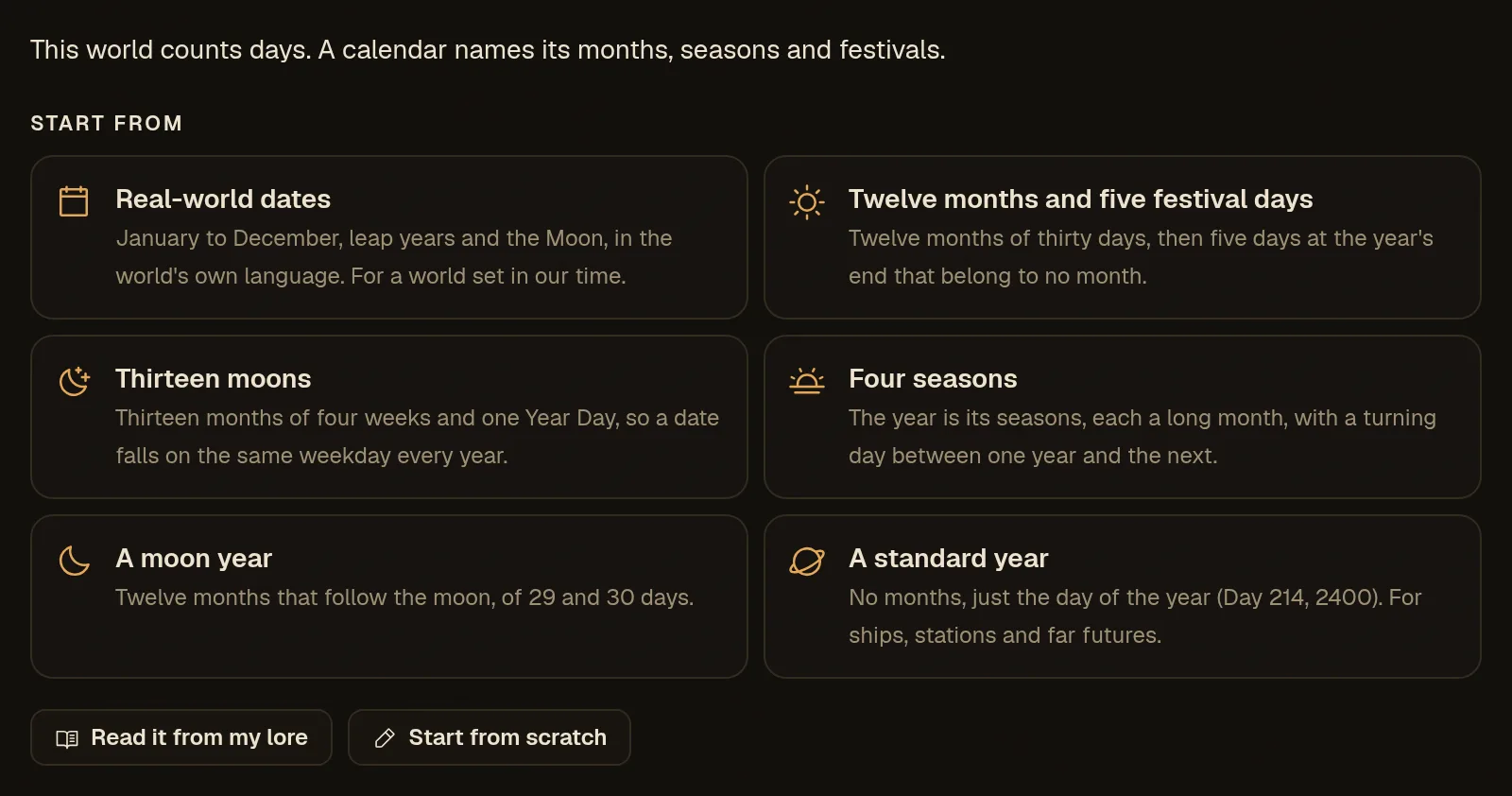
Open the Calendar tab in the Studio. Start from a preset, read it from your lore, or start from scratch, then change anything. Each control is also described in the Studio, tab by tab.
| Preset | The year | Good for |
|---|---|---|
| Real-world dates | January to December, leap years, the real weekdays and the Moon, named in the world's own language | Present-day worlds |
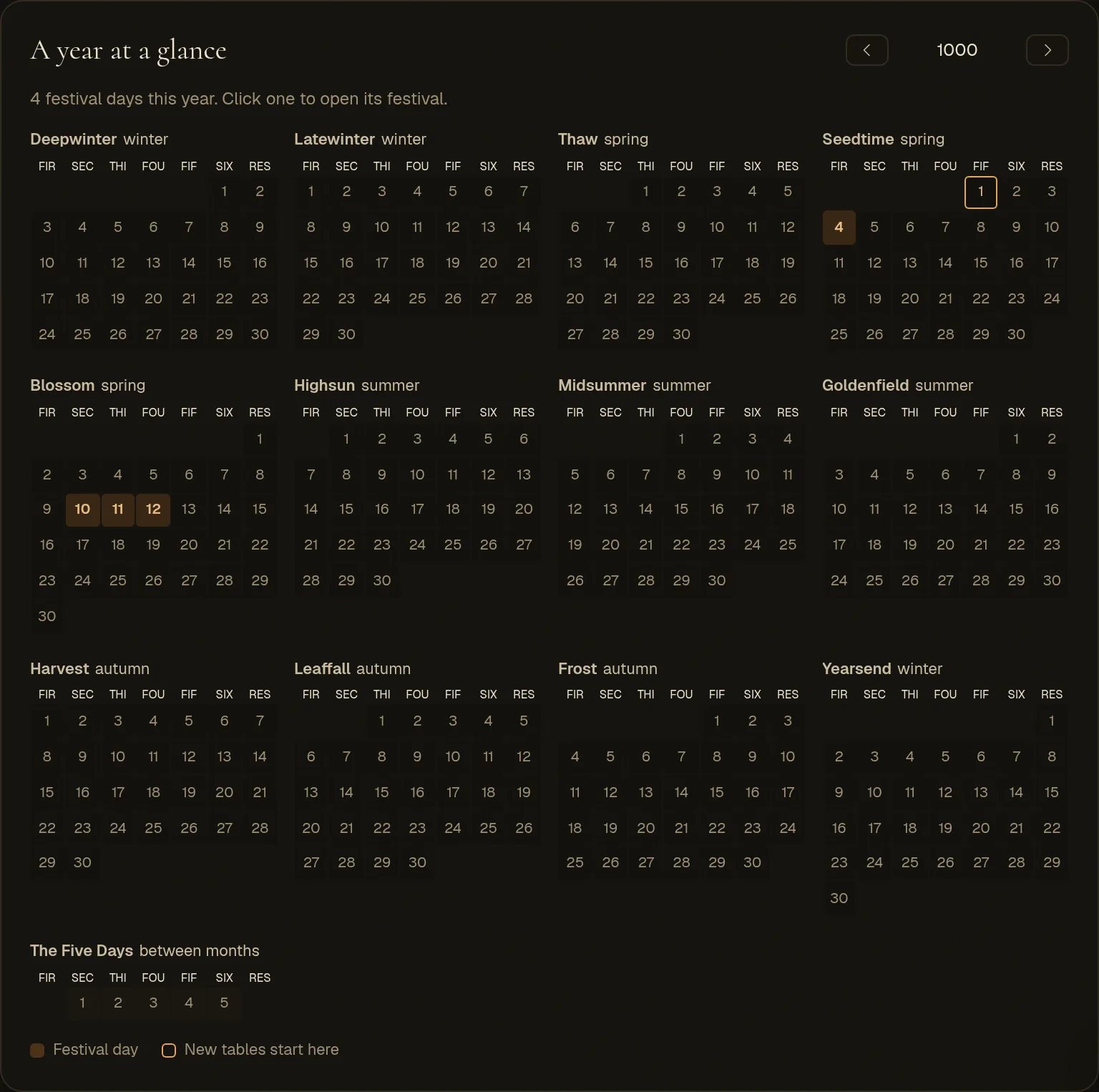
| Twelve months and five festival days | Twelve months of thirty days, then five days at the year's end that belong to no month | Fantasy |
| Thirteen moons | Thirteen months of four weeks and one Year Day, so a date falls on the same weekday every year | Folk and fantasy worlds |
| Four seasons | Four long months, one for each season, and a turning day between years | Simple worlds |
| A moon year | Twelve months of 29 and 30 days that follow the moon | Peoples who count by the moon |
| A standard year | No months, just the day of the year: Day 214, 2400 | Ships, stations and far futures |
Read it from my lore. Your world book is read for month names, weekdays, an era, festivals and dated history, and a calendar is drafted from what it says. Nothing is invented: if your lore names no months, you are told what it does say instead.
Start from scratch. One month of thirty days, to build up from.
With Hob
Your own Claude Code or Codex can do the same through the builder tools: Claude Code and Codex.
Months, weeks and years
- Months
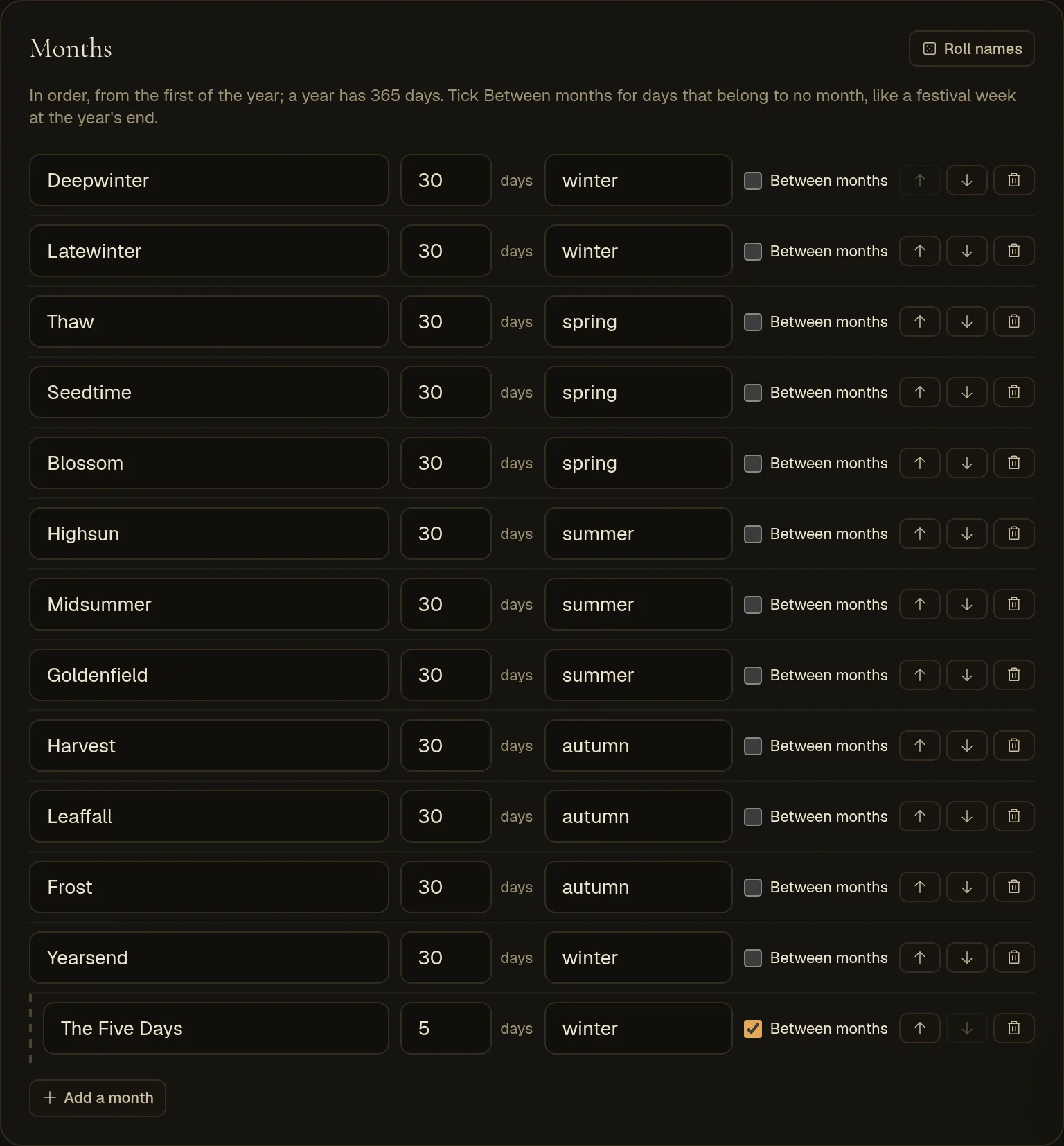
- In order from the first of the year, any number of days each. A season word on each month says what time of year it is ("winter", "the rains"). Between months marks days that belong to no month, like a festival week at the year's end.
- Weekdays
- Optional, and a week can have any number of days. With none, dates are written without a weekday.
- The era
- How years are counted ("the Long Peace"), what is written after a year (1042 AR), and what is written for years before year 1 (300 BE).
- Leap day
- One more day in a month every few years. Real-world dates use the real rule: every 4 years, but not every 100, except every 400. A rule of your own nests the same way.
- Moons
- Each moon's cycle in days. Its phase on any day is worked out from that.
- New tables start on
- The date a new private table opens on.
Festivals and holy days
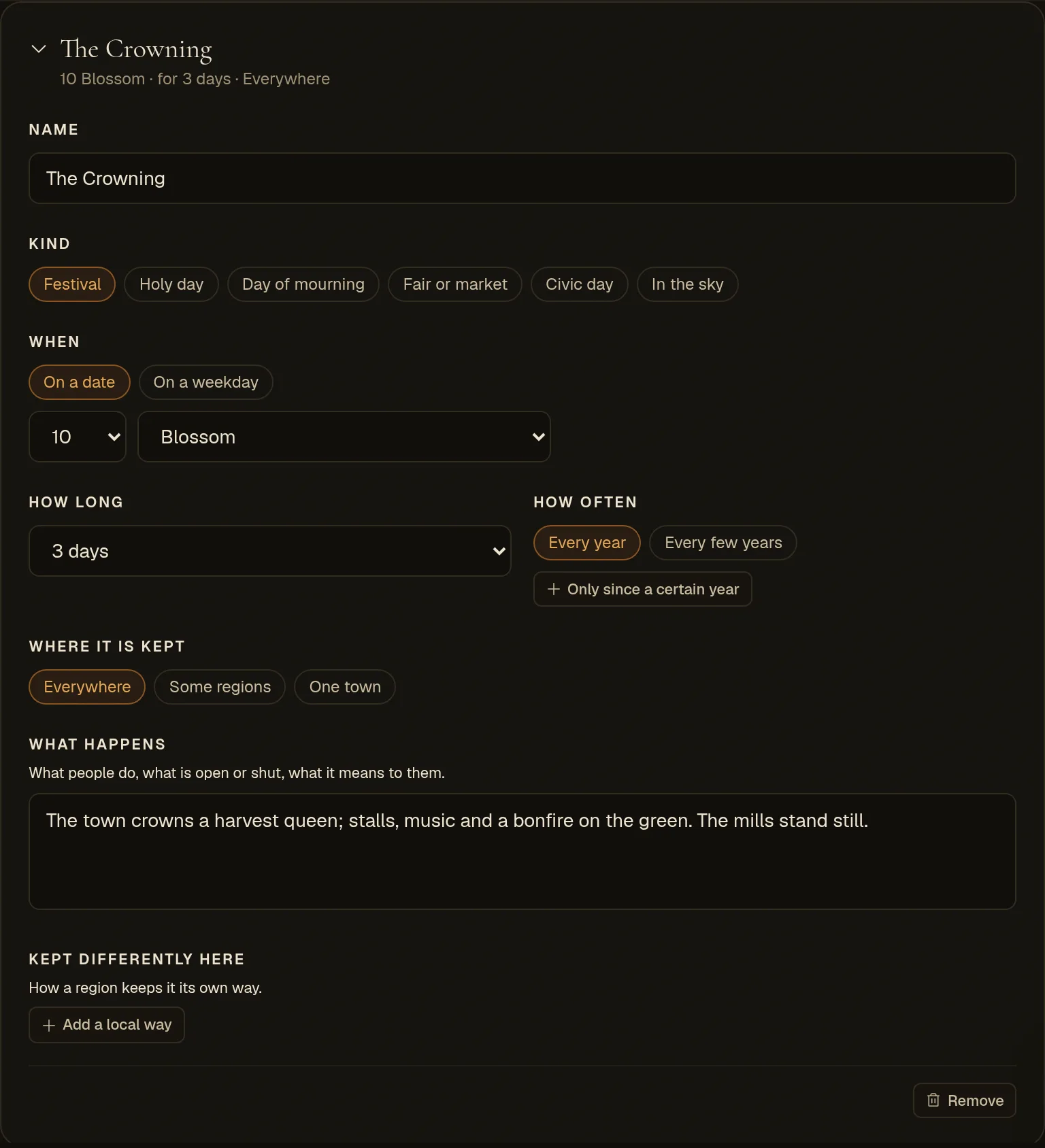
Each festival has a name, a kind (a festival, holy day, day of mourning, fair or market, civic day, or something in the sky) and:
- When
- A day of a month (10 Blossom), or a weekday of it (the first Firstday of Seedtime, the last Restday of Frost).
- How long
- One day or several. A festival that runs past the year's end carries on into the new year.
- How often
- Every year, every few years counted from the first year it was held (a comet every seven years from 1001), or every year only since a certain year.
- Where it is kept
- Everywhere, in chosen regions or realms, or in one town. The storyteller hears of a festival only where the player is.
- What happens
- What people do, what is open or shut, what it means to them. This is what the storyteller plays.
- Kept differently here
- A region's own way of keeping it: "In the Saltmarsh they burn a straw king on the dunes."
Dated history
Dated entries of the past: a year, and a month and day if you like ("312: the Sundering"). They go into the codex's chapter on the calendar, and Ask and the world review read them.
At a table, the storyteller is told when today is an anniversary: "On this day, 300 years ago, the Sundering." Engine
In play
At a table that keeps the calendar, the storyteller is told on every turn: Engine
- today's date, weekday and season, and each moon's phase;
- the festivals kept where the player stands today, which of their days it is, and how this region keeps them;
- the festivals coming here within the week;
- any anniversary in the world's dated history.
It names a date, month, season or year only from those lines, counts any other date from today, and never invents a festival the calendar doesn't have. The rest of the year never reaches it, so a calendar adds only a few lines to a turn. Storyteller
Dates show wherever the day count did: the time cards between scenes, the room's header and ledger, the character sheet, the travel bar on the map, and the Story So Far chapters. Hover the date for the season and today's festivals.
Waiting for a day
Say what you are waiting for, in your own words:
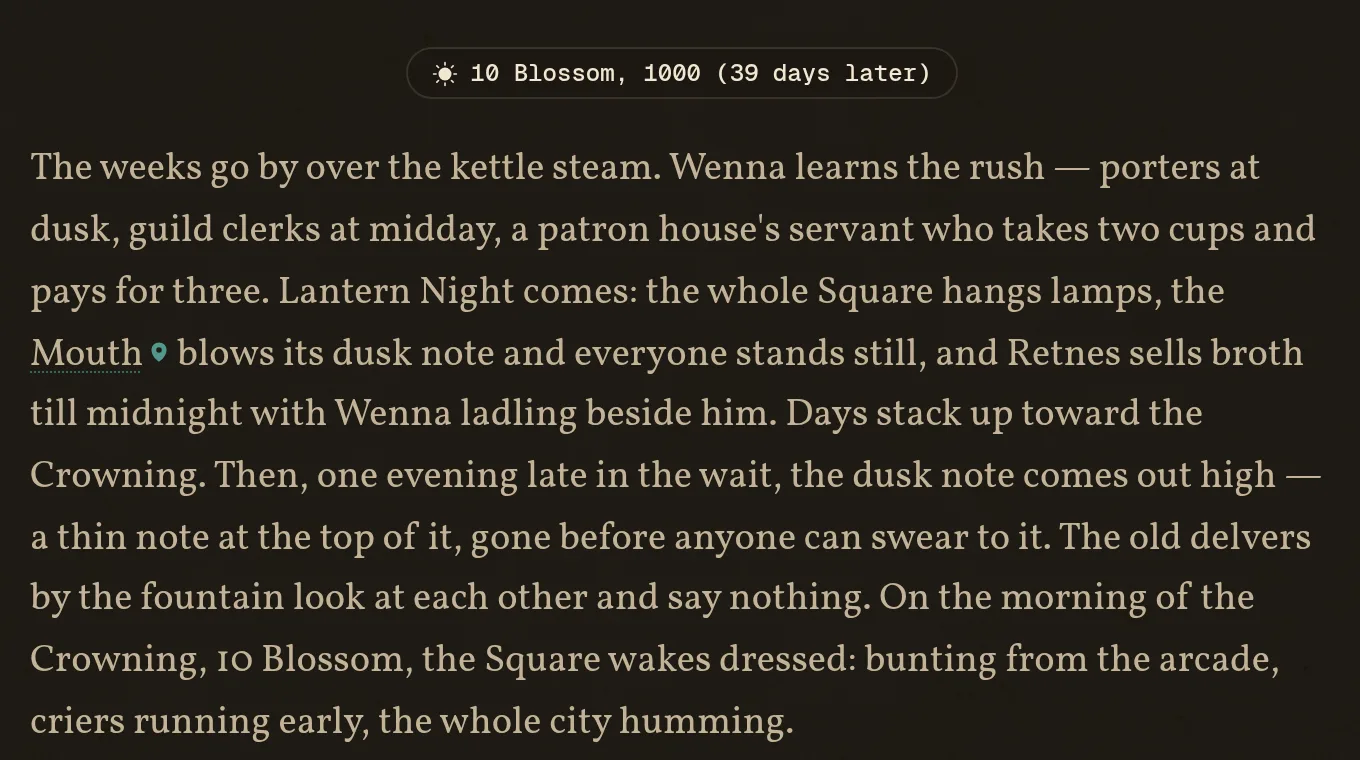
- I take a room and wait until the Crowning.
- We winter here until spring.
- I lie low until the next full moon.
- Wake me on Restday.
- I wait until the 3rd of Frost.
The day is matched against the calendar (the festivals kept where you are, its months, seasons, moon phases, weekdays and dates) and the days are counted. The storyteller tells the wait in a few lines, and the clock moves to the morning of that day. Waiting for a festival already under way ends at once. Engine
- A wait goes at most a year.
- Nothing is earned while you wait: no pay, training or standing. The world goes on as it would.
- Waiting a number of hours or days ("I wait three days") is an ordinary wait, as in any world.
- Undo puts the clock back, as long as nothing has moved it since (a journey after the turn stays charged).
- Party members who are with you keep in step with you: travelling together.
Languages, editions and files
A language edition can rename the months, weekdays, moons and festivals, and translates what happens at each festival and the world's history. Days, dates and where festivals are kept come from the source world. Dates are written the way each language writes them.
A world file carries the calendar as its own section, so you can bring one world's calendar into another: Importing and exporting.
For plugins
wt.clock.now()also returns date at a table that keeps the calendar: the year, month, day, weekday, season and the festivals under way.wt.clock.advance({ years })counts a year as the calendar's own year.festivalis an event that fires for each festival the clock passes into the first day of.
See the plugin API · plugin events.