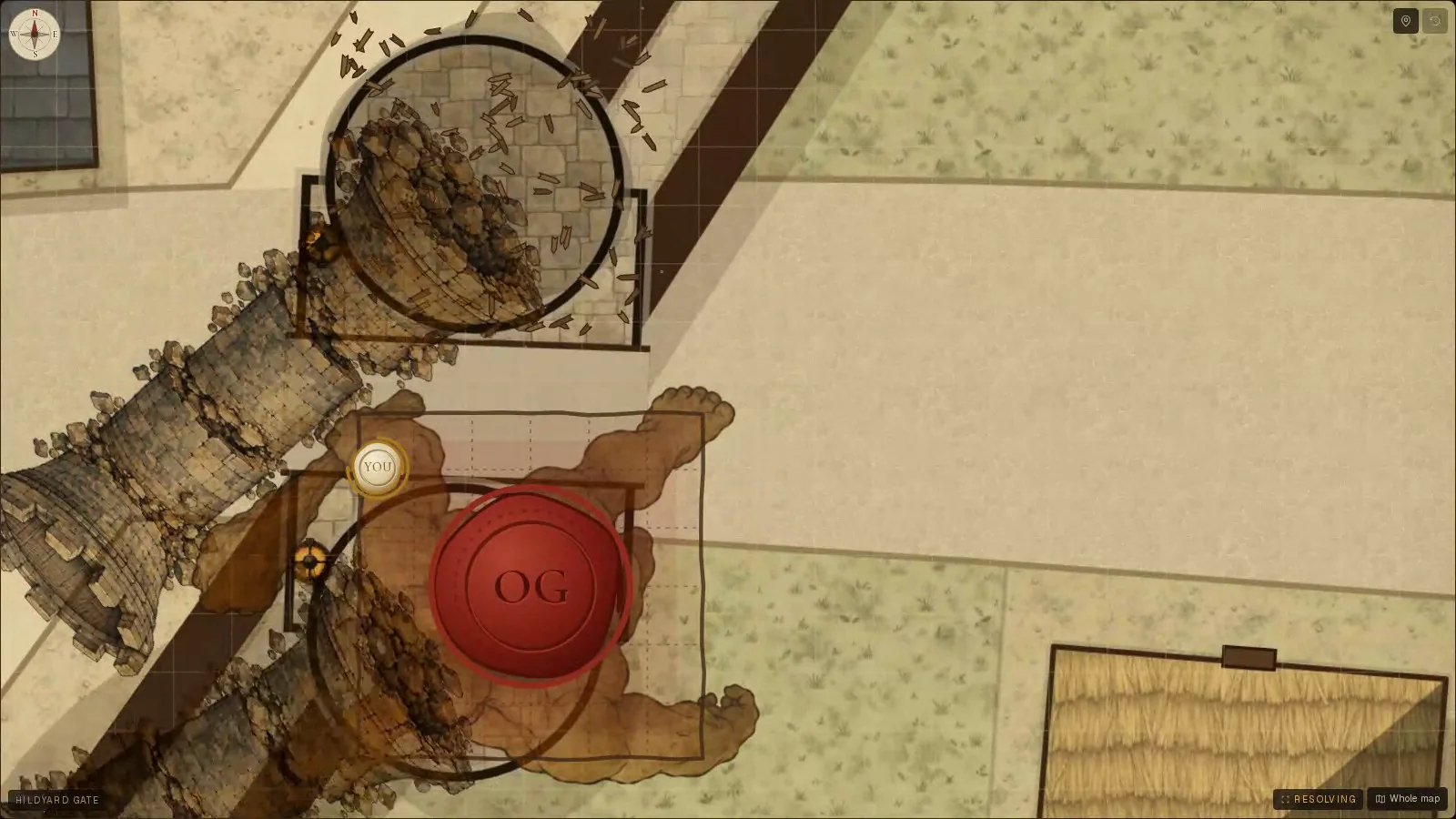
Fights as big as the monsters in them
Big things are big, hordes fight as one, and a fight in town breaks the town.
A dragon used to stand on one square of the battle map, the same as you. Twenty goblins were twenty separate fighters, and a fight in the middle of a town was played on some other square while the town itself never noticed.
Now big things are big, a horde fights as a horde, and a fight in town is fought in that town's own streets. What it breaks stays broken.
Big things take up room
Everyone in a fight has a size, from small up to titanic. A horse or an ogre fills 2×2 squares, a giant 3×3, an elder dragon 4×4 and a titan 6×6. The bigger something is, the further it moves and reaches, and the further it can throw you. You can't shove anything two sizes bigger than you. You fight a dragon's flank, its foreleg or its tail, not "the square next to the dragon".
A creature's size comes from its world first. Builders set it in the Studio, on a creature in the bestiary or on a people, in words: about the size of a horse, a house, a mountain. Anything without a size is judged once from what it is, and the answer is kept, so the same dragon is the same size next time.
The map grows with the fight, up to 44 by 30 squares. When titans fight each other, the squares grow too, to 15 feet each. People are small among them: several can share a square, and a titan's blow can't single one out, only its sweeps and blasts catch them.
Hordes
Twenty goblins are one foe with twenty bodies. A fireball burns every body it lands on, a goblin thrown into the pack bowls over the ones behind it, and the rest close in around you. When half are down, or their leader falls, the others break and run for the edges. The dead stay where they fell. Up to 40 bodies are on the map at once, and the rest wait at the edges and come in as others fall.
Ground made for giants
Big fights get big ground: a caldera, a cliff band you can climb, a chasm with its bridges, a fallen colossus. A pillar can be brought down on a giant, the ground can crack open under one, and you can climb onto a dragon's back and fight from there.
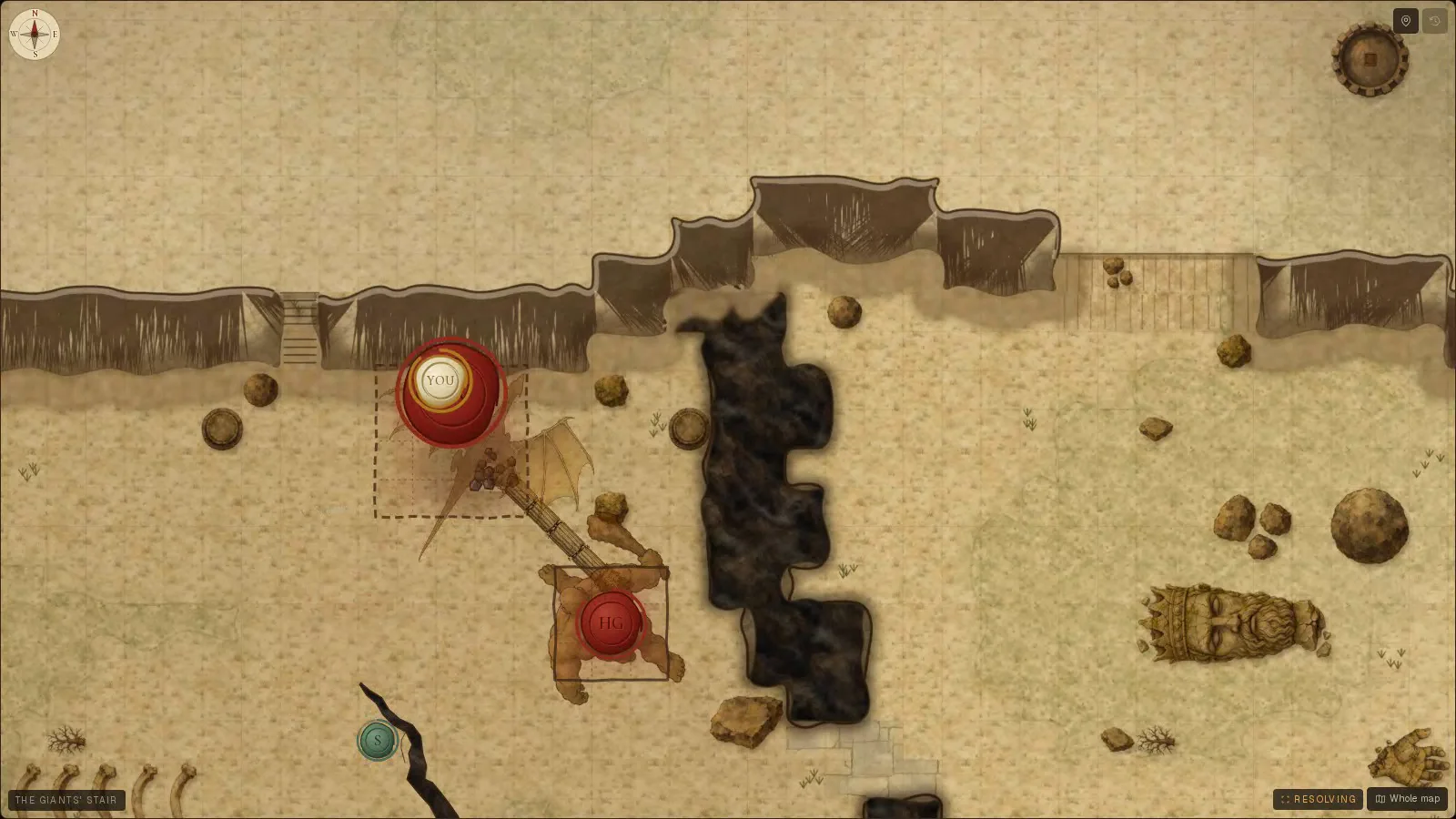
A fight in town is fought on the town
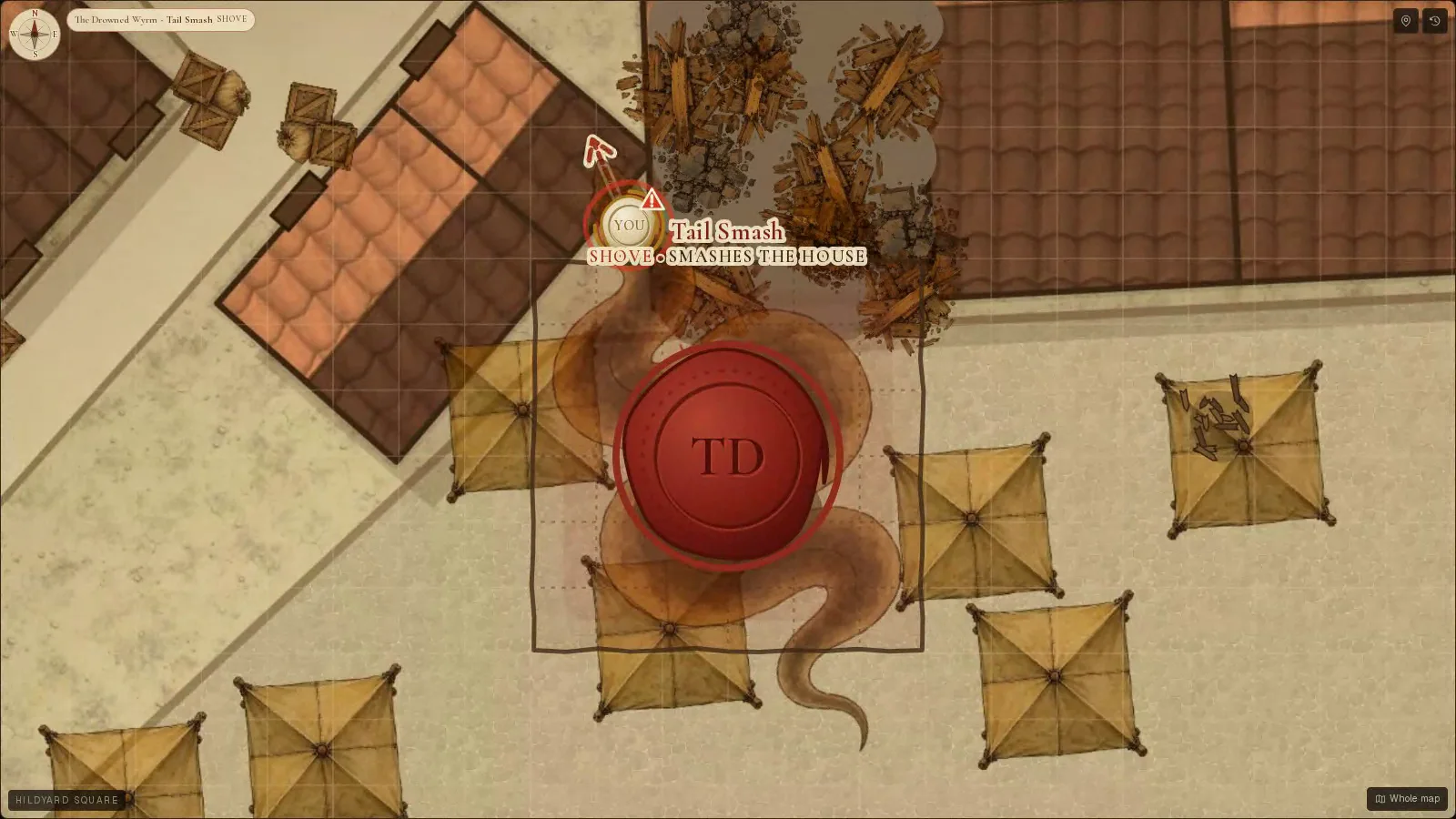
A fight in a town's square, its market, a street, the docks or at the gate is now played on that town's own map. You get the same streets, buildings, wall, river and bridges as on the town page, cut around where you stand. Each building is one thing on the map, and the storyteller calls it what the town does: The Hildyard Tavern, or a house on Potters' Row.
Big things break it. A giant walking through a house smashes it. A tower brought down caves in the roofs it lands on. Fire on a burning square spreads into the houses beside it, and a colossus goes straight through the town wall, gate and all. A person's blow never breaks a building.
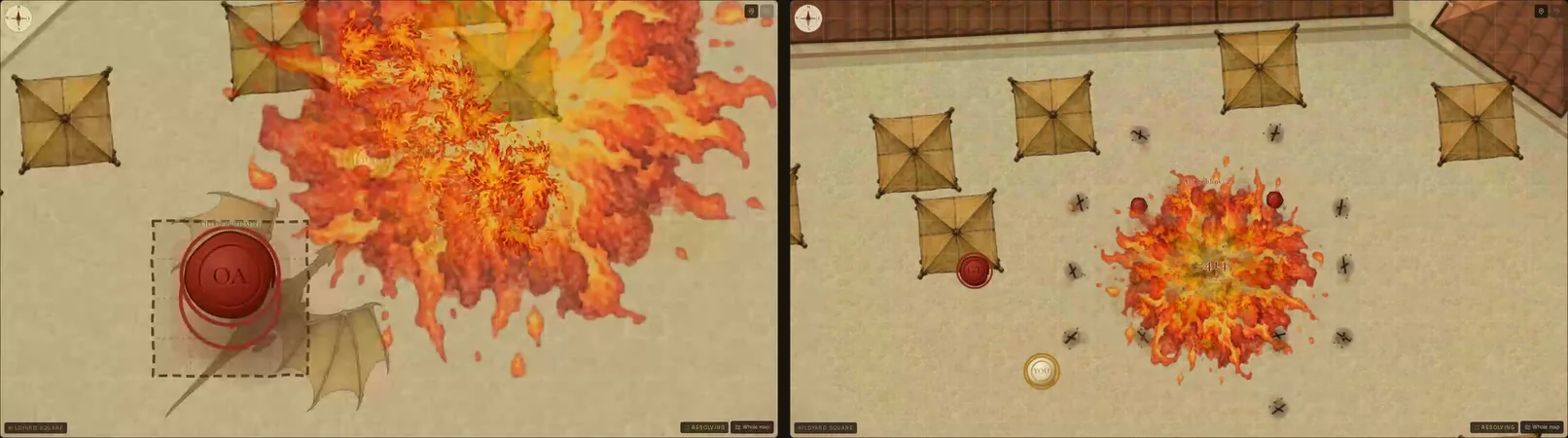
Whatever the fight breaks is written into the town's history, the same history a world's builders add events to. The town page shows the breach and the rubble, and the next fight there is fought in the damaged town.
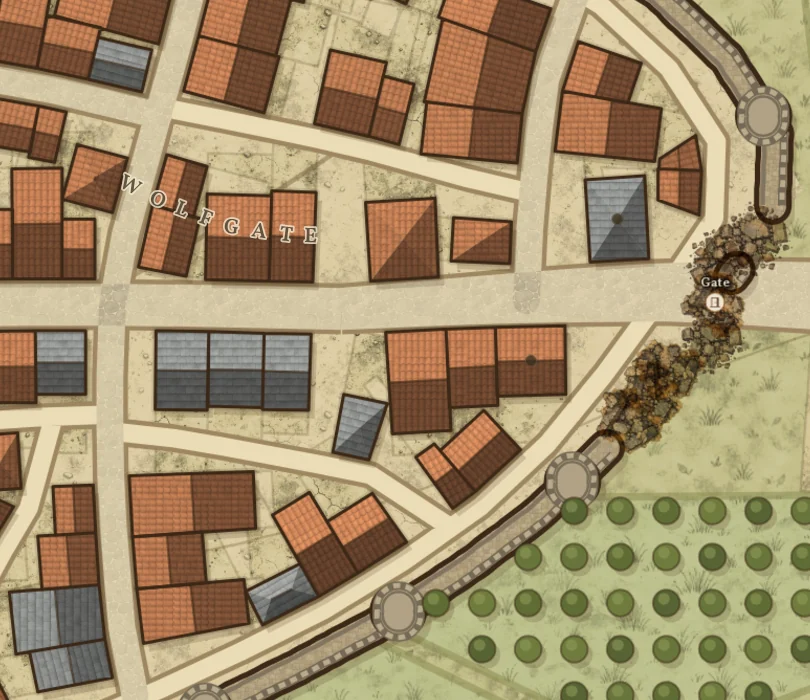
When something titanic joins a fight in town, you see the whole town at once: a village on 15-foot squares, a town on 30-foot ones.
Undo puts it all back
Undoing a turn takes back what it broke. The houses stand again, on the town page and on the fight's map, and everyone is back on the square they stood on. Changes a turn made to the world map itself, like a crater or a burned building, are now taken back by undo too.
What to expect
- Worlds with battle maps only. A world whose rules play without a grid has no battle map, so none of this applies there.
- A town's map takes about a second the first time a fight starts there, and loads at once after that.
- Sizes can be judged wrong. If a creature comes out the wrong size, set it in the Studio and it will be that size from then on.
- Undo is still off in party fights and inside dungeons.
If a town fight breaks something it shouldn't, or a giant fits where it can't, tell us in Discord. A screenshot of the map helps.