Calendars
Worlds can keep their own months, festivals and dated history, with live dates at private tables.
A world can now keep a calendar: its own months, weekdays, seasons and moons, a way of counting years, the festivals its people keep, and dates for its history. At a private table, play runs on real dates.
Making a calendar
Open the new Calendar tab in the Studio.
- Start from a preset: real dates (with leap years, and month names in your world's language), twelve months and five festival days, thirteen moons, four seasons, a moon year, or a sci-fi standard year.
- Or read it from your lore. Read it from my lore looks through your world book for month names, weekdays, an era, festivals and dated history, and drafts a calendar from what it finds. It doesn't invent anything your lore doesn't say.
- Or ask Hob. "Give the world twelve months, and a three-day Crowning festival from the 10th of Blossom." Hob can rename a month later, and its festivals and history move with it.
What a calendar holds
- Months of any length, in order, each with a season word ("winter", "the rains"). Days between months, like a festival week at the year's end, are allowed too.
- Weekdays, an era for counting years, a leap day, and moons with their own cycles.
- A start date: the day a new private table opens on.
- A year view: every month as a grid of days, with festival days filled in and the start date ringed. Click a festival day to open it, and step through the years to see festivals that don't come every year.
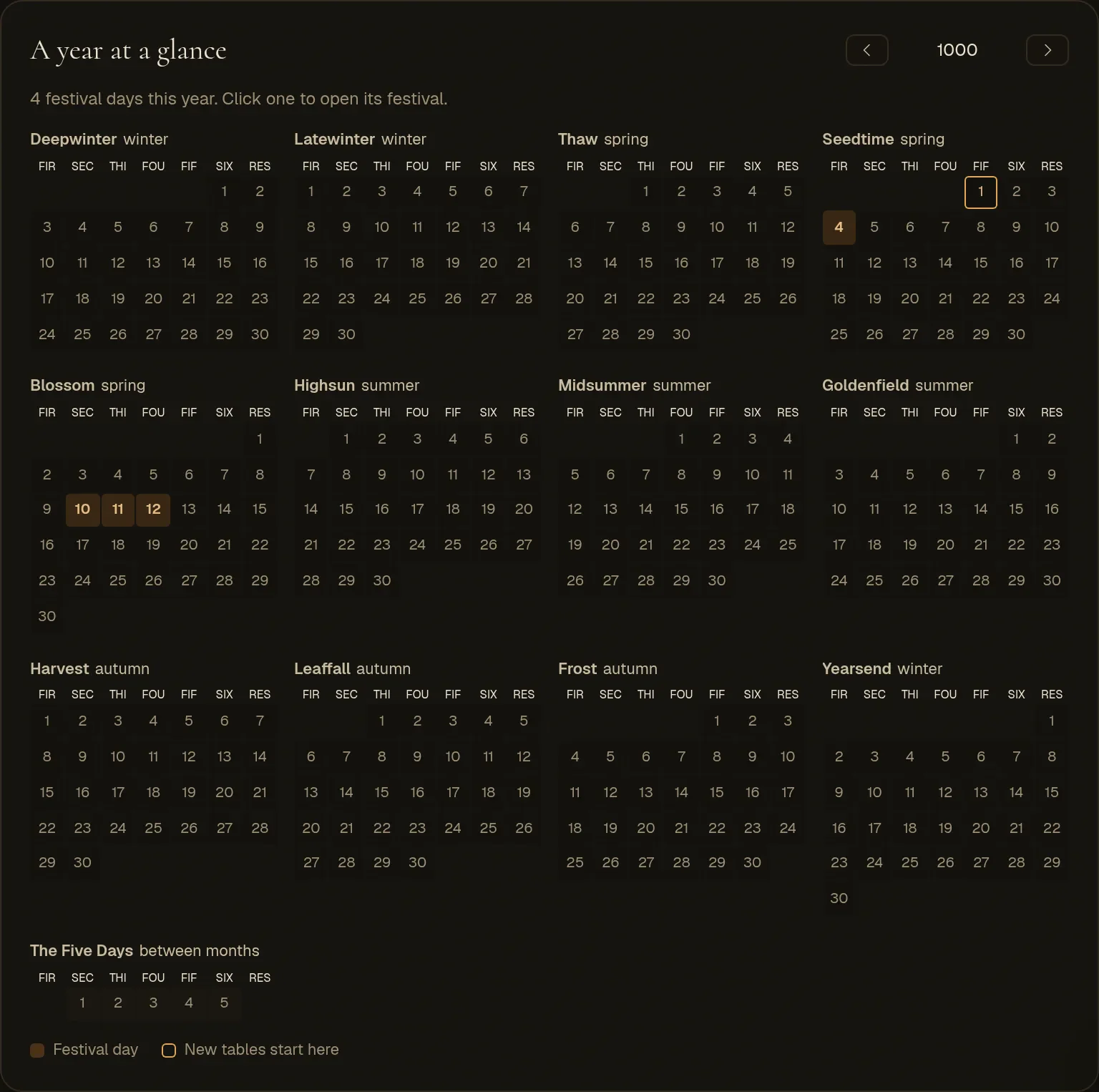
Festivals and holy days
- Kinds: a festival, holy day, day of mourning, fair or market, civic day, or something in the sky.
- When and how long: one day or several. One that runs past the year's end carries on into the new year.
- How often: every year, or every few years.
- Where it's kept: everywhere, in chosen regions or realms, or in a single town, with notes on how each place keeps it. Rename a region and its festivals follow it.
Dated history
Put your world's past on the calendar: wars, foundings, a king's death. The storyteller can then tell how long ago something happened, and a day's anniversaries come up in play.
Playing with dates
Live dates run only at private tables. A table is one group playing together, so everyone there can share a date. In the shared world each character keeps their own day count, and two players meeting in a room could be a hundred days apart, so there the calendar is lore the storyteller knows, and the days are counted as before.
At a table that keeps the calendar:
- The storyteller knows today's date, which festivals are under way where you're standing, the ones coming up within the week, and anything that happened on this day in history. It names dates only from what the calendar says, and never makes up a festival.
- Festivals are local. A festival kept in one region isn't mentioned in another.
- Dates show everywhere the day count did: the time cards between scenes, the room's header and ledger, your character sheet, the travel bar on the map, and the Story So Far chapters.
- Wait for a day. Say "I wait until the Crowning", or the new moon, or the first of next month. The day is found on the calendar, the days are counted, and the storyteller plays out the wait, up to a year.
- Undo puts the clock back when the turn you undo moved it.
- Newcomers start on the table's date, the furthest day anyone at the table has reached.
- The host decides. In the Party tab, the host can set today's date, or switch dates off and go back to counting days. Switching back on keeps the date.
Everything else
- Editions translate the month, weekday, moon and festival names, and what happens at each festival.
- World files carry the calendar, and the Codex has a chapter on it.
- Plugins get the date on the clock, can advance by years, and get a festival event when one begins.
- The docs have a full page: Calendars and dates.