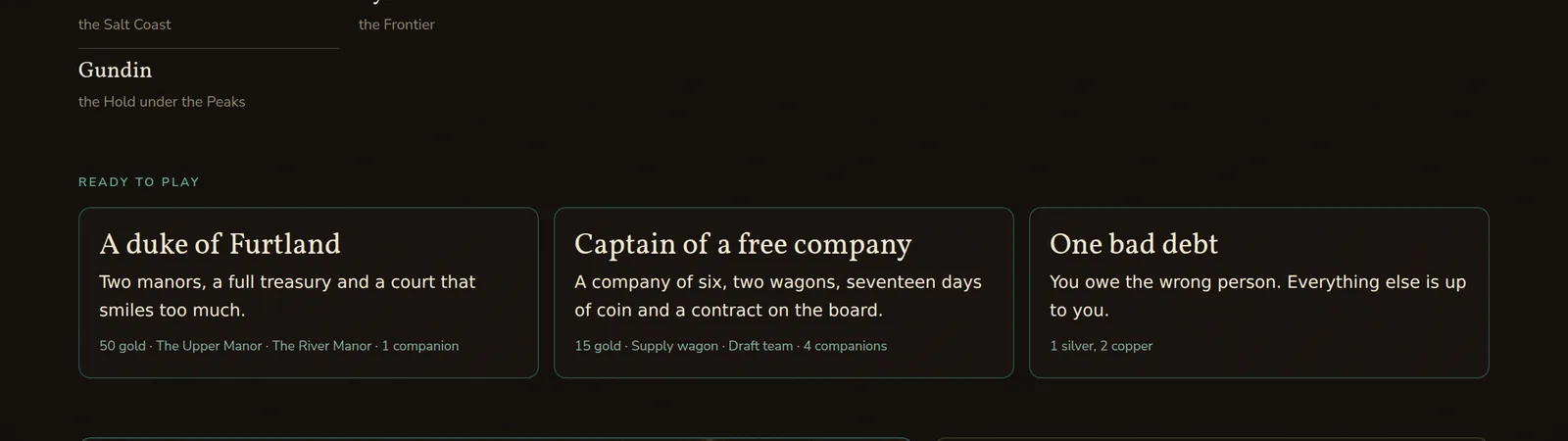
Ready-made ways to begin
Builders can write ready-made ways to begin, from a whole person with a company to a bare position. Plus daily costs that get charged and relationships that follow the numbers.
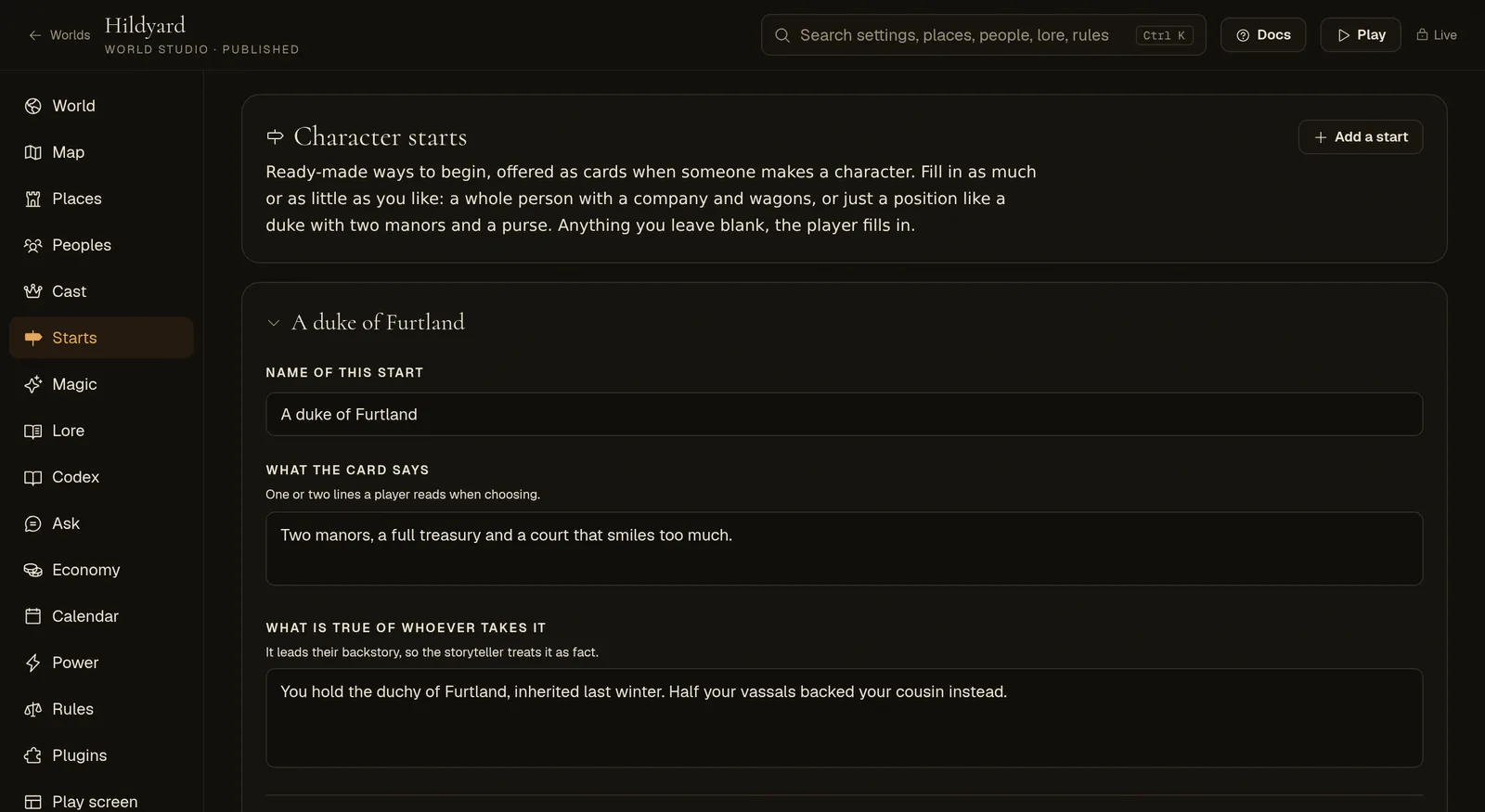
Builders can now write character starts: ready-made ways into a world, offered as cards when someone makes a character. A start can be a whole person with a company and wagons, or only a position, like "a duke, with two manors and a full treasury". Whatever the builder fills in is fixed. Whatever they leave blank is the player's to choose.
For players
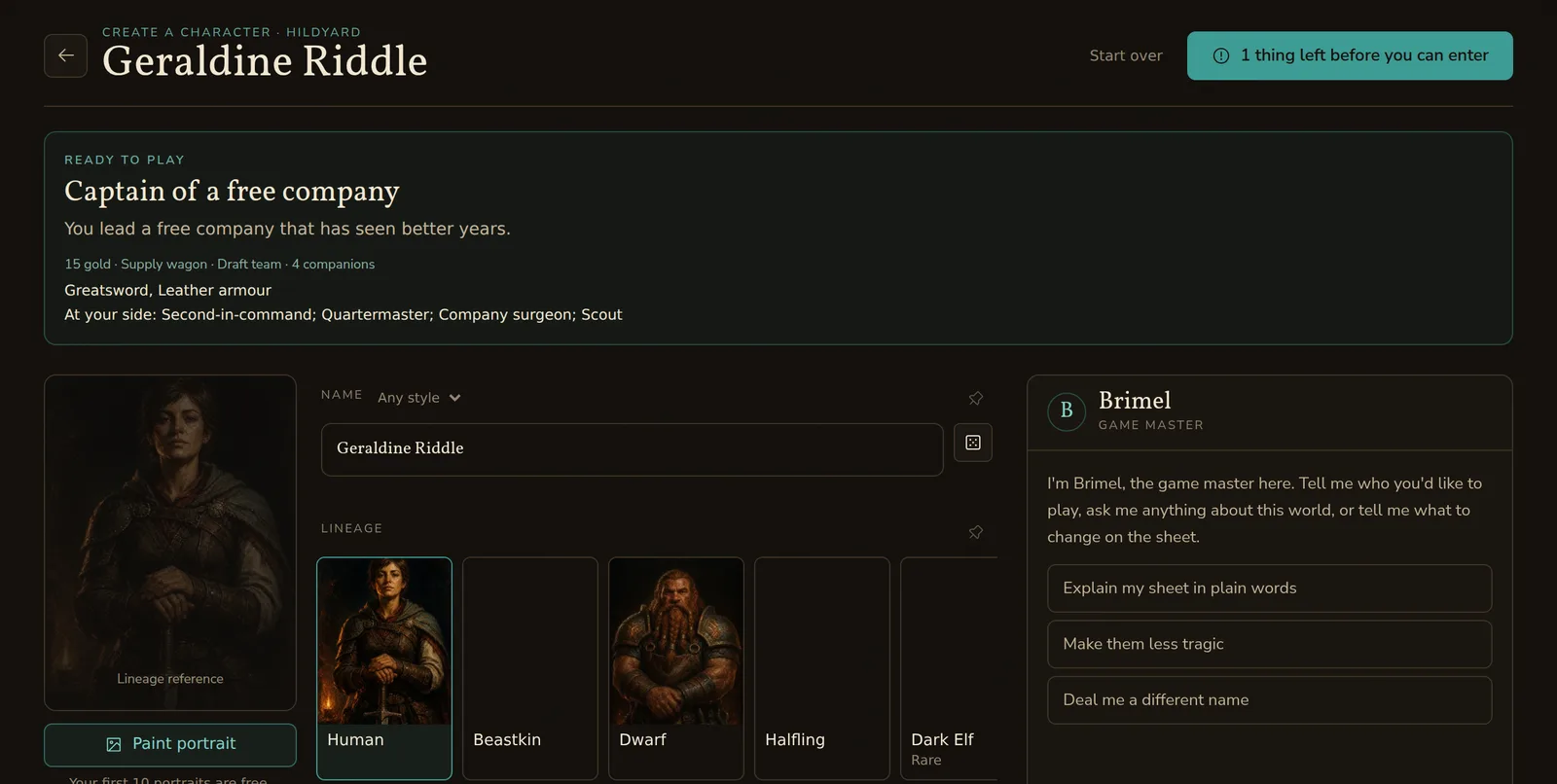
- Pick a card, or don't. Worlds with starts show them under Ready to play on the character screen. Making your own character works exactly as before.
- You can see what you're getting. A banner on your sheet shows the start's purse, holdings, gear and who will be at your side. Parts the start sets are locked, and everything else stays open, including your name if the builder left it blank.
- Choose how it opens. A start can offer a few first scenes to pick from, like an escort job or an old debt come due.
- You don't arrive alone. Your companions stand beside you from the first line. The opening scene is written with them in it, and they know you as the start says: a sworn second trusts you from day one, and a new hire is still making up their mind. Once you're playing, they're in your Party tab.
For builders
Open Studio, then Starts, and press Add a start. Every part is optional except its name.
- What the card says, and what is true of whoever takes it. That second line leads the character's backstory, so the storyteller treats it as fact.
- The person: name, people, occupation, where they begin, backstory and appearance.
- What they own: a purse, gear they're already wearing, and anything your rules count, like holdings, retainers or units, with their own income and upkeep.
- Who's with them: pick someone from your cast, or describe someone new and they're made when the character is.
- Ways it can open: a line each, shown to the player as cards.
Hob can write starts too, and it's the way to set two things the page doesn't have yet: exact stats, and how close each companion is to the character. Exact stats can go past the usual point budget, but each stays within its own range. Start text is translated with the rest of your world's editions.
A cast member is still one person in your world. If a start brings someone who's already following another player, that person stays where they are, and the new player is told who's away.
Players can't change what a start sets. The server reads it from your world, not from what their browser sends.
Daily costs get charged
In worlds with holdings or wages, a day that cost more than it earned used to charge nothing. It now comes out of your purse. If you've got upkeep that outruns your income, you'll start to see that money go. Builders may want to check their numbers are per day and in the coin they meant.
Relationships follow the numbers
What someone is to you (friend, ally, rival, lover, enemy) is no longer something the storyteller picks. It's worked out from trust, respect, attraction and hostility, every time they change, using the same scale scenes already read. Spouse, mentor and student stay as they are, since no number can say those.
Powerful people take more trust to win over, so someone formidable may read lower than you expect the next time your standing with them changes. That's the scale they've always been judged on in play, and now the label agrees with it.
Smaller fixes
- A failed character no longer costs you your current one. Your active character used to be set aside before the new one was saved. Now that only happens once the save works.
- A taken name says so, and offers to replace that character instead of failing with an error.
- Every character could vanish in a world whose rules defined a kind of thing without any tracks. Those kinds are now filled in on load, and the character list is back.